
Explore the Hubble Space Telescope’s journey: from stunning cosmic images to groundbreaking discoveries, and its lasting impact on astronomy and beyond.
Hubble Space Telescope: A Window to the Cosmos
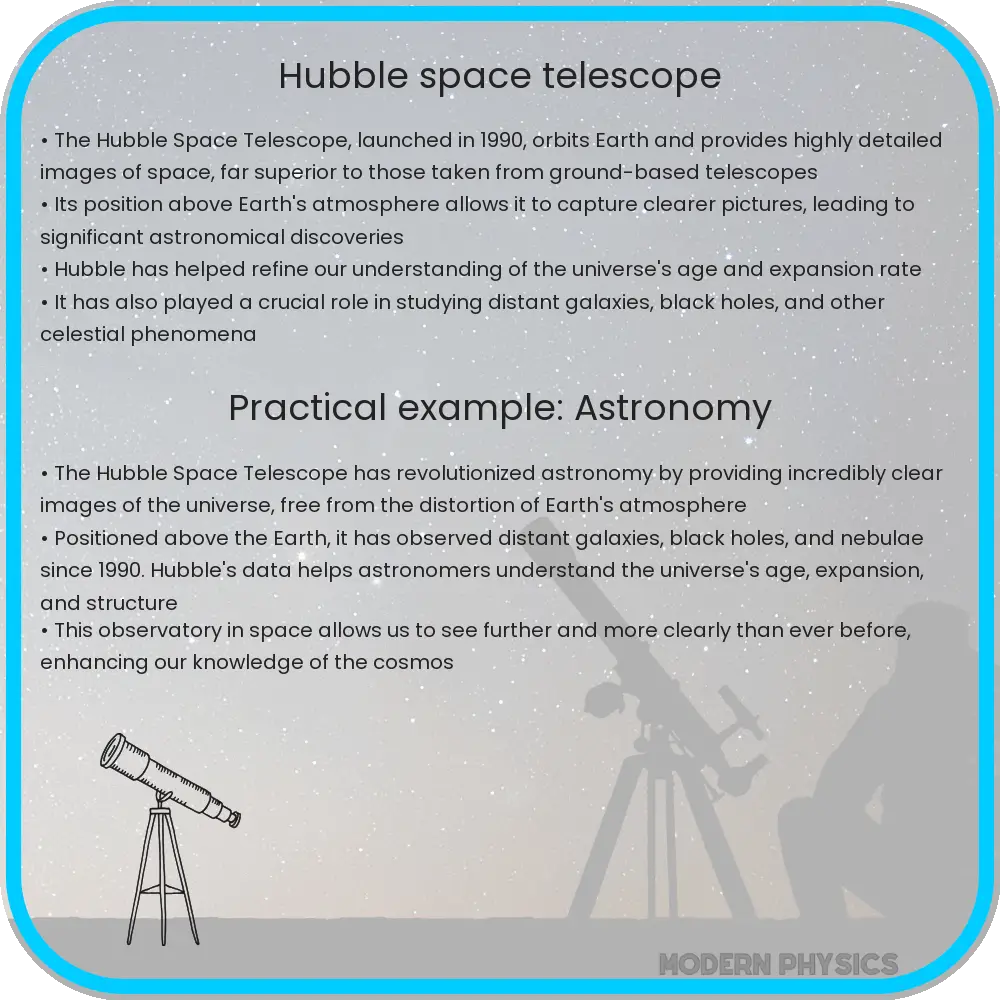
Since its launch in 1990, the Hubble Space Telescope (HST) has revolutionized our understanding of the universe. Positioned outside the distortion of Earth’s atmosphere, Hubble offers an unobstructed view of the cosmos, capturing images of unparalleled clarity and depth. This has not only captivated the imagination of people around the world but also provided scientists with critical data to unlock the mysteries of the universe.
Unveiling the Universe’s Splendor
The Hubble Space Telescope has been instrumental in capturing breathtaking images that span the vastness of the cosmos. From the intricate details of the Crab Nebula to the vibrant bands of Jupiter, Hubble’s observations have provided us with a visual feast of the universe’s diverse phenomena. These images are more than just stunning visuals; they are snapshots of different regions of space at various stages of cosmic evolution, offering clues about the life cycle of stars, the structure of galaxies, and the distribution of matter in the universe.
Pioneering Discoveries
Hubble’s contributions to science are monumental. It played a key role in determining the rate of expansion of the universe, a value known as the Hubble constant. This discovery has implications for understanding the age and size of the universe. Additionally, Hubble has been pivotal in studying the atmospheres of exoplanets, observing distant supernovae, and exploring dark energy and dark matter—components of the universe that remain largely mysterious.
Technological Marvel
The Hubble Space Telescope stands as a testament to human ingenuity. It operates across various wavelengths, from ultraviolet to near-infrared, enabling it to observe phenomena that are invisible to the naked eye. Despite its age, Hubble continues to function due to several servicing missions that have upgraded its instruments and systems. These enhancements have ensured that Hubble remains at the forefront of astronomical research, contributing to our understanding of the cosmos.
Educational and Cultural Impact
The Hubble Space Telescope has transcended its scientific mandate to become a cultural icon. Its images have entered the public consciousness, inspiring a generation of scientists, artists, and ordinary people fascinated by the mysteries of the cosmos. Educational programs and resources based on Hubble’s discoveries have made the universe more accessible, helping to demystify space science and stimulate curiosity in the STEM fields.
Legacy and Future Endeavors
As Hubble continues to age, the scientific community looks forward to the era of the James Webb Space Telescope (JWST) and other advanced observatories. However, the legacy of Hubble will endure. It has set high standards for astronomical research and paved the way for future missions. The methodologies developed and the questions raised by Hubble’s findings will continue to influence space science for decades to come.
Moreover, the synergy between Hubble and forthcoming telescopes is anticipated to unlock even more secrets of the universe. By comparing Hubble’s near-ultraviolet to visible light observations with JWST’s infrared capabilities, scientists will gain a more comprehensive understanding of celestial phenomena, from the formation of stars and planets to the dynamics of galaxies.
Conclusion
The Hubble Space Telescope has been more than a mere observational tool; it has been a beacon of discovery, shedding light on the darkest corners of the universe and challenging our perceptions of the cosmos. Its stunning images and groundbreaking discoveries have contributed immensely to our understanding of space and our place within it. As we advance into a new era of astronomical research, Hubble’s legacy will continue to inspire curiosity and wonder, serving as a reminder of our limitless quest for knowledge and the boundless possibilities of human achievement.