
Explore the origins, impacts, and research of cosmic ray anisotropy in our comprehensive article. Unravel the mysteries behind these cosmic phenomena.
Cosmic Ray Anisotropy: Unraveling the Mysteries
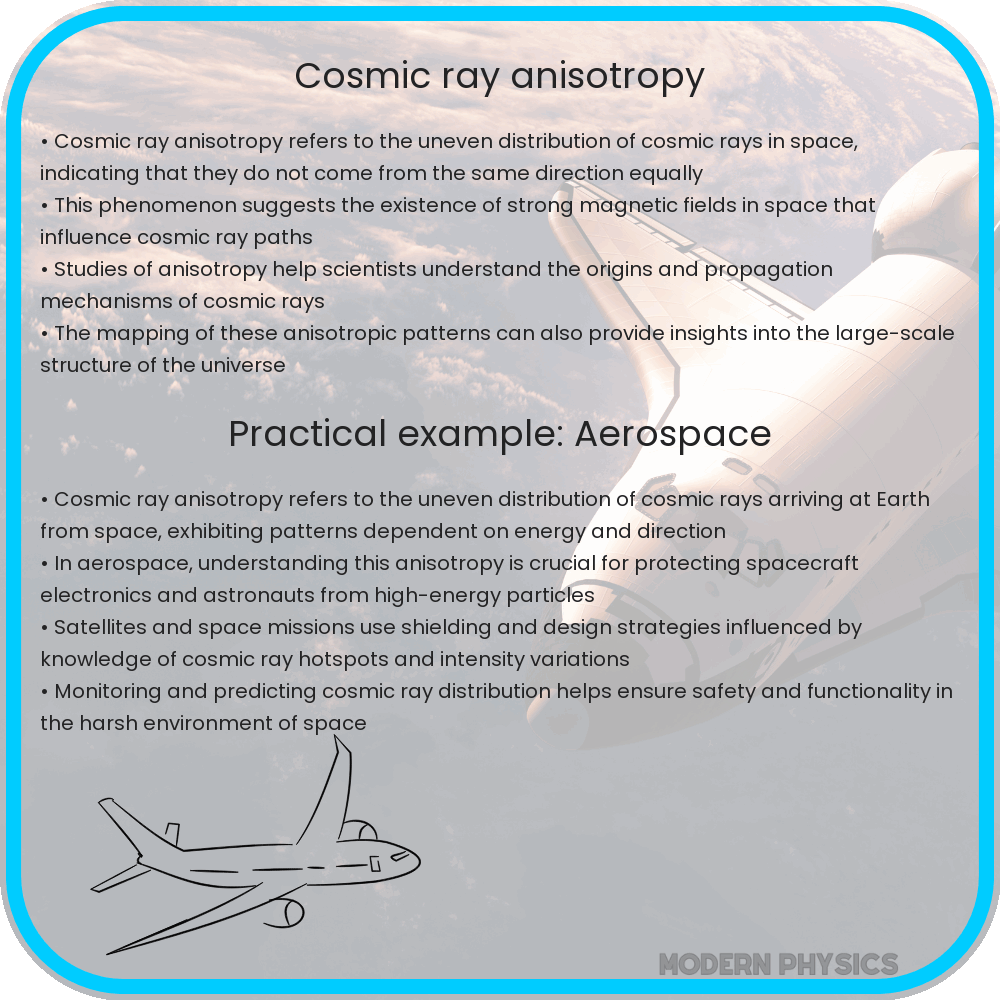
Cosmic rays, high-energy particles primarily consisting of protons and atomic nuclei, have long fascinated scientists due to their origins and effects on Earth. While these particles bombard our planet uniformly from all directions, detailed observations reveal subtle differences in their intensity, a phenomenon known as cosmic ray anisotropy. This article delves into the origins, impacts, and ongoing research surrounding this intriguing cosmic puzzle.
Origins of Cosmic Ray Anisotropy
The origins of cosmic ray anisotropy are as enigmatic as the particles themselves. Cosmic rays travel across the galaxy, deflected by magnetic fields, which makes tracing their origins challenging. However, scientists hypothesize that these variations in intensity may be linked to the spatial distribution of their sources, such as supernovae, and the interstellar magnetic fields they encounter on their journey to Earth. The anisotropy can also be affected by solar winds and the Earth’s own magnetic field, which shield us from these high-energy particles.
Impacts of Cosmic Rays on Earth
Despite their elusive nature, cosmic rays have significant impacts on Earth and its inhabitants. On a grand scale, they contribute to the ionization of the Earth’s atmosphere, affecting atmospheric chemistry and possibly influencing climate patterns. Additionally, cosmic rays play a crucial role in the formation of cloud nuclei, thus potentially impacting weather and climate. For technology and health, they pose a challenge; cosmic rays can disrupt electronic systems in satellites and aircraft and increase the radiation exposure of astronauts and high-altitude travelers.
Ongoing Research and Exploration
Research into cosmic ray anisotropy is vibrant and ongoing, with scientists using ground-based observatories and space missions to gather data. These studies aim to unravel the complexities of cosmic ray propagation and their interaction with interstellar and solar magnetic fields. By understanding the patterns and origins of anisotropy, researchers hope to solve broader astrophysical puzzles, such as the processes governing our galaxy and the interstellar medium. This knowledge not only deepens our understanding of the universe but also enhances our ability to mitigate the effects of cosmic rays on technology and health.
Challenges in Studying Cosmic Ray Anisotropy
The study of cosmic ray anisotropy presents unique challenges. The primary issue lies in the detection and measurement of these high-energy particles. As cosmic rays interact with the Earth’s atmosphere, they create showers of secondary particles. Ground-based detectors and satellite instruments must meticulously record these events to deduce the primary cosmic rays’ properties and directions. Additionally, the varying strengths of cosmic rays, influenced by solar activity and Earth’s magnetic field, necessitate long-term observations to distinguish genuine anisotropic patterns from temporary fluctuations.
Advancements in Technology and Methodology
Recent advancements in technology and methodology have significantly bolstered our ability to study cosmic rays. The development of extensive air shower arrays, such as the Pierre Auger Observatory and the Telescope Array Project, has allowed scientists to collect data with unprecedented precision. These facilities can cover vast areas, increasing the chances of detecting rare, high-energy cosmic rays. Moreover, improvements in satellite technology provide detailed observations of cosmic rays beyond the influence of the Earth’s atmosphere, offering clearer insights into their origins and propagation.
Interdisciplinary Implications
The study of cosmic ray anisotropy extends beyond astrophysics, intersecting with other scientific disciplines. For instance, understanding the impact of cosmic rays on Earth’s atmosphere contributes to climatology and atmospheric science. In the field of engineering, insights into cosmic ray interactions help improve the resilience of spaceborne and airborne electronic systems. Furthermore, the health implications of cosmic rays spur advancements in medical research, particularly in radiobiology and cancer therapy.
Conclusion
Cosmic ray anisotropy remains one of the compelling mysteries in astrophysics, offering a unique window into the processes that shape our universe. The continuous efforts in observing, understanding, and interpreting the anisotropic patterns of cosmic rays not only enhance our understanding of the cosmos but also bring practical benefits to technology, health, and environmental science. As technological capabilities and methodologies evolve, the future of cosmic ray research promises to unveil further secrets of our galaxy, improving our understanding of the cosmic environment and its influence on our planet.