
Explore the hidden universe with infrared astronomy: unveiling cosmic secrets from star formation to galactic centers, and how technology is expanding our cosmic view.
Infrared Astronomy: Unveiling the Hidden Universe
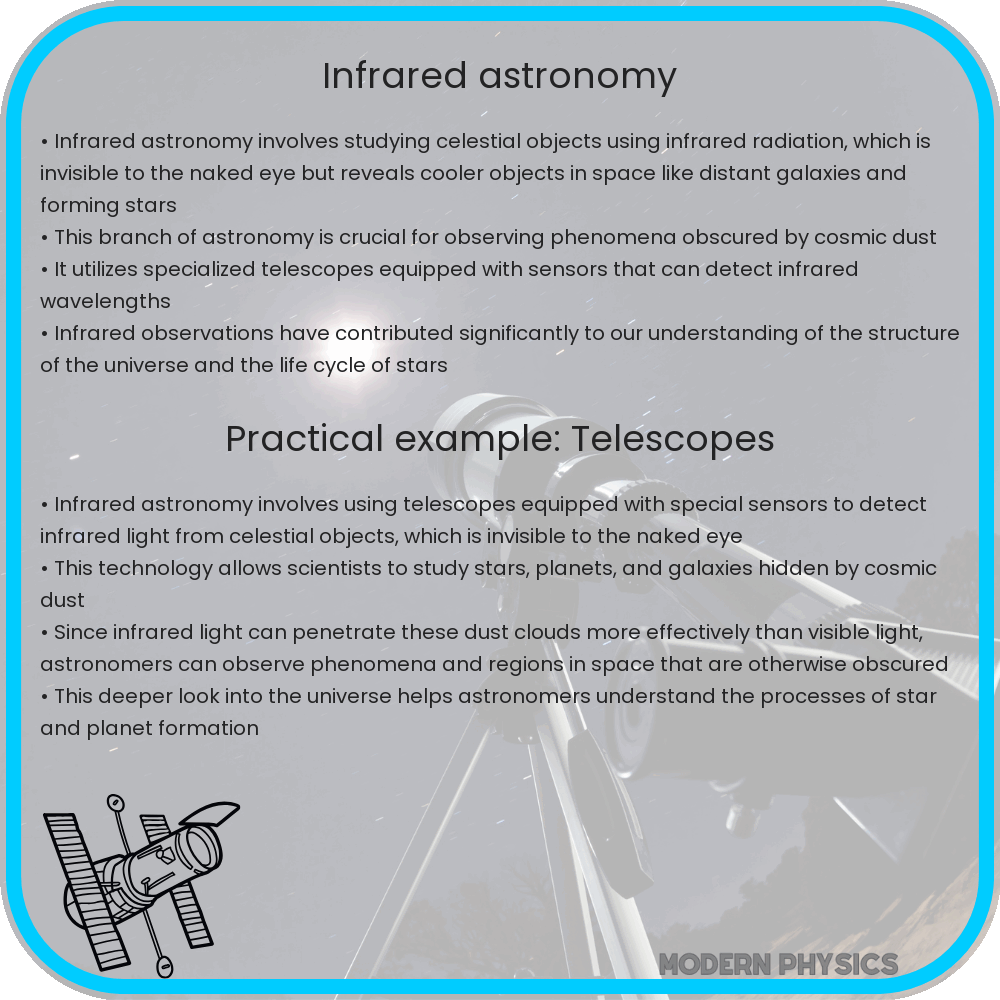
Infrared astronomy is a branch of astronomy that studies celestial objects in the infrared part of the electromagnetic spectrum. Unlike visible light, infrared radiation is not absorbed as much by dust and gas, allowing astronomers to peer into regions of space that are otherwise obscured. This capability makes infrared astronomy critical for understanding the formation of stars, the structure of galaxies, and the composition of the cosmos.
The Birth of Infrared Astronomy
The field of infrared astronomy began in the early 19th century but gained significant traction in the mid-20th century with the advent of sensitive detectors. The discovery that celestial objects emit infrared radiation led to the development of specialized telescopes and instruments designed to detect and analyze this light. Unlike traditional optical telescopes, which are limited by atmospheric interference, infrared telescopes are often placed on high mountains or in space to minimize absorption by Earth’s atmosphere.
Exploring the Cosmos in a New Light
Infrared observations have revolutionized our understanding of the universe. By observing the heat emitted by objects in space, astronomers can study the lifecycle of stars, from their dusty beginnings in nebulae to their explosive ends as supernovae. This has led to significant discoveries, such as the identification of complex organic molecules in interstellar space, hinting at the building blocks of life scattered throughout the cosmos.
Unveiling the Galactic Center and Star Formation
One of the most significant achievements of infrared astronomy has been the detailed observation of the Milky Way’s center. Shrouded in thick dust, the galactic center remained a mystery until infrared technology allowed us to see through the veil, revealing a supermassive black hole and myriad stars in unprecedented detail. Additionally, infrared astronomy plays a crucial role in the study of star formation, providing insights into the processes that lead to the birth of stars and planetary systems.
Mapping the Invisible Universe
Aside from revealing hidden cosmic phenomena, infrared astronomy contributes to the mapping of the cold, dark areas of the universe. By detecting the faint heat of distant objects, astronomers can construct more complete maps of galaxies and celestial structures, offering a fuller understanding of the universe’s vastness and complexity.
The Role of Infrared Satellites and Observatories
The advancement of infrared astronomy has been significantly boosted by space-based observatories. Satellites like the Hubble Space Telescope’s infrared camera, the Spitzer Space Telescope, and the James Webb Space Telescope have provided unparalleled views of the universe. These observatories orbit beyond Earth’s atmosphere, allowing them to capture infrared radiation without atmospheric interference. Their observations have led to breakthroughs in understanding the early universe, cosmic dust, and exoplanets.
Infrared Technology and Instrumentation
The progress in infrared astronomy is also due to advances in technology. Infrared detectors must be cooled to very low temperatures to be sensitive to the faint heat of distant celestial bodies. The development of cryogenic cooling systems and sensitive infrared sensors has dramatically increased the capability of telescopes to observe the universe in this light. Moreover, the integration of computer technology with infrared instruments has facilitated the analysis and interpretation of complex data.
Future Prospects and Challenges
The future of infrared astronomy looks promising, with several missions planned to explore the cosmos further. However, challenges remain, such as the need for better cooling technologies, more sensitive detectors, and innovative methods to filter out background infrared noise from both the Earth and the telescope itself. Despite these challenges, the potential discoveries awaiting in the infrared universe continue to drive the field forward.
Conclusion
Infrared astronomy has opened a new window to the universe, allowing us to see beyond the veil of cosmic dust and gas that obscures our view in visible light. It has transformed our understanding of the cosmos, from the life cycle of stars to the structure of galaxies, and has provided profound insights into the origins of the universe. As technology advances, infrared astronomy promises to unveil more about the mysterious, cold, and hidden aspects of space, continuing to expand our knowledge and challenge our understanding of the cosmos. The journey of discovery in infrared astronomy is far from over, and its future findings are sure to captivate the imagination of humanity for years to come.