
Explore the mysteries of High-Velocity Clouds (HVCs), their composition, origins, and impact on the Milky Way, unveiling the secrets of galactic dynamics and evolution.
Unraveling the Mysteries of High-Velocity Clouds
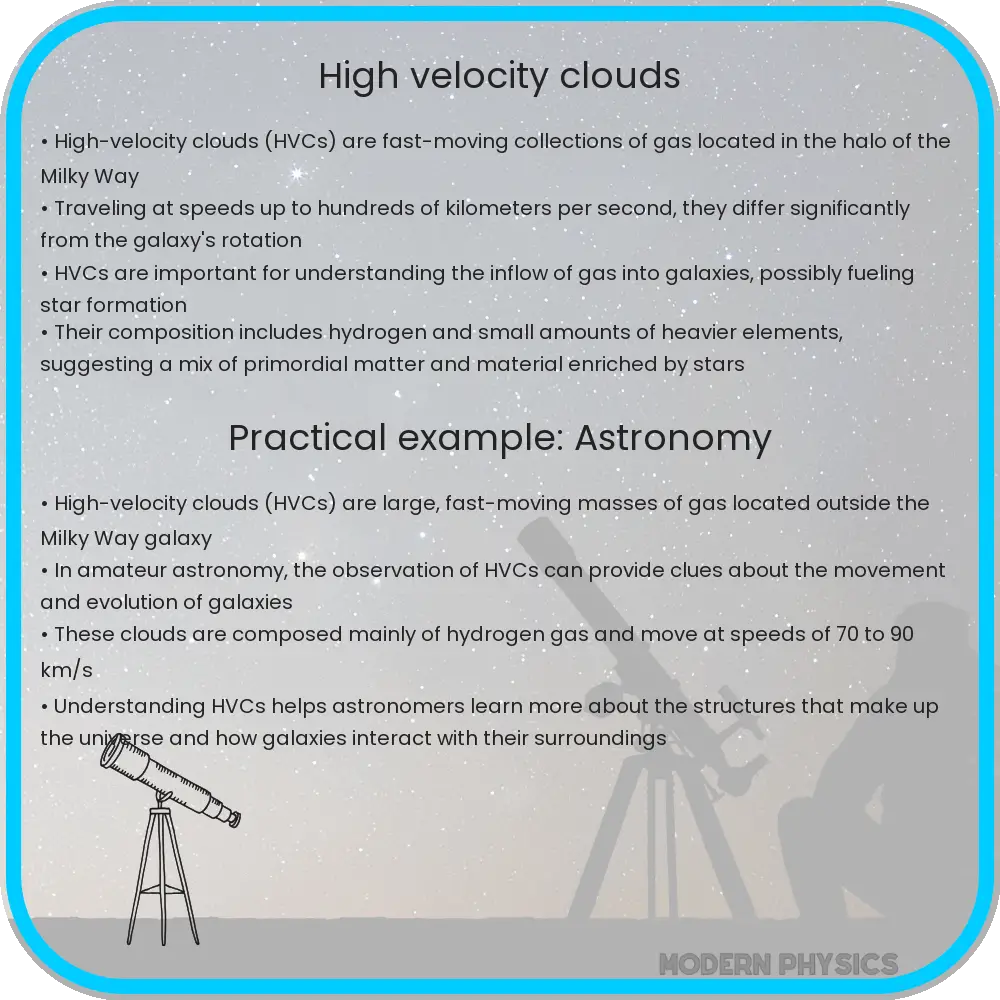
High-Velocity Clouds (HVCs) stand as enigmatic entities in the cosmic landscape, captivating astronomers with their mysterious origins and potential impact on the Milky Way. These clouds, composed primarily of hydrogen gas, travel at speeds significantly higher than the galaxy’s rotation, challenging our understanding of galactic dynamics and interstellar matter.
Composition and Characteristics
At the heart of HVCs lies their primary component, hydrogen gas, existing in both atomic (HI) and molecular (H2) forms. These clouds often contain small amounts of heavier elements like oxygen, carbon, and iron, hinting at their complex formation processes. Their temperatures can range widely, from a few hundred to several thousand Kelvin, indicating diverse environments and histories. HVCs vary in size and mass, with some extending over thousands of light-years and containing millions of solar masses of material.
Origins and Mysteries
The origins of HVCs are as diverse as their composition. Some are believed to be remnants of the early Galaxy, providing insights into its formation and evolution. Others may have originated from the intergalactic medium, representing material being accreted onto the Milky Way. There are also theories suggesting that HVCs could be the result of supernova explosions or the ejection of material from the Galactic disc.
Despite extensive studies, many aspects of HVCs remain shrouded in mystery. Their exact distances, total mass, and impact on the Galactic ecosystem are subjects of ongoing research. Understanding these high-velocity entities is crucial for unraveling the history of galaxy formation and the complex processes governing the interstellar medium.
Impact on the Milky Way
HVCs are not mere isolated phenomena; they significantly influence the Galactic environment. As they travel through the halo of the Milky Way, they can trigger star formation by compressing the interstellar medium in their path. Additionally, by infusing fresh gas into the Galactic disc, they contribute to the continuous cycle of star formation and evolution. The interaction between HVCs and the Galaxy’s magnetic field, as well as their potential role in the Galactic ecosystem, continues to be a focal point of astrophysical research.
Scientific Significance and Challenges
The study of HVCs offers vital clues to the processes that govern galaxy evolution and structure. By analyzing these clouds, scientists can gain insights into the Milky Way’s accretion history and the complex mechanisms driving galactic dynamics. However, researching HVCs presents significant challenges. Their distances and motions are difficult to measure accurately, complicating efforts to determine their origins and impact. Advanced telescopes and observational techniques are continuously being developed to probe these elusive structures more effectively.
Future Research and Prospects
Future research on HVCs promises to peel back layers of cosmic mystery. With the advent of more powerful astronomical instruments, such as the James Webb Space Telescope and ground-based radio telescopes, astronomers hope to clarify the distances, compositions, and trajectories of these clouds. These advancements may unveil the connections between HVCs and other galactic phenomena, offering a more integrated view of the cosmos.
Additionally, simulations and theoretical models are evolving to predict the behavior and influence of HVCs within galactic ecosystems. By integrating observations with theoretical frameworks, researchers aim to construct a comprehensive understanding of how these clouds contribute to the cycling of matter within and between galaxies.
Conclusion
High-Velocity Clouds are key pieces in the cosmic puzzle, bridging the vast expanse between galactic phenomena and interstellar processes. Their study not only sheds light on the Milky Way’s past and present but also offers glimpses into the universal principles governing all galactic systems. As we stand on the brink of new astronomical discoveries, HVCs continue to challenge our perceptions, driving the quest for a deeper understanding of the universe. The mysteries they hold are a testament to the dynamic and ever-changing nature of space, prompting a continual reevaluation of our cosmic surroundings.