
Explore the fascinating world of galaxy morphology, including their structures, types, and the dynamics that influence their evolution and formation processes.
Understanding Galaxy Morphology
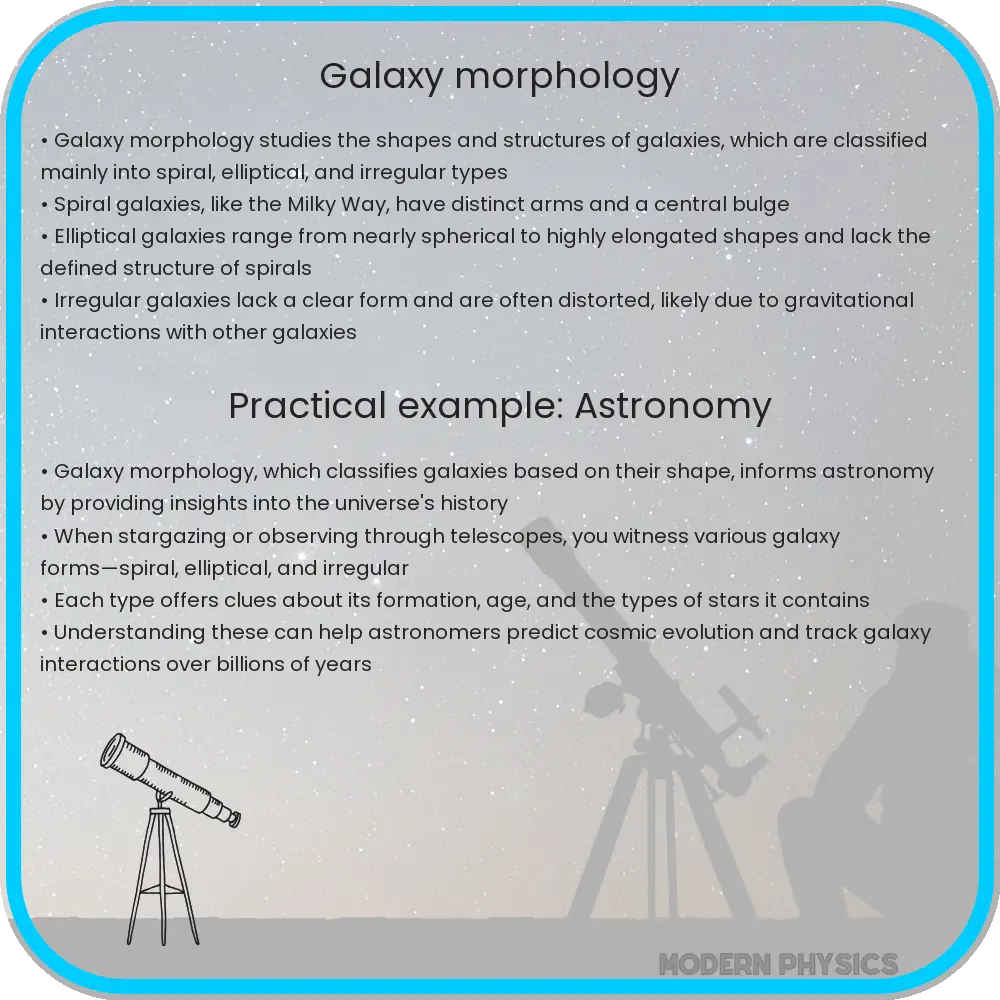
Galaxy morphology is the branch of astronomy that involves the study of the shapes, structures, and forms of galaxies. It is a critical field that helps scientists understand the universe’s vast and varied constituents. The morphology of a galaxy can provide valuable insights into its formation history, age, and the processes that have shaped its evolution.
Structural Components of Galaxies
Galaxies are composed of several key components, each playing a crucial role in their overall structure and behavior. These components include:
- Stellar Populations: Galaxies contain billions of stars, ranging from young, hot, blue stars to older, cooler, red stars. The distribution and composition of these stars can reveal much about a galaxy’s history and formation.
- Gas and Dust: The interstellar medium consists of gas and dust, crucial for star formation. The presence and amount of gas and dust can significantly influence a galaxy’s morphology and star formation rate.
- Dark Matter: This invisible substance does not emit, absorb, or reflect light, but its gravitational effects are essential in forming and shaping galaxies.
- Central Black Hole: Many galaxies, particularly active ones, harbor massive black holes at their centers, affecting their dynamics and evolution.
Classification of Galaxies
The classification of galaxies into different types is primarily based on their visual appearance. Edwin Hubble devised a system that categorizes galaxies into three main types:
- Spiral Galaxies: Characterized by rotating, flat disks with spiral arms, these galaxies, like the Milky Way, are rich in gas and dust, fostering active star formation.
- Elliptical Galaxies: Ranging from nearly spherical to elongated shapes, these galaxies have little gas and dust and contain older, redder stars, indicating a lack of new star formation.
- Irregular Galaxies: Lacking a distinct shape, these galaxies often result from galactic collisions or other disruptive events, leading to erratic star formation and composition.
Evolution and Dynamics of Galaxies
The evolution of galaxies is a complex process influenced by various factors, including gravitational interactions, mergers, and internal processes. Over billions of years, galaxies can undergo significant transformations, evolving from irregular shapes into more defined forms like spiral and elliptical galaxies. Gravitational forces play a crucial role in this evolution, leading to galaxy mergers that can significantly alter their structure and star formation rates.
Galactic dynamics, the study of the motion of galaxies and their components, is integral to understanding their evolution. It involves the investigation of orbital motions within galaxies and the interactions between them. These dynamics are governed by the laws of physics and are influenced by factors such as dark matter, the distribution of stars, gas, and dust, and the presence of central black holes.
Implications of Galaxy Morphology
The study of galaxy morphology has profound implications for our understanding of the universe. It helps astronomers to trace the history of galaxies, understand the processes that shape them, and predict their future evolution. By examining the structure and composition of galaxies, scientists can gain insights into the nature of dark matter, the formation and lifecycle of stars, and the cosmic web that connects all structures in the universe.
Moreover, understanding galaxy morphology is crucial for cosmology—the study of the universe’s origin, evolution, and eventual fate. The distribution and types of galaxies across the universe provide essential clues about the cosmic conditions in the early universe and the fundamental laws that govern its large-scale structure.
Conclusion
Galaxy morphology serves as a window into the past, present, and future of the universe. By classifying galaxies, studying their components, and understanding their dynamics and evolution, astronomers can unravel the mysteries of the cosmos. This field not only enriches our knowledge of the universe but also challenges our understanding of the fundamental laws of physics. As observational techniques and theoretical models continue to improve, the study of galaxy morphology promises to unveil even more about the intricate tapestry of the cosmos.