
Explore the fascinating world of galactic kinematics: the study of motion, structure, and dynamics within galaxies, including the mysterious role of dark matter.
Introduction to Galactic Kinematics
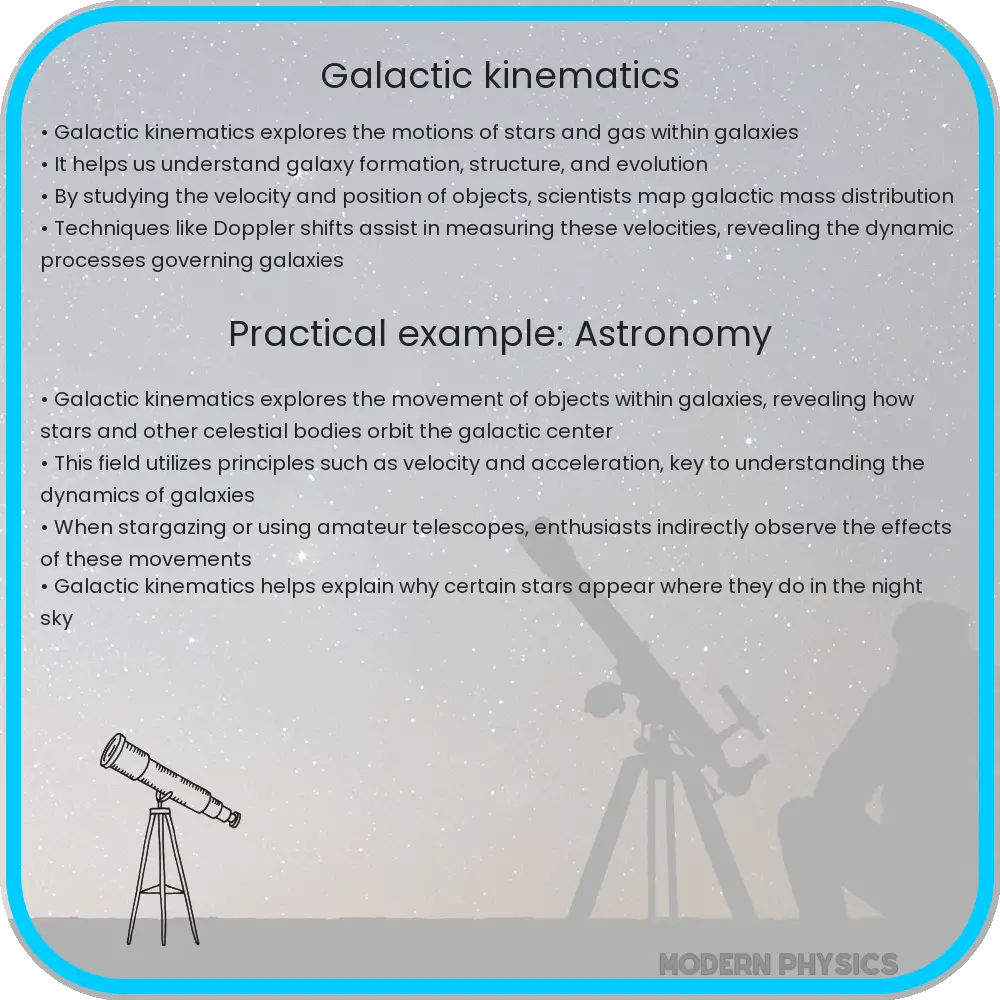
Galactic kinematics is the study of the motion of objects within galaxies, including stars, gas clouds, and other celestial bodies. This field of astronomy is crucial for understanding the overall structure, formation, and evolution of galaxies. By examining the motion of these objects, astronomers can infer the mass distribution within a galaxy, including the presence of dark matter, and gain insights into the dynamic processes shaping the galaxies.
Motion within the Galaxy
The motion of stars and other objects in a galaxy is primarily governed by gravity. The most visible part of a galaxy, the stellar disk, contains most of the galaxy’s luminous matter and showcases various kinematic phenomena such as rotation curves, spiral arms, and bar structures. The rotation curve, a plot of the orbital speeds of stars and gas clouds as a function of their distance from the galactic center, provides vital clues about the mass distribution within the galaxy. Typically, these curves remain flat far beyond the visible edge of the galaxy, suggesting the presence of a significant amount of unseen, or dark, matter.
Structure and Dynamics
Galactic structure is determined by the distribution and dynamics of its constituent stars, gas, and dark matter. The dynamics of a galaxy are influenced by its initial mass, angular momentum, and the evolutionary processes it undergoes. The structure can be broadly classified into the central bulge, the disk, and the halo. The bulge is a dense, spherical aggregation of stars; the disk is composed of stars, gas, and dust with a flattened shape; and the halo is a more diffuse, spherical component extending beyond the disk, containing old stars and dark matter.
- Bulge: Central, spherical component, often hosting older, red stars.
- Disk: Flattened region containing young, blue stars, gas, and dust, showing features such as spiral arms.
- Halo: Outer, spherical region, home to older stars and dark matter.
Understanding these components and their interactions is essential for unraveling the history and future evolution of galaxies.
Galactic Dynamics and Dark Matter
The role of dark matter in galactic kinematics is profound. Dark matter does not emit, absorb, or reflect light, making it completely invisible to traditional telescopic observations. However, its gravitational effects are observable through the motion of stars and gas clouds. The flat rotation curves of galaxies suggest that dark matter constitutes a significant portion of the total mass of galaxies, influencing their structure and dynamics. Understanding the distribution of dark matter is crucial for modeling galactic motions and predicting the evolution of galaxies.
Methods of Studying Galactic Kinematics
Astronomers employ various methods to study galactic kinematics. Spectroscopy, the analysis of the light spectrum from stars and gas, allows astronomers to measure velocities and infer the mass distribution within galaxies. Additionally, the Doppler effect, which shifts the wavelengths of light from moving objects, provides information on the speed and direction of celestial bodies. These techniques, combined with computer simulations, enable scientists to construct detailed models of galaxies and understand their complex motions.
- Spectroscopy: Used to determine the composition, temperature, density, and relative motion of celestial objects.
- Doppler Effect: Utilized to measure the velocities of stars and gas clouds within galaxies.
- Computer Simulations: Help in modeling galactic formation and evolution, enhancing our understanding of galactic dynamics.
Conclusion
Galactic kinematics is a vital field within astronomy that provides insights into the motion, structure, and dynamics of galaxies. By studying the movement of stars, gas, and other components, astronomers can infer the distribution of both visible and dark matter within galaxies. This knowledge helps us understand the formation, evolution, and future of galaxies. The interplay between observational data and theoretical models continues to deepen our understanding of the universe, challenging and refining our perceptions of the cosmic landscape. As technology advances, so too will our understanding of galactic kinematics, propelling us closer to unraveling the mysteries of the cosmos.