
Explore the complexities of helicopter dynamics, focusing on stability, control, and maneuverability, and the latest advancements in design.
Understanding Helicopter Dynamics: Stability, Control, and Maneuverability
Helicopter dynamics, a complex and fascinating area of aerospace engineering, involves the study of the forces and moments that affect helicopter flight. These dynamics are pivotal in determining a helicopter’s stability, control, and maneuverability, which are essential for safe and efficient operation.
Stability in Helicopters
Stability refers to the helicopter’s ability to maintain or return to a desired flight condition without excessive pilot intervention. There are two main types of stability: static and dynamic. Static stability is the initial tendency of the helicopter to return to its original position after a disturbance, while dynamic stability refers to the behavior of the helicopter over time after a disturbance.
- Static Stability: Assessed by the initial response to a disturbance. A helicopter with positive static stability will naturally tend to return to its equilibrium state.
- Dynamic Stability: Involves the motion of the helicopter after the initial disturbance. A dynamically stable helicopter will dampen out oscillations and return to equilibrium over time.
Control in Helicopters
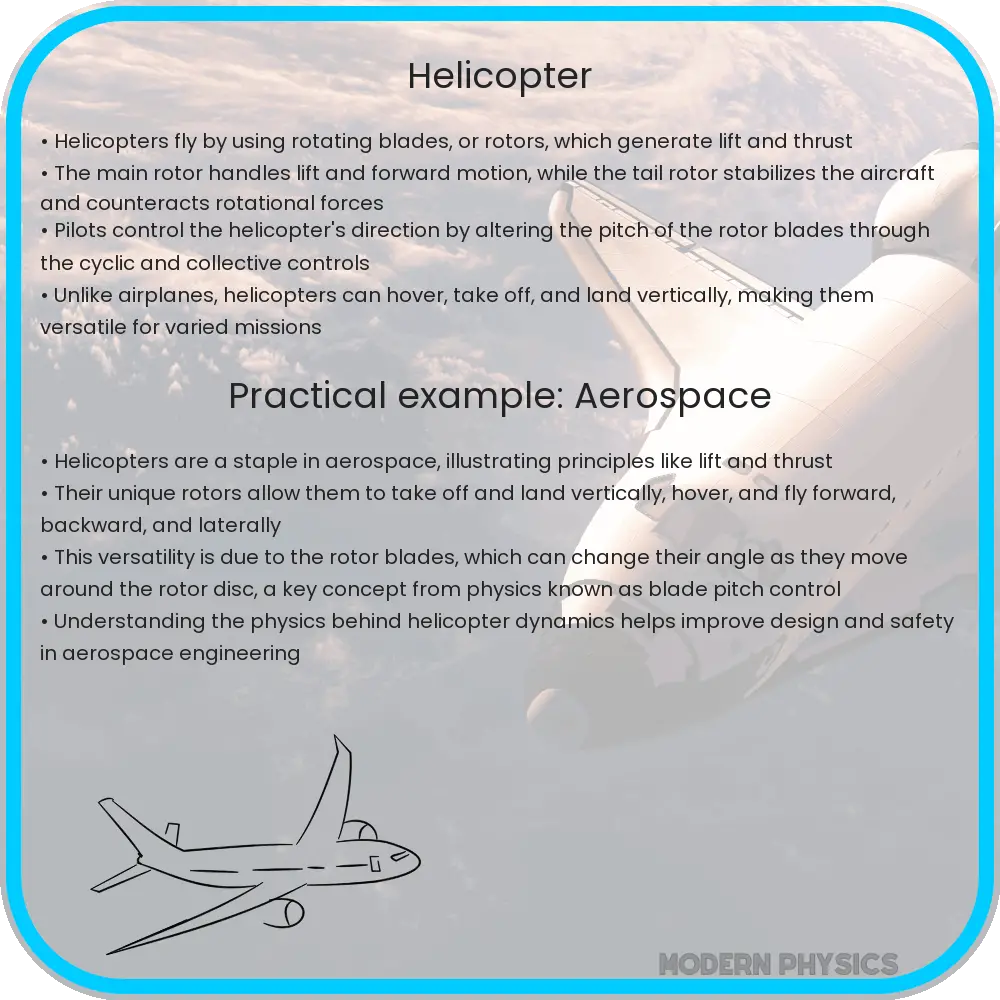
Control in helicopters is achieved through the manipulation of rotor blades. The pilot can control the helicopter’s pitch, roll, and yaw by varying the pitch angle of the rotor blades, using the cyclic and collective controls, and the tail rotor.
- Cyclic Control: Alters the pitch angle of the rotor blades individually as they rotate, enabling the helicopter to move in the desired direction (forward, backward, left, or right).
- Collective Control: Changes the pitch angle of all rotor blades simultaneously, controlling the altitude and vertical velocity of the helicopter.
- Tail Rotor: Provides the necessary counteracting force to control the helicopter’s yaw, preventing it from spinning due to the main rotor’s torque.
Maneuverability of Helicopters
Maneuverability is the helicopter’s ability to change its flight path and attitude. This attribute is significantly influenced by the design of the rotor system and the helicopter’s overall aerodynamic characteristics. Factors such as rotor disk loading, blade aspect ratio, and power availability play crucial roles in determining a helicopter’s maneuverability.
Understanding these aspects of helicopter dynamics is crucial for pilots and engineers alike, as they directly impact the safety, performance, and capabilities of these versatile aircraft.
Advanced Aspects of Helicopter Dynamics
Further exploring helicopter dynamics, it is crucial to consider advanced factors like aerodynamic efficiency, vibration control, and the impact of environmental conditions.
- Aerodynamic Efficiency: Helicopters are less efficient compared to fixed-wing aircraft due to the complexity of rotor aerodynamics. Efficiency improvements focus on rotor blade design, minimizing drag, and optimizing lift-to-drag ratios.
- Vibration Control: Due to rotating components and aerodynamic forces, helicopters are prone to vibrations, which can reduce comfort and increase maintenance needs. Engineers use various techniques, such as active vibration control systems, to mitigate these effects.
- Environmental Impact: Helicopters must be designed to perform in diverse environments, from high-altitude mountainous regions to maritime operations. Environmental factors like temperature, air density, and wind conditions significantly influence helicopter performance.
Technological Innovations in Helicopter Design
Technological advancements have significantly influenced helicopter design and performance. Innovations such as fly-by-wire controls, advanced composite materials for rotor blades, and more efficient engines have enhanced the capabilities of modern helicopters.
- Fly-By-Wire Controls: These systems replace manual controls with electronic interfaces, providing pilots with more precise control and reducing workload.
- Advanced Composite Materials: Used in rotor blades, these materials offer higher strength-to-weight ratios, improving performance and durability.
- Efficient Engines: Modern engines provide greater power and fuel efficiency, extending the range and capabilities of helicopters.
Conclusion
The field of helicopter dynamics is an intricate blend of physics, engineering, and technology. Understanding stability, control, and maneuverability is fundamental for designing and operating these versatile aircraft. As technology advances, we can expect further improvements in helicopter performance, efficiency, and safety. For pilots, engineers, and enthusiasts, the ongoing developments in helicopter dynamics offer an exciting glimpse into the future of aviation, where helicopters continue to play a pivotal role in various applications, from rescue missions to urban mobility solutions.