
Explore the complexities of helicopter kinematics, covering 3D flight dynamics, maneuverability, control systems, and environmental impacts.
Understanding Helicopter Kinematics: 3D Flight, Maneuverability & Control
The intricate dynamics of helicopter flight present a unique challenge in the realm of aviation. Unlike fixed-wing aircraft, helicopters possess the ability to hover, move in any direction, and even fly backwards, making their kinematics particularly complex. This article delves into the fundamental aspects of helicopter kinematics, focusing on 3D flight, maneuverability, and control mechanisms.
Three-Dimensional Flight Dynamics
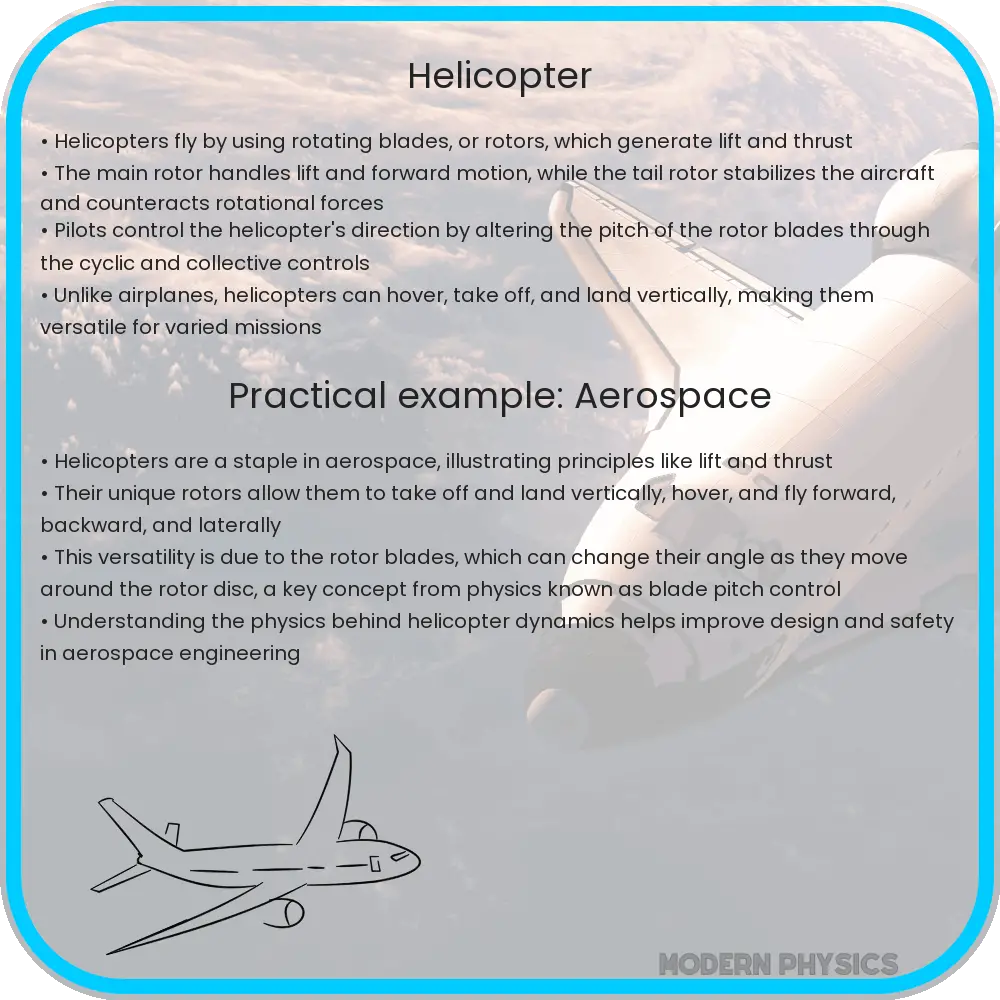
Helicopters exhibit three-dimensional flight capabilities, primarily due to their rotor system. The rotor blades of a helicopter can change their angle of attack through a process known as ‘cyclic pitch control’. This control allows the helicopter to move laterally, longitudinally, and vertically. In addition, the ‘collective pitch control’ adjusts the pitch angle of all the rotor blades simultaneously, enabling the helicopter to ascend or descend vertically.
Maneuverability and Control
One of the most distinctive features of helicopter flight is its remarkable maneuverability. This is largely attributed to the rotor system’s ability to generate lift and thrust in virtually any direction. For instance, by tilting the rotor disc forward, the helicopter moves forward. Similarly, tilting it to the side results in lateral movement. These maneuvers are achieved through the cyclic pitch control, which alters the pitch of each rotor blade individually as it rotates around the rotor disc.
Understanding the Rotor System
The heart of a helicopter’s maneuverability lies in its rotor system. The main rotor, responsible for lift and thrust, is complemented by the tail rotor, which counters the torque effect generated by the main rotor. This balance is crucial for stable flight. The tail rotor also plays a vital role in controlling the helicopter’s yaw motion (rotation about the vertical axis), allowing the pilot to steer left or right.
Advanced Control Mechanisms
Modern helicopters are equipped with sophisticated control systems that enhance flight stability and maneuverability. These systems include gyroscopes and computer-assisted flight controls, which help in maintaining balance and managing the complex interplay of aerodynamic forces. Additionally, autopilot systems in advanced helicopters can automate certain aspects of flight, reducing pilot workload.
Understanding the kinematics of helicopter flight not only sheds light on the complexities of rotorcraft aerodynamics but also highlights the engineering marvels enabling these versatile machines to perform a wide range of maneuvers in three-dimensional space.
Flight Stability and Aerodynamics
Helicopter stability is a critical aspect of its flight dynamics. Unlike fixed-wing aircraft that rely on forward motion to maintain lift, helicopters maintain stability through rotor rotation. The design of the rotor blades and their aerodynamic properties are crucial for stable flight. Helicopters often employ stabilizer bars or electronic stabilization systems to mitigate the effects of turbulence and enhance control responsiveness.
Impact of Environmental Factors
Environmental factors like wind, temperature, and altitude significantly impact helicopter flight. Wind can affect lift and control, necessitating adjustments in rotor pitch and power settings. Higher altitudes and warmer temperatures, where air density is lower, can reduce lift and engine performance, challenging the helicopter’s ability to hover and maneuver.
Challenges in Helicopter Control
Controlling a helicopter requires skill and precision, as pilots must simultaneously manage multiple controls. These include the cyclic for direction, the collective for altitude, and the tail rotor pedals for yaw control. The interdependence of these controls means that a change in one can necessitate adjustments in the others, making helicopter piloting a complex and demanding task.
Technological Advancements in Rotorcraft Design
Technological advancements continue to revolutionize helicopter design and performance. Innovations in rotor materials and design have led to more efficient, quieter, and safer helicopters. Additionally, advancements in avionics and control systems, such as fly-by-wire technology, have greatly enhanced the pilot’s ability to control and navigate the aircraft effectively.
Conclusion
The world of helicopter kinematics is one of intricate engineering and precise control. From the complexities of the rotor system to the challenges posed by environmental factors, understanding the dynamics of helicopter flight reveals the ingenuity behind these versatile machines. As technology continues to advance, we can expect even greater capabilities and efficiencies in helicopter design and operation, further cementing their role in various applications, from rescue operations to urban mobility solutions. The study of helicopter kinematics not only underscores the marvel of human ingenuity in conquering the skies but also paves the way for future innovations in aerial transportation.