
Explore the essentials of airplane dynamics, including flight mechanics, control systems, and stability, with a focus on modern aviation technologies.
Airplane Dynamics: Understanding Flight Mechanics, Control, and Stability
The study of airplane dynamics encompasses a complex blend of aerodynamics, physics, and engineering, crucial for understanding how aircraft are controlled and stabilized during flight. This field is integral to designing and operating aircraft safely and efficiently. Here, we delve into the key aspects of flight mechanics, control systems, and stability that define an airplane’s performance in the skies.
Flight Mechanics: The Forces of Flight
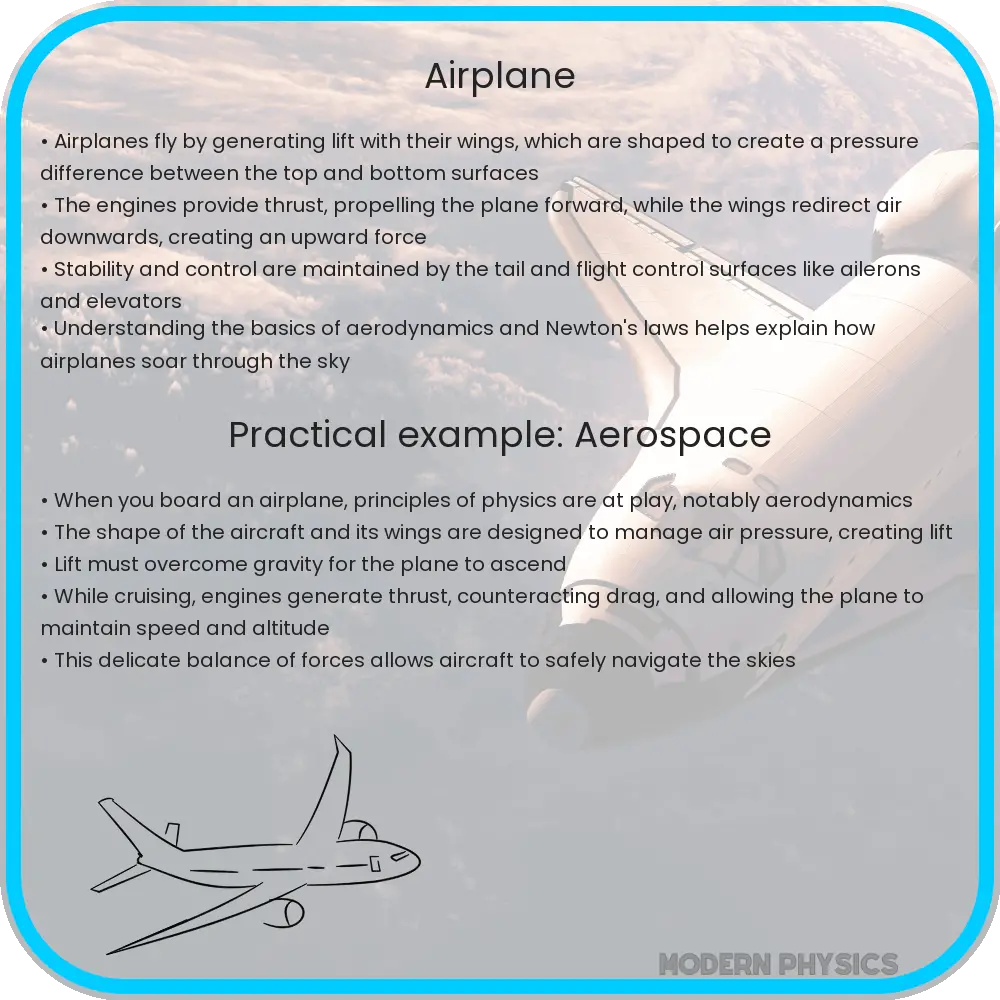
Flight mechanics involve the forces that act on an aircraft during flight, including lift, gravity, thrust, and drag. Lift, generated by the wings, counters gravity and enables an aircraft to ascend and maintain altitude. The lift force is primarily a function of the wing’s shape, airspeed, and air density. Thrust, produced by engines, propels the aircraft forward, overcoming drag, the resistance exerted by air. The interplay of these forces determines the aircraft’s trajectory and maneuverability.
Aircraft Control Systems
Control systems in aircraft are designed to manage its orientation and flight path. These systems include ailerons, elevators, and rudders. Ailerons, located on the wings, control roll about the longitudinal axis, allowing the aircraft to bank and turn. Elevators, attached to the tail, manage pitch, influencing the aircraft’s ascent or descent. The rudder, also located at the tail, controls yaw, dictating the aircraft’s left or right movement relative to its vertical axis.
Stability: Maintaining Equilibrium
Stability in flight is crucial for maintaining control and ensuring safety. Aircraft stability is categorized into static and dynamic stability. Static stability refers to an aircraft’s natural tendency to return to its original flight condition after a disturbance. Dynamic stability involves the aircraft’s response over time after being disturbed. A well-designed aircraft exhibits positive static and dynamic stability, ensuring it remains on course and recovers quickly from disruptions like turbulence.
These aspects of airplane dynamics are not just theoretical concepts; they are vital for pilots and engineers. Understanding these principles allows for the design of aircraft that are not only functional but also safe and efficient. In the next section, we will explore the intricacies of aircraft design and the advanced technologies that contribute to modern aviation.
Advanced Technologies in Airplane Dynamics
Modern aviation has seen remarkable advancements in airplane dynamics, significantly enhancing flight safety and performance. Computational Fluid Dynamics (CFD) plays a pivotal role in designing and testing aircraft. CFD allows engineers to simulate and analyze airflow around an aircraft, optimizing its aerodynamic properties. This technology leads to designs with reduced drag and improved fuel efficiency, essential in today’s eco-conscious world.
The Role of Flight Control Systems
Flight Control Systems (FCS) have revolutionized airplane dynamics. These sophisticated systems use computer algorithms to assist in maintaining stability and control. The FCS continuously monitors flight conditions and automatically adjusts control surfaces to maintain desired flight paths, greatly reducing pilot workload. This automation is particularly vital in managing complex situations like turbulence or system failures.
Stability Augmentation Systems
Stability Augmentation Systems (SAS) are another critical aspect of modern aircraft. SAS enhances an aircraft’s inherent stability, ensuring smoother and safer flights. These systems are particularly beneficial in larger aircraft, where manual control becomes more challenging. SAS use sensors and actuators to continuously adjust control surfaces, maintaining optimal flight conditions.
Conclusion
The field of airplane dynamics is a fascinating blend of science and engineering, critical to the advancement of aviation. Understanding flight mechanics, control systems, and stability is essential for designing aircraft that are not only efficient but also safe in the diverse conditions of the sky. The integration of advanced technologies like CFD, FCS, and SAS marks a significant leap in aviation, offering enhanced performance, safety, and environmental sustainability.
As we continue to push the boundaries of aviation, the principles of airplane dynamics will remain the cornerstone of aircraft design and operation. The ongoing research and development in this field promise even safer, more efficient, and environmentally friendly aircraft for the future, reflecting the incredible potential of human ingenuity in conquering the skies.