
Explore the mysterious world of gravitinos, key particles in supergravity theory, and their impact on cosmology and dark matter research.
Introduction to Gravitinos
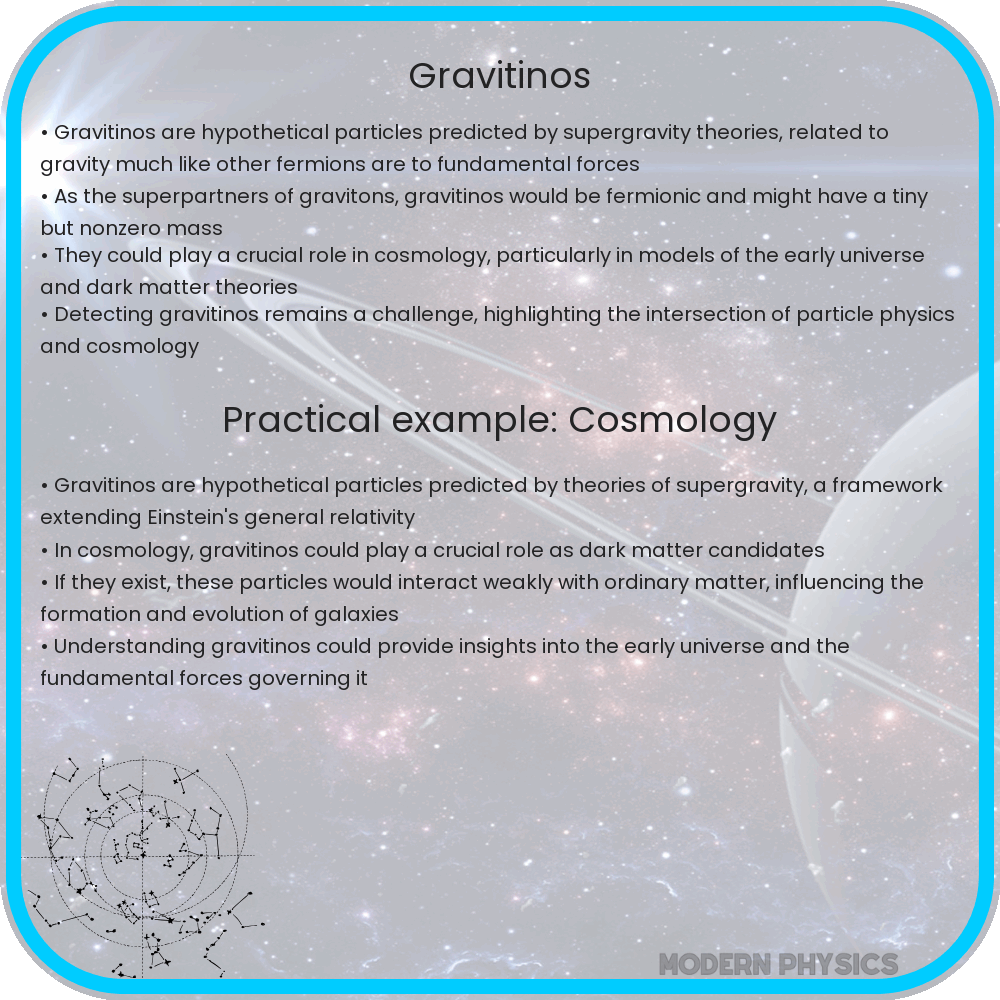
Gravitinos are hypothetical particles that arise within the framework of supergravity, a theory that attempts to merge general relativity with supersymmetry. In supergravity, each particle known from the Standard Model of particle physics is paired with a “superpartner” that differs in spin by a half-unit. The gravitino is the superpartner of the graviton, the elementary particle that mediates the force of gravity according to quantum field theory. While the graviton is hypothesized to be massless and has a spin of 2, the gravitino is expected to have a spin of 3/2 and may have a non-zero mass.
Theoretical Background
The concept of gravitinos stems from efforts to reconcile the principles of quantum mechanics with those of general relativity, leading to the development of quantum gravity theories. Supersymmetry extends this by proposing a symmetry between bosons (particles that follow Bose-Einstein statistics) and fermions (particles that follow Fermi-Dirac statistics). In theories of supergravity, the gravitino plays a crucial role, potentially influencing the structure of the universe, dark matter, and other cosmological phenomena.
Gravitino Production and Cosmic Implications
Gravitinos could be produced in the early universe following the Big Bang, under conditions of high temperature and energy density. Their properties and interactions depend heavily on their mass, which is still unknown and subject to theoretical speculation and experimental searches. In cosmology, gravitinos are considered as a viable candidate for cold dark matter, a form of matter that does not emit, absorb, or reflect light and thus cannot be observed directly with telescopes. The exact role and abundance of gravitinos in the cosmos could provide critical insights into the early phases of the universe, including inflation, supersymmetry breaking, and the thermal history following the Big Bang.
Research and Experimental Searches
Despite their theoretical importance, gravitinos have not yet been detected experimentally. Their existence and properties remain one of the significant challenges in particle physics and cosmology. Research involves indirect searches through the effects they might have on the decay of other supersymmetric particles, cosmological observations, and direct detection experiments at particle accelerators. The detection of gravitinos would be a monumental step in understanding the fundamental laws governing the universe and could offer profound insights into the dark sectors of the cosmos.
Challenges in Gravitino Research
The study of gravitinos presents unique challenges, primarily due to their weak interaction with other particles. This elusive nature makes direct detection extremely difficult. Moreover, the theoretical framework surrounding gravitinos—supergravity—is highly complex and still under development. The mass of the gravitino, which plays a critical role in its properties and interactions, varies widely in different supergravity models, adding another layer of complexity to its study. Researchers rely on sophisticated mathematical models and high-energy particle experiments to probe these particles’ characteristics and effects.
Implications of Gravitino Discovery
Should gravitinos be detected, the impact on physics would be profound. Firstly, it would provide tangible evidence for supersymmetry, significantly altering our understanding of the universe’s fundamental symmetries. It could also clarify the nature of dark matter, shedding light on one of the most significant mysteries in cosmology. Furthermore, the properties of gravitinos could offer insights into the conditions of the early universe, potentially opening new avenues for understanding the Big Bang and subsequent cosmic evolution.
Future Prospects
The search for gravitinos is intertwined with the broader quest for supersymmetry particles. As particle accelerators reach higher energies and detectors become more sensitive, the prospects for detecting gravitinos improve. Additionally, astronomical observations and studies of the cosmic microwave background may yield indirect evidence of gravitinos. Theoretical advancements are also crucial, as they guide experimental searches and help interpret potential signals. Collaboration between theorists and experimentalists is essential to navigate the complex landscape of supergravity and unlock the secrets of gravitinos.
Conclusion
Gravitinos occupy a fascinating niche at the intersection of particle physics, cosmology, and theoretical physics. While their existence remains hypothetical, the quest to understand these particles embodies the cutting-edge challenges and aspirations of modern science. A discovery would not only validate key theories but also transform our understanding of the universe’s most fundamental aspects. As the boundaries of technology and theory expand, the mystery of the gravitino continues to inspire scientists around the globe, driving forward the perpetual quest for knowledge and understanding of the cosmos.