
Photinos: Hypothetical fermionic particles theorized as dark matter constituents and superpartners of photons in supersymmetric models.
Exploring Photinos: Unveiling the Mysteries of Dark Matter
One of the most intriguing and elusive components of the universe is dark matter. Despite being imperceptible to light and other forms of electromagnetic radiation, dark matter plays a crucial role in the cosmos, accounting for approximately 27% of its total mass and energy. Among the various hypothetical particles proposed to explain the nature of dark matter, photinos stand out as a particularly compelling candidate. In this article, we delve into the concept of photinos, exploring their characteristics, theoretical backing, and significance in the broader context of cosmology.
What are Photinos?
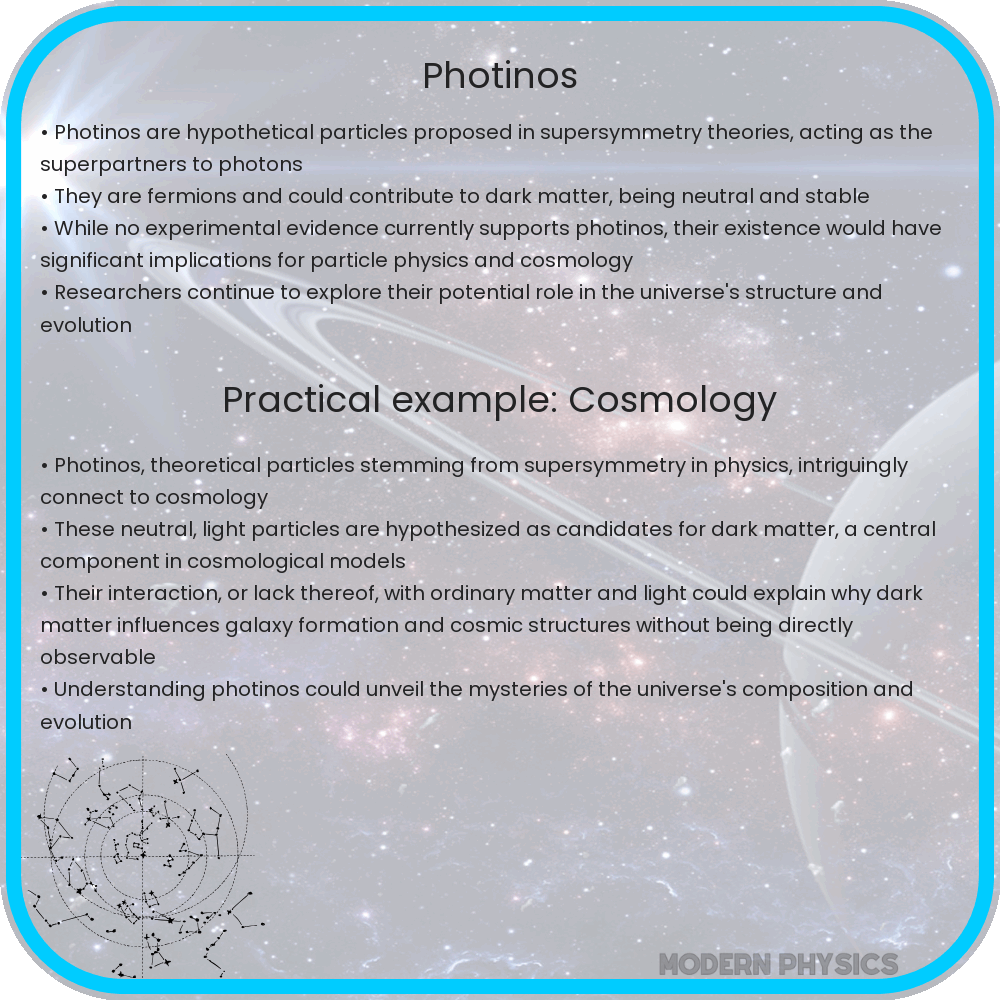
Photinos are theorized fermionic particles that could constitute dark matter. They belong to a group of particles called neutralinos, which are predicted by supersymmetric theories—a framework that extends the Standard Model of particle physics by positing that each particle has a supersymmetric partner, often dubbed a “sparticle. Photinos are the superpartners of photons, the quanta of light, in these models.
Theoretical Foundation
The existence of photinos stems from the theories of supersymmetry (SUSY), an extension of the Standard Model that seeks to resolve some of its shortcomings and unify the forces of nature. According to SUSY, every boson (a particle that follows Bose-Einstein statistics) has a corresponding fermion (a particle that follows Fermi-Dirac statistics) and vice versa. In this framework, the photon’s superpartner would be the photino, a neutral and significantly more massive particle.
Supersymmetry not only enriches the particle zoo but also provides a candidate for dark matter. Photinos, with their neutral charge and weak interaction with ordinary matter, fit well into the dark matter framework as they would not absorb, emit, or scatter light, making them essentially ‘invisible’—much like the dark matter observed in astronomical measurements.
Role in Cosmology
Photinos could potentially solve several cosmological puzzles, chiefly among them being the problem of dark matter. The gravitational effects of dark matter are evident in phenomena such as the rotational speeds of galaxies and the movements of galaxy clusters, yet it does not interact electromagnetically with the matter that we can see and measure directly.
If photinos are a major component of dark matter, they can offer insights into the structure and evolution of the universe. For instance, their distribution in space could help explain why galaxies form and cluster in the ways that they do. Additionally, understanding the properties of photinos could also help elucidate the early stages of the universe, offering clues into the conditions right after the Big Bang.
Experimental Searches and Challenges
Despite their theoretically appealing attributes, photinos have yet to be directly detected. The quest to find them involves sophisticated experiments like those conducted with particle accelerators, such as the Large Hadron Collider (LHC), and direct dark matter detection experiments deep underground or in ice, such as those operated by the Cryogenic Dark Matter Search (CDMS) and IceCube collaborations.
The search for photinos faces numerous challenges, not least of which is their weak interaction with other matter. This elusive quality, while congruent with the nature of dark matter, makes experimental verification extremely difficult. Advanced detectors with high sensitivity are required, as well as novel methods to discern the subtle signals that such particles might produce.
Photinos, like all candidates for dark matter, therefore exist at the challenging intersection of theoretical necessity and experimental elusiveness. Bridging this gap continues to be a primary goal of both particle physics and cosmology, driven by the prospect that understanding photinos could unlock some of the universe’s most profound secrets.
Potential Impacts on Technology and Science
The discovery and analysis of photinos could lead to groundbreaking advancements not only in cosmology but also in various technological fields. For instance, the deep understanding of particle physics required to detect photinos could propel the development of more advanced particle accelerators. These improvements could, in turn, spur innovations in medical imaging and cancer treatment technologies, where particle accelerators are used for precision therapies.
Moreover, the materials and detection techniques developed in the search for photinos could have broader applications. High-sensitivity detectors might find use in national security for scanning or surveillance, or in other fields of science, such as neutrino astronomy where detecting low-intensity signals is also crucial.
Educational and Collaborative Opportunities
The search for photinos presents an excellent opportunity for international collaboration, as it requires massive, complex instruments that no single country could feasibly develop alone. This fosters a global scientific community committed to sharing knowledge and resources, which could lead to faster scientific advancements in other areas as well.
Furthermore, as this area of research is relatively new and continually evolving, it offers a rich source of educational materials. Teachers and educators can use the mystery and intrigue surrounding dark matter and photinos to engage students and the public, potentially inspiring the next generation of physicists.
Conclusion
The exploration of photinos represents a fascinating frontier in modern physics, combining the intellectual rigour of theoretical physics with the cutting-edge technology of experimental physics. While the challenges in detecting these elusive particles are significant, the potential rewards are profound. Unravelling the mysteries of photinos could not only deepen our understanding of the cosmos but could also lead to new technologies and foster global collaboration and innovation. As such, the quest for photinos isn’t just about finding another particle; it’s about expanding our understanding of the universe and our place in it. The journey to uncover the secrets of dark matter continues to be one of the most exciting in science, pushing the boundaries of human knowledge and technological capabilities.