
Explore the intricacies of managing crippling stress in statics, covering design strategies, real-world case studies, and advanced techniques.
Understanding Crippling Stress in the Context of Statics
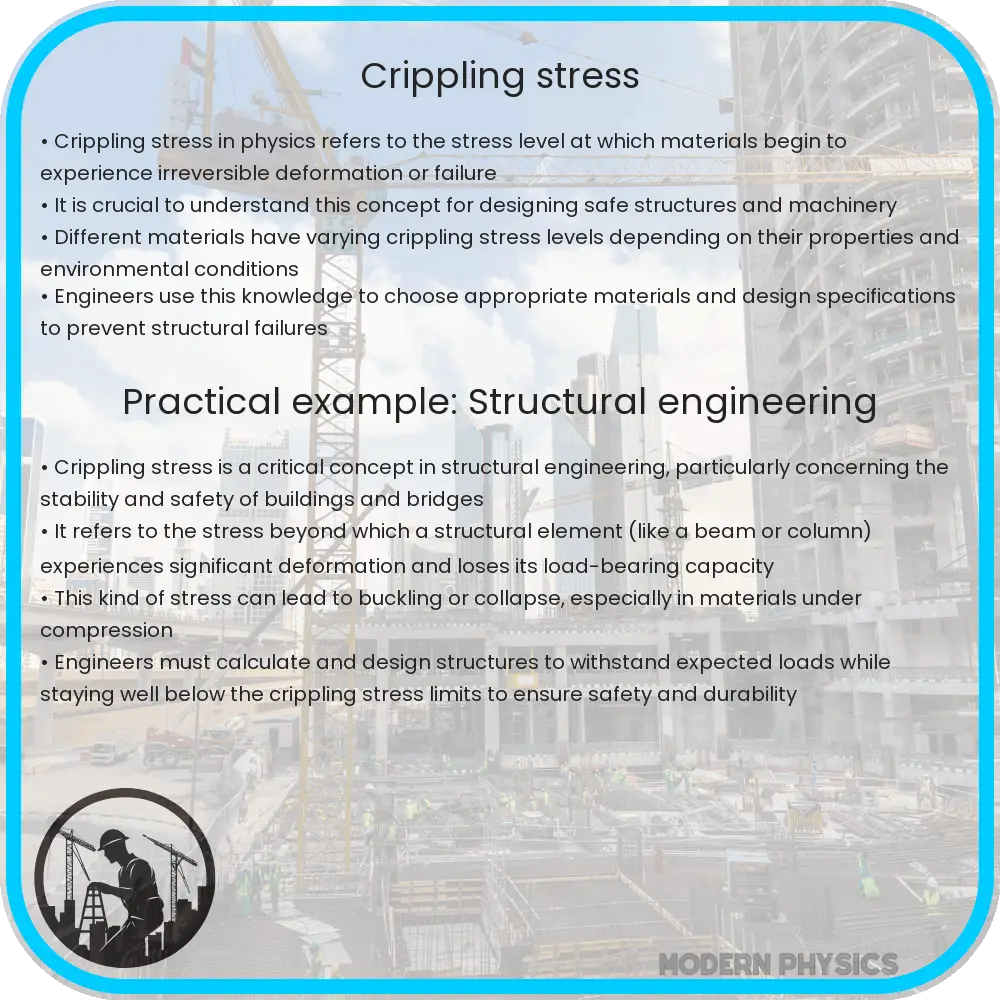
Crippling stress, a critical concept in the field of statics, refers to the point at which a material undergoes significant deformation, leading to a loss of load-carrying capacity. This phenomenon is particularly important in the design and analysis of structures where stability and durability are paramount. Understanding and managing crippling stress is not only about preventing structural failures but also about optimizing material use and ensuring safety.
The Nature of Crippling Stress
Crippling stress occurs when the applied stress exceeds the elastic limit of a material, leading to plastic deformation. This kind of stress is a concern in columns, beams, and other structural elements subjected to compression. The Euler’s buckling formula, given by:
\[ P_{cr} = \frac{\pi^2 EI}{(KL)^2} \]
where \( P_{cr} \) is the critical load, \( E \) is the modulus of elasticity, \( I \) is the moment of inertia, \( K \) is the column effective length factor, and \( L \) is the actual length of the column, helps in determining the buckling load, a critical factor in assessing crippling stress.
Overcoming Crippling Stress in Design
Effective management of crippling stress involves several strategies, starting from the design phase. Utilizing materials with higher elastic limits and designing structures to distribute loads evenly are key. Additionally, incorporating safety factors into design calculations provides a margin of safety against unexpected loads or material imperfections.
Applying Crippling Stress Concepts in Statics
In statics, the application of crippling stress concepts is vital for ensuring structural integrity. By understanding the properties of materials and the mechanics of structures, engineers can predict potential failure points and reinforce them accordingly. This application is not just limited to building construction but extends to designing machinery, vehicles, and even spacecraft.
Advanced analytical methods, such as finite element analysis (FEA), are used to simulate how structures behave under various load conditions. This allows for a more nuanced understanding of where and how crippling stress might occur, leading to more robust and efficient designs.
Advanced Techniques in Managing Crippling Stress
With advancements in material science and computational methods, the approach to managing crippling stress has evolved. Materials like composites and high-strength alloys offer higher resistance to deformation, allowing for more resilient designs. Additionally, the use of sophisticated simulation tools provides a detailed insight into stress distribution and potential failure modes in structures.
Case Studies in Statics: Learning from Real-world Scenarios
Studying real-world cases where crippling stress was either successfully managed or led to failure provides invaluable lessons. For instance, the analysis of bridge collapses or structural failures in buildings often reveals critical insights into how crippling stress can be better predicted and mitigated. These case studies serve as a practical guide for engineers and designers in applying theoretical knowledge to real-world situations.
The Role of Continuous Monitoring and Maintenance
Even with robust design and material selection, continuous monitoring and maintenance play a crucial role in managing crippling stress over the lifetime of a structure. Technologies like stress sensors and periodic structural health monitoring ensure that any signs of stress concentration or material degradation are identified and addressed promptly.
Education and Training: Empowering the Next Generation of Engineers
For future engineers and designers, comprehensive education and training in the principles of statics and material science are indispensable. Understanding the nuances of crippling stress and how to manage it is a fundamental part of their skill set. Continuous learning through professional development courses and staying abreast of the latest research are also crucial for those currently in the field.
Conclusion
Crippling stress, a phenomenon of paramount importance in the field of statics, demands a multi-faceted approach encompassing thoughtful design, material selection, advanced analysis, real-world case studies, and ongoing structure monitoring. As materials and technologies evolve, so too must the strategies for managing crippling stress. The key lies in a deep understanding of statics principles, combined with practical application and continuous innovation. Ultimately, the goal is to create structures that are not only efficient and economical but also safe and durable, standing the test of time and stress.