
Explore the concept of galactic habitability, factors affecting life potential in the universe, and research advancing our understanding of habitable zones in galaxies.
Introduction to Galactic Habitability
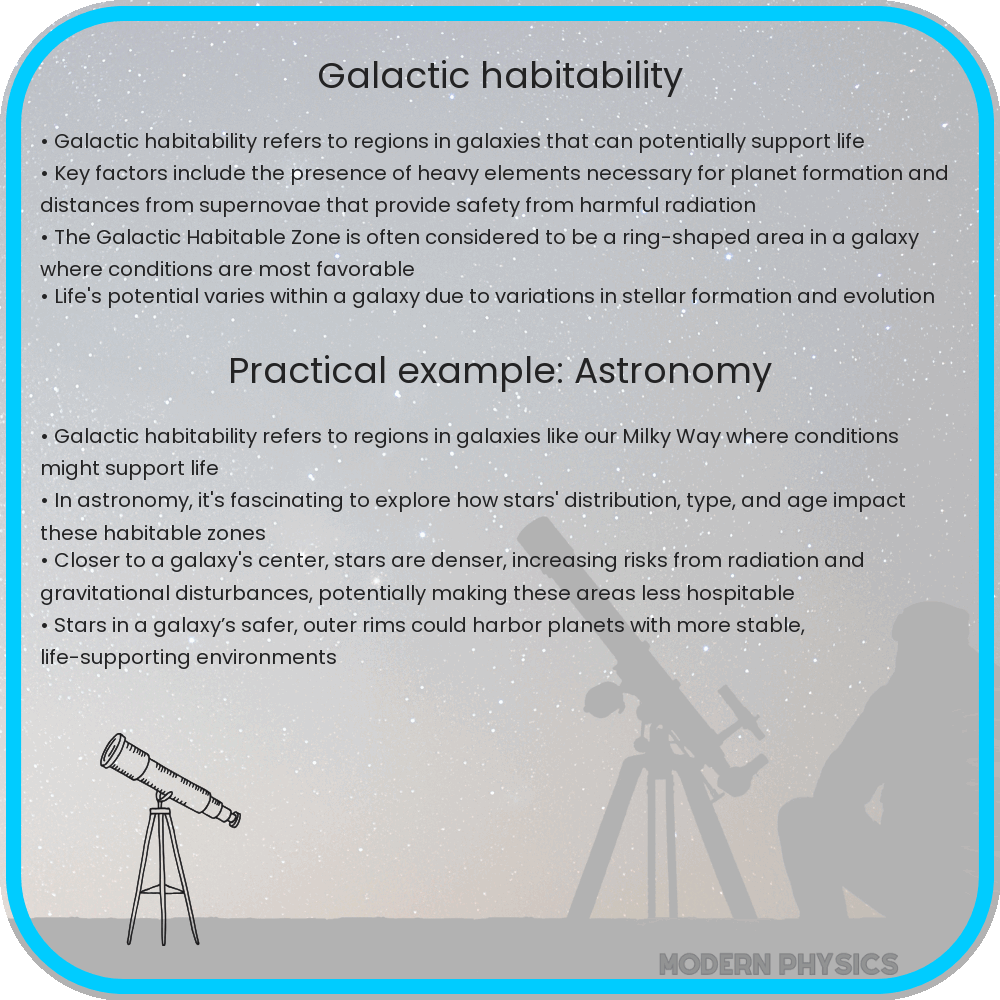
The concept of galactic habitability examines the conditions and regions within galaxies that are favorable for the emergence and sustainability of life. Unlike planetary habitability, which focuses on the suitability of specific worlds, galactic habitability encompasses a broader perspective, assessing how stellar and galactic environments influence the potential for life’s existence. This field intertwines astronomy, astrobiology, and environmental science to understand the cosmic prerequisites for life as we know it.
Factors Influencing Galactic Habitability
Several factors play crucial roles in determining the habitability of regions within a galaxy:
- Stellar Density: Areas with high stellar density, such as galaxy centers, often experience frequent supernovae and close stellar encounters, leading to harsh conditions for life.
- Metallicity: A higher concentration of elements heavier than hydrogen and helium, known as metals, is crucial for planet formation and the development of life-sustaining molecules.
- Radiation: The intensity and type of radiation from nearby stars and galactic cores can significantly impact the habitability of surrounding areas.
Galactic Habitable Zones
The Galactic Habitable Zone (GHZ) is a theoretical region in a galaxy where conditions are most likely to support life. It lies in a ring-like area avoiding the galactic center’s harsh radiation and gravitational disturbances while still containing enough metal-rich stars to form planetary systems. The exact location and width of the GHZ can vary depending on the galaxy’s size, type, and dynamics. However, it generally avoids the galactic bulge and extends outward, where star formation rates and heavy element abundances are conducive to life’s development.
Research and Exploration
Scientists use a combination of observational astronomy, computer modeling, and indirect detection methods to study the factors affecting galactic habitability. By examining the distribution of exoplanets, the chemical composition of distant stars, and the structure of galaxies, researchers aim to refine our understanding of where and how life might arise in the universe.
Challenges in Galactic Habitability Research
Despite significant advances, the study of galactic habitability faces numerous challenges. One major obstacle is the vast distances involved, which make direct observation of exoplanetary environments beyond our own solar system difficult. Additionally, the interplay between galactic-scale phenomena and planetary systems is complex and not yet fully understood. Factors such as dark matter distribution, galactic collisions, and the evolution of galaxies over cosmic time scales add layers of complexity to this field.
Implications for the Search for Extraterrestrial Life
The concept of galactic habitability extends the search for extraterrestrial life beyond our solar neighborhood. By identifying regions within the Milky Way and other galaxies that are more likely to host habitable environments, astronomers can prioritize these areas for future observations. The James Webb Space Telescope, along with other ground-based and space-based observatories, are expected to provide valuable data that will enhance our understanding of galactic habitability.
Future Directions
Future research in galactic habitability will likely focus on refining the criteria and models used to identify habitable zones within galaxies. This includes integrating more detailed chemical and physical data about stars, planetary systems, and interstellar environments. Additionally, as detection techniques improve, direct observations of exoplanets and their atmospheres may offer new insights into the conditions necessary for life and how these conditions are influenced by their galactic context.
Conclusion
Galactic habitability is a fascinating and complex field that expands our perspective on where life could potentially exist in the universe. It challenges us to think beyond our own solar system and consider the vast array of environmental conditions present in our galaxy and beyond. As our tools and understanding improve, the study of galactic habitability will continue to play a crucial role in our quest to answer one of humanity’s oldest questions: Are we alone in the universe? Through collaborative efforts in astronomy, astrobiology, and related disciplines, we may one day uncover the secrets of life’s distribution in the cosmos.