
Explore the world of optical tweezers, a revolutionary tool in biology and physics, offering insights into molecular and cellular mechanics.
Understanding Optical Tweezers: Revolutionizing Precision and Control in Biological Research
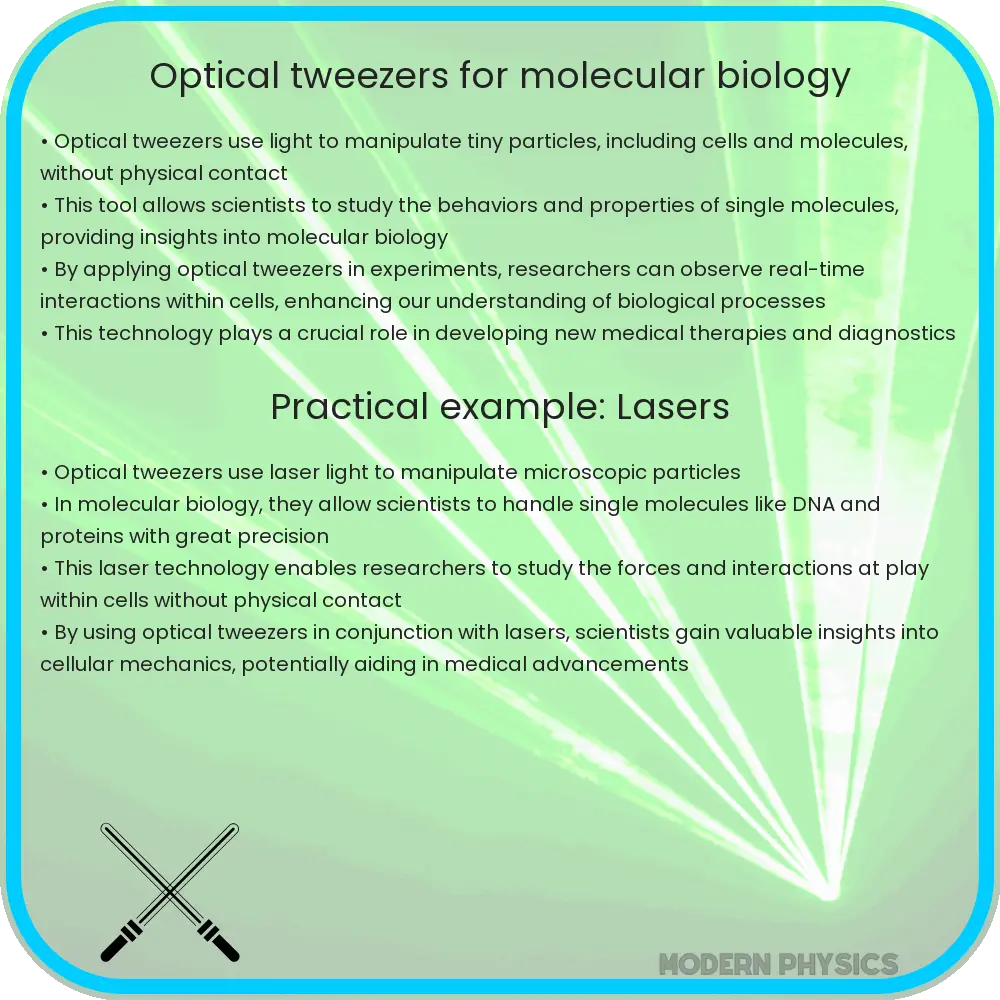
Optical tweezers have emerged as a groundbreaking tool in the realms of physics and biology, offering unprecedented precision and control at the microscopic level. This innovative technology utilizes a highly focused laser beam to trap and manipulate microscopic particles, including cells and molecules, with extraordinary delicacy and accuracy. The ability to manipulate objects as small as a single atom has not only deepened our understanding of the physical world but also opened new avenues in biological research.
Principles Behind Optical Tweezers
At the heart of optical tweezers lies the principle of radiation pressure, first proposed by Arthur Ashkin in the 1970s. When a laser beam is focused through a high-quality microscope objective, it creates a highly concentrated light field. Particles near this focused light are drawn towards the center of the beam, where the light intensity is greatest. This effect is akin to a microscopic ‘tractor beam’, capable of holding and moving particles in three dimensions without physical contact. The precision of this method is so refined that it can manipulate particles as small as a few nanometers to several micrometers in size.
Applications in Biological Insights
Optical tweezers have become an invaluable tool in the biological sciences. They are used to probe the mechanical properties of cells, manipulate chromosomes, and study the forces involved in cellular processes. One of the key advantages of optical tweezers is their non-invasive nature, allowing researchers to interact with living cells without causing significant damage. This has enabled real-time studies of cellular mechanisms, providing insights into the fundamental workings of life at the molecular level.
- Studying Molecular Motors: Optical tweezers have been instrumental in studying the behavior of molecular motors like kinesin and myosin. These studies have shed light on how these motors convert chemical energy into mechanical work, a fundamental process in biological systems.
- Measuring Cell Mechanics: The technique allows scientists to measure the elasticity and viscosity of cell membranes and cytoplasm, enhancing our understanding of cell mechanics and disease pathology.
The precision and control afforded by optical tweezers have thus opened up a new frontier in biological research, enabling scientists to explore the microscopic world like never before.
Advanced Techniques and Future Prospects
Recent advancements in optical tweezers technology have expanded its capabilities, leading to more sophisticated experiments and deeper biological insights. Scientists are now combining optical tweezers with other techniques like fluorescence microscopy and Raman spectroscopy, offering a multi-dimensional view of cellular processes. This integration allows for simultaneous manipulation, visualization, and analysis of biological samples, paving the way for groundbreaking discoveries in cell biology and biophysics.
Challenges and Limitations
Despite their versatility, optical tweezers face certain limitations. The intensity of the laser beam can potentially damage delicate biological samples, necessitating careful control of laser power. Additionally, the technique requires transparent media, limiting its use with opaque or highly scattering materials. Researchers continue to work on overcoming these challenges, enhancing the tool’s applicability in a broader range of scientific inquiries.
Conclusion
In conclusion, optical tweezers represent a significant milestone in the intersection of physics and biology. Their ability to manipulate individual molecules and cells with unmatched precision has provided profound insights into the mechanics of life at the molecular level. The integration of optical tweezers with other analytical techniques is set to propel biological research into new realms, offering the potential to unravel complex biological mysteries. As technology continues to evolve, we can anticipate even greater advancements, further cementing the role of optical tweezers as a cornerstone tool in scientific research. The future of optical tweezers is not only bright but promises to be a key driver in our quest for deeper understanding and control over the fundamental processes of life.