
Explore how Fourier Optics revolutionizes image processing, enhancing clarity, precision, and speed across various fields, from medical imaging to remote sensing.
The Role of Fourier Optics in Enhancing Image Processing
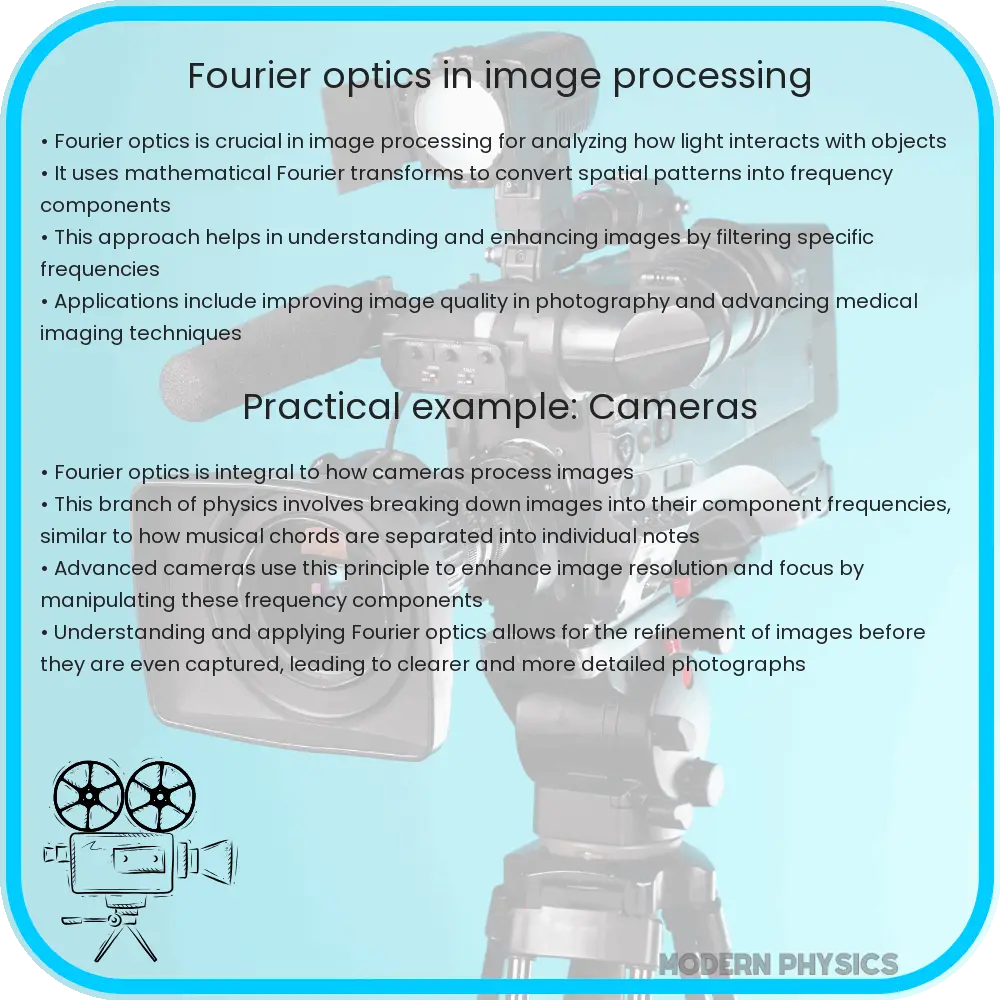
Fourier Optics, a branch of optical physics, plays a pivotal role in the field of image processing by offering tools that enhance clarity, precision, and processing speed. This technique leverages mathematical principles to transform spatial domain images into the frequency domain, providing a unique perspective for analyzing and manipulating images in ways that are often more efficient and revealing than traditional methods.
Understanding Fourier Optics
At its core, Fourier Optics is based on the Fourier Transform, a mathematical operation that decomposes an image into its sine and cosine components. This transformation allows scientists and engineers to examine the frequency characteristics of an image, which can be critical for various applications such as noise reduction, image sharpening, and pattern recognition.
Applications in Image Clarity and Precision
One of the primary applications of Fourier Optics in image processing is enhancing image clarity and precision. By manipulating the frequency domain representation of an image, it’s possible to filter out noise or unwanted information, enhance specific details, and correct aberrations that may blur an image. This is particularly useful in fields such as microscopy, where the ability to distinguish fine details can be crucial for accurate analysis.
Speeding Up Image Processing
Fourier Optics also significantly contributes to increasing the speed of image processing. Traditional spatial domain operations can be computationally intensive, especially for high-resolution images. By converting images into the frequency domain, many operations can be performed more efficiently, leading to faster processing times without sacrificing quality. This is especially beneficial in real-time applications, such as in medical imaging or satellite imagery analysis, where quick decision-making is essential.
In conclusion, Fourier Optics offers a powerful set of tools for improving the clarity, precision, and speed of image processing. Its ability to transform and manipulate images in the frequency domain opens up new possibilities for analysis and enhancement that are invaluable in many technological and scientific fields.
Advancements in Fourier Optics for Image Processing
Recent advancements in Fourier Optics have led to the development of more sophisticated algorithms and techniques that further enhance its application in image processing. Innovations such as phase retrieval algorithms and holography have expanded the capabilities of Fourier Optics, enabling the reconstruction of phase information from intensity patterns and the creation of three-dimensional images, respectively. These advancements have not only improved the accuracy of image analysis but have also opened up new avenues in non-invasive imaging techniques.
Integration with Digital Technologies
The integration of Fourier Optics with digital technologies has revolutionized the way images are processed and analyzed. Digital Fourier Transform (DFT) algorithms, implemented on high-speed computers, have made it possible to perform complex transformations and image manipulations in milliseconds. This synergy between optical physics and digital technology has enhanced the efficiency and effectiveness of image processing applications, paving the way for automated systems capable of performing advanced image analysis in real-time.
Challenges and Future Directions
Despite its significant contributions, the application of Fourier Optics in image processing faces challenges, particularly in handling large datasets and in the real-time processing of complex images. Ongoing research is focused on optimizing algorithms for greater efficiency and developing hardware capable of supporting the computational demands of Fourier-based image processing. Furthermore, the exploration of quantum Fourier Optics presents an exciting frontier, promising even faster processing speeds and enhanced imaging capabilities through the principles of quantum mechanics.
Conclusion
Fourier Optics has fundamentally transformed the landscape of image processing, offering unparalleled clarity, precision, and speed. Its applications span across various fields, from medical imaging to remote sensing, demonstrating its versatility and importance. As digital technology continues to advance, the integration of Fourier Optics with computational algorithms will undoubtedly lead to even more innovative solutions. The future of image processing, powered by Fourier Optics, holds the promise of overcoming current limitations and unlocking new potentials in imaging technology. As we continue to explore and innovate, the contributions of Fourier Optics to image processing will remain a cornerstone in the quest for clearer, more precise, and faster image analysis.