
Explore the accuracy, portability, and usage of Field Mills for electric field measurement, crucial in scientific and industrial applications.
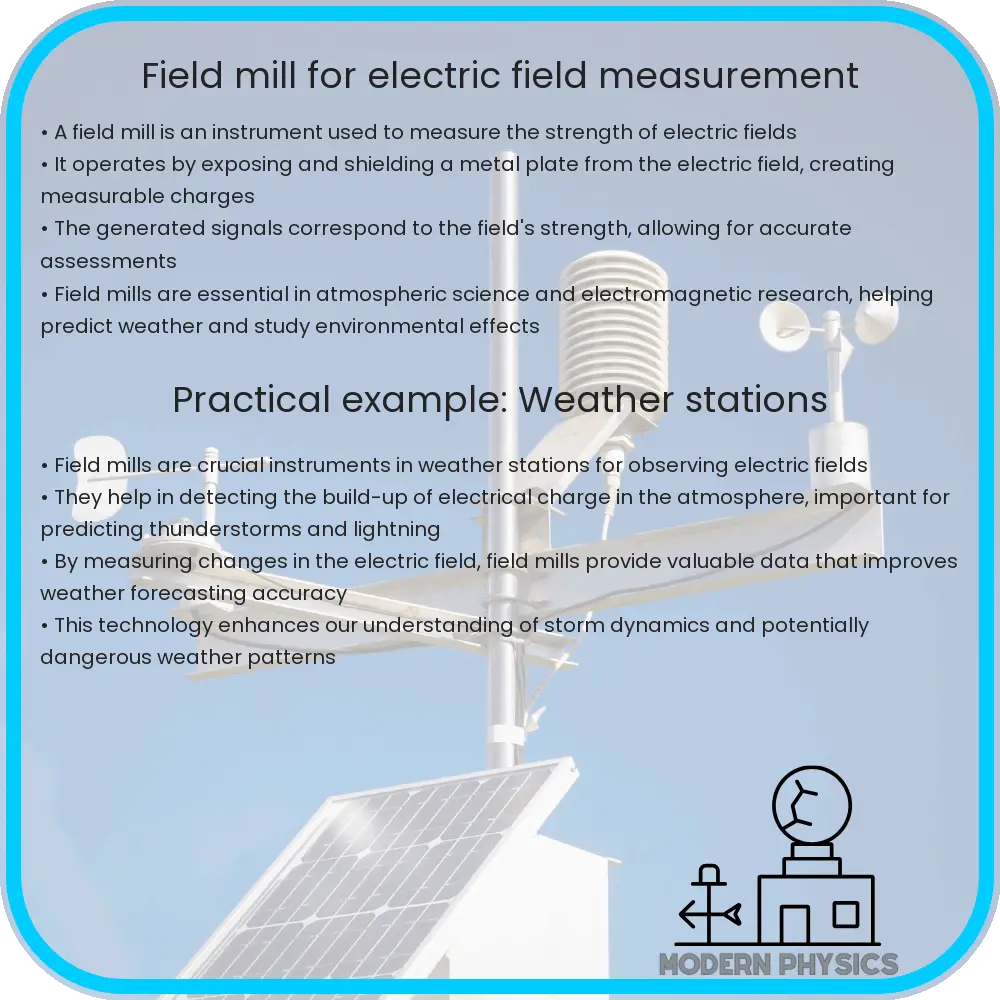
Understanding Field Mills for Electric Field Measurement
Electric fields are a fundamental aspect of electromagnetism, playing a crucial role in various scientific and engineering applications. The Field Mill is an essential tool for accurate measurement of electric fields. Its design allows for both laboratory precision and field portability, making it a versatile instrument in numerous contexts.
Accuracy of Field Mills
Field Mills are renowned for their accuracy in measuring electric fields. They operate on the principle of rotating a conductor within an electric field. The rotation modulates the electric field, enabling the instrument to measure the field’s strength with minimal interference from ambient conditions. This method ensures precise readings, crucial for applications such as atmospheric studies, electromagnetic compatibility testing, and safety assessments around power lines.
Portability and Usage
One of the significant advantages of Field Mills is their portability. Unlike some other electric field measurement instruments, Field Mills are designed to be compact and easily transportable. This feature is particularly beneficial for field studies where measurements need to be taken in various locations, such as in meteorological research or during environmental surveys.
Field Mills are also relatively simple to use. They typically come with user-friendly interfaces and do not require extensive training to operate. This ease of use, combined with their portability, makes them an ideal choice for a wide range of users, from professional scientists to students and amateur enthusiasts.
Applications of Field Mills
The application of Field Mills spans across diverse fields. In meteorology, they are used to study thunderstorm and lightning phenomena by measuring the electric fields within storm clouds. In the aerospace industry, Field Mills help in assessing the electromagnetic environment to ensure the safety and functionality of aircraft and spacecraft. They are also employed in industrial settings to monitor the static electric fields that can affect sensitive electronic components.
Additionally, Field Mills play a crucial role in environmental monitoring. They help in assessing the impact of electric fields generated by power lines, mobile towers, and other infrastructures on the surrounding environment and living organisms.
Overall, Field Mills are indispensable tools in the realm of electric field measurement. Their accuracy, portability, and ease of use make them a top choice for professionals and amateurs alike.
Advanced Features and Innovations in Field Mills
Recent advancements in Field Mill technology have introduced features that enhance their functionality and accuracy. Modern Field Mills now often incorporate digital data processing, which allows for real-time analysis and more precise measurements. Additionally, improvements in materials and design have led to more durable and weather-resistant models, further extending their applicability in harsh field conditions.
Another notable innovation is the integration of wireless technology. This feature enables remote data collection and monitoring, a significant advantage in areas that are difficult or dangerous to access, such as high-altitude locations or near high voltage power lines.
Considerations for Choosing a Field Mill
When selecting a Field Mill, several factors should be considered to ensure it meets specific needs. The sensitivity and range of the instrument are paramount, particularly in applications requiring detection of weak electric fields. The environmental conditions in which the Field Mill will be used also dictate the choice; for example, waterproof and rugged designs are essential for outdoor use. Furthermore, the user interface and data output formats should be compatible with the user’s data collection and analysis systems.
Challenges and Limitations
Despite their advantages, Field Mills do face certain challenges and limitations. One of the primary concerns is the potential for electromagnetic interference (EMI), which can affect readings. Users must be aware of the surrounding environment and potential sources of interference when deploying Field Mills. Additionally, while they are designed for portability, some models may still be relatively bulky or heavy, which could pose challenges in extremely remote or inaccessible locations.
Conclusion
The Field Mill stands as a pivotal tool in the measurement of electric fields. Its blend of accuracy, portability, and user-friendliness makes it an invaluable instrument in a wide array of scientific and industrial applications. From meteorological research to environmental monitoring and electromagnetic compatibility testing, Field Mills offer a reliable and efficient means of measuring electric fields. The ongoing technological advancements in this area promise even greater capabilities, ensuring that Field Mills will remain at the forefront of electric field measurement technologies. For researchers, engineers, and environmentalists, the Field Mill is an indispensable tool, providing insights and data critical to understanding and navigating the complex world of electromagnetism.