
Learn about atmospheric electric field mills, devices measuring electric field strength and direction in the atmosphere to aid weather forecasting.
Understanding Atmospheric Electric Field Mills
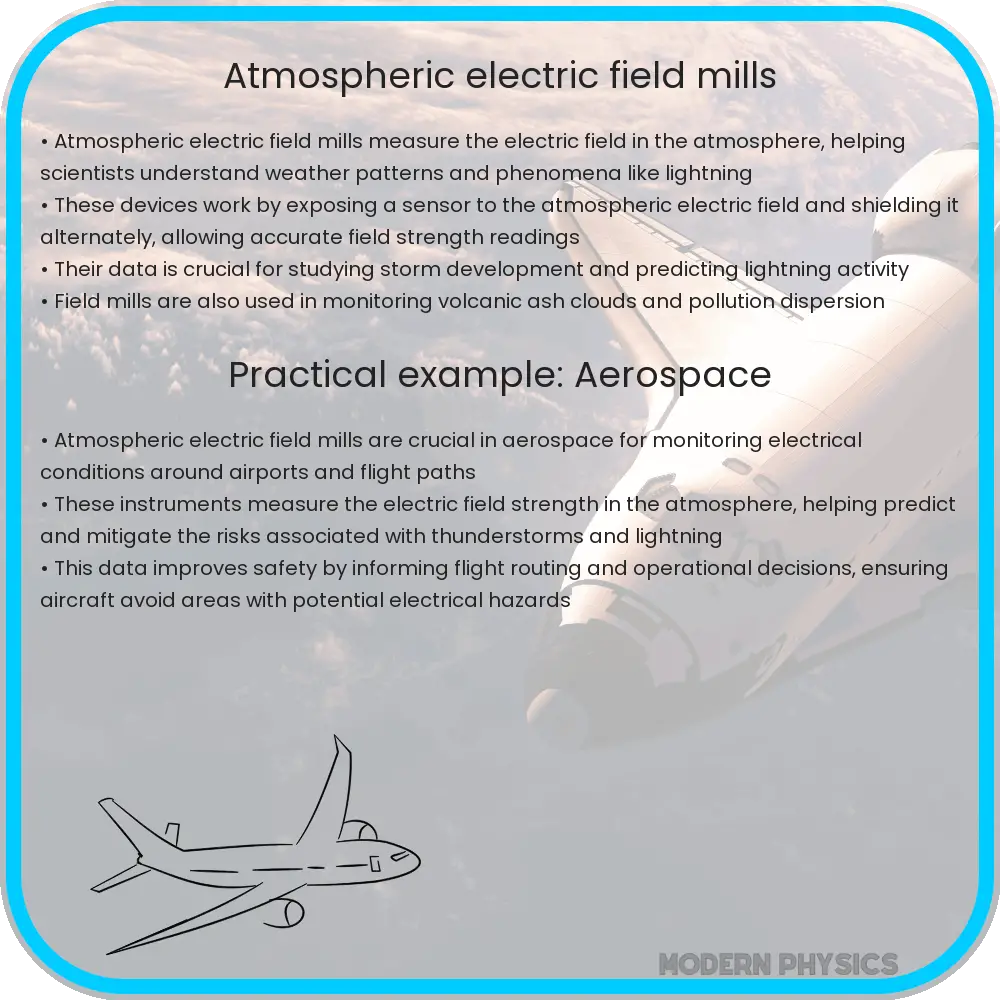
Atmospheric electric fields play a crucial role in the dynamics of the Earth’s weather systems and can give insights into various atmospheric processes. An atmospheric electric field mill is an instrumental device designed to measure the strength and direction of an electric field in the atmosphere at a particular point. This article explores how these devices work, their precision, and their significance in weather analysis and forecasting.
How Atmospheric Electric Field Mills Work
An electric field mill typically consists of a rotating chopper and a stationary electrode. The rotating chopper modulates the electric field, allowing the device to measure changes in the field’s strength and direction over time. The fundamental principle involves the disruption of an electric field by the chopper, which induces a charge on the stationary electrode. By measuring this charge, the field mill can infer the electric field’s characteristics.
Precision and Calibration
The precision of an electric field mill is paramount for accurate measurements. These devices must be calibrated carefully to avoid errors due to environmental factors such as temperature, humidity, and pressure. Calibration involves setting the field mill in a known electric field and adjusting the response to match the known value. The precision is often determined by the sensitivity of the electrode and the stability of the electronic system that processes the signal.
Using Field Mills in Weather Analysis
Atmospheric electric fields are influenced by ionospheric disturbances, solar activity, and tropospheric weather conditions. By analyzing the data gathered by field mills, meteorologists can improve their understanding of storm formation and development. Electric field mills can detect changes in the field strength that precede lightning flashes, providing valuable information for forecasting severe weather events.
- Storm Prediction: Sudden changes in electric field strength can indicate the potential for severe weather, including thunderstorms and tornadoes.
- Air Quality Monitoring: Changes in atmospheric electricity can also reflect variations in air pollution levels, influencing air quality assessments.
Forecasting and Future Prospects
With technological advancements, the use of atmospheric electric field mills in forecasting is becoming more sophisticated. Integration with other meteorological data, such as radar and satellite imagery, enhances the predictive capabilities of weather models. Future developments in sensor technology and data analysis methods are expected to improve the accuracy and responsiveness of atmospheric electric field measurements.
Researchers are also exploring the potential of field mills in long-term climate studies and their relationship with global electric circuits. This could help in understanding broader climatic patterns and their implications on weather and climate systems.
The application of atmospheric electric field mills is a compelling example of how precise instrumentation and analysis can aid in the detailed understanding and prediction of weather patterns, potentially leading to better preparedness and response strategies to natural phenomena.
Challenges and Limitations
Despite the utility of atmospheric electric field mills, they face several challenges and limitations. One significant challenge is the interference from local sources of electromagnetic noise, such as power lines and electronic devices, which can affect the accuracy of readings. Additionally, field mills are sensitive to physical obstructions and must be placed in open areas to avoid structural interferences that could skew the data.
Maintenance and operational costs also pose constraints, especially in remote or extreme weather conditions where field mills are often most needed. The complexity of the data produced by these instruments requires specialized knowledge to interpret accurately, which can limit their use to areas with access to skilled meteorologists and analysts.
Educational and Community Impact
Atmospheric electric field mills not only serve scientific and practical purposes but also have educational and community impacts. These instruments provide tangible data that can be used in educational programs to teach students about atmospheric science and electrical phenomena. By involving communities in monitoring projects, people can become more aware of their local weather conditions and contribute to citizen science initiatives.
Furthermore, public access to data from electric field mills can help increase community preparedness for weather-related emergencies, fostering a proactive approach to disaster management. This engagement helps demystify science, making it more accessible and interesting to the public.
Conclusion
Atmospheric electric field mills represent a critical tool in the arsenal of meteorological instrumentation. By providing precise and real-time data on electric fields, these devices help meteorologists forecast severe weather events with greater accuracy and offer insights into atmospheric dynamics that were previously less understood. While there are challenges in their use, the benefits they provide in improving weather predictions and understanding atmospheric phenomena are invaluable.
As technology progresses and our understanding deepens, the potential for these tools in both practical weather forecasting and broader scientific research is likely to expand. Whether it’s improving the accuracy of storm prediction, monitoring air quality, or contributing to long-term climate studies, atmospheric electric field mills are poised to play an increasingly important role in our ongoing exploration of Earth’s complex and dynamic atmosphere.