
Discover how the F-Number in lens design affects aperture, clarity, and light control to enhance photography. Learn to master depth of field and lighting.
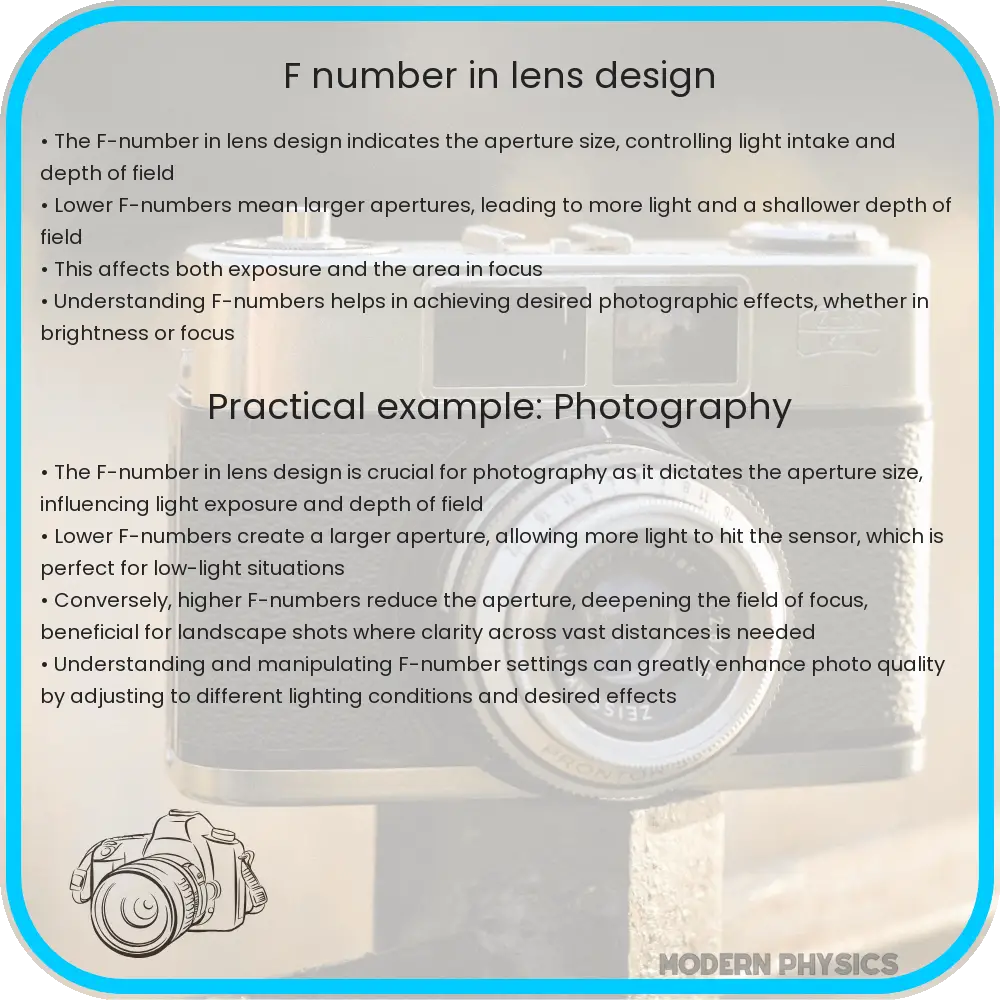
Understanding F-Number in Lens Design
The F-Number, often symbolized as f/N or simply N, plays a pivotal role in photography and optics, defining the aperture size of a lens. This crucial parameter not only influences the amount of light entering the lens but also impacts the clarity and depth of field in the images captured. By mastering the intricacies of the F-Number, photographers and optics enthusiasts can significantly enhance their control over lighting and image quality.
The Essence of F-Number
At its core, the F-Number is a ratio: the focal length of the lens divided by the diameter of the entrance pupil (the aperture). Mathematically, it’s expressed as N = f/D, where f is the focal length and D is the aperture diameter. This ratio is instrumental in determining the lens’s light-gathering ability and depth of field, making it a fundamental aspect of lens design and photography.
Aperture: The Gateway to Light Control
The aperture of a lens is akin to the iris of an eye, adjusting to control the amount of light that passes through. A lower F-Number (e.g., f/1.8) signifies a larger aperture, allowing more light to enter, which is ideal for low-light conditions. Conversely, a higher F-Number (e.g., f/16) indicates a smaller aperture, reducing the light intake, which is beneficial for achieving a greater depth of field in brightly lit environments.
Clarity and Depth of Field
The F-Number directly affects the depth of field, which is the extent of the scene in focus. A lower F-Number results in a shallow depth of field, beautifully isolating the subject from the background by blurring the latter. This effect is particularly sought after in portrait photography. On the other hand, a higher F-Number increases the depth of field, bringing both the foreground and background into sharp focus, which is ideal for landscape photography.
Conclusion
Understanding and manipulating the F-Number is essential for controlling light and achieving desired clarity in photographs. By adjusting the aperture size, photographers can master the balance between light intake and depth of field, thereby enhancing the artistic and technical quality of their images. The next section will delve deeper into the impact of F-Number on image quality and how it influences lens design.
Impact of F-Number on Image Quality and Lens Design
The selection of an F-Number is a critical decision in photography that influences not just exposure but also the overall image quality. A lower F-Number, while allowing more light to hit the sensor, can also introduce lens aberrations such as spherical aberration and chromatic aberration, which can slightly degrade image sharpness at wide apertures. Conversely, using a very high F-Number can lead to diffraction, a phenomenon where light waves interfere with each other as they pass through a small aperture, reducing the image’s overall sharpness.
Choosing the Right F-Number
Choosing the optimal F-Number for a given photographic situation involves balancing light capture, desired depth of field, and potential aberrations. Photographers often employ the “sweet spot” of a lens, usually two to three stops down from the widest aperture, where the lens achieves its best performance in terms of sharpness and minimal aberrations. This sweet spot varies between lenses but is a crucial concept in achieving high-quality images.
Lens Design Considerations
Lens manufacturers face significant challenges in designing lenses that maintain high optical performance across a range of F-Numbers. Advanced optical designs and materials, such as low dispersion glass and aspherical elements, are employed to minimize aberrations. The design and engineering of a lens involve intricate trade-offs between size, weight, maximum aperture, and cost, with the goal of offering photographers a tool that meets their needs under various shooting conditions.
Conclusion
The F-Number is a fundamental concept in lens design and photography, serving as a crucial bridge between artistic vision and technical execution. By understanding and judiciously selecting F-Numbers, photographers can exert precise control over light, depth of field, and image quality. The ability to manipulate the F-Number allows for creative freedom while understanding its implications on lens design helps photographers make informed choices about their equipment. As technology advances, the quest for lenses that offer greater versatility and superior image quality at various F-Numbers continues, pushing the boundaries of photography and optical science.
In essence, the F-Number is not just a technical specification; it is a gateway to artistic expression. Whether it’s capturing the delicate blur of a portrait background or the crisp detail of a sweeping landscape, mastering the F-Number empowers photographers to bring their vision to life with clarity and precision.