
Explore how aperture and field stop impact optical system performance, enhancing image clarity, depth, and control in photography and astronomy.
Understanding Aperture and Field Stop in Optical Systems
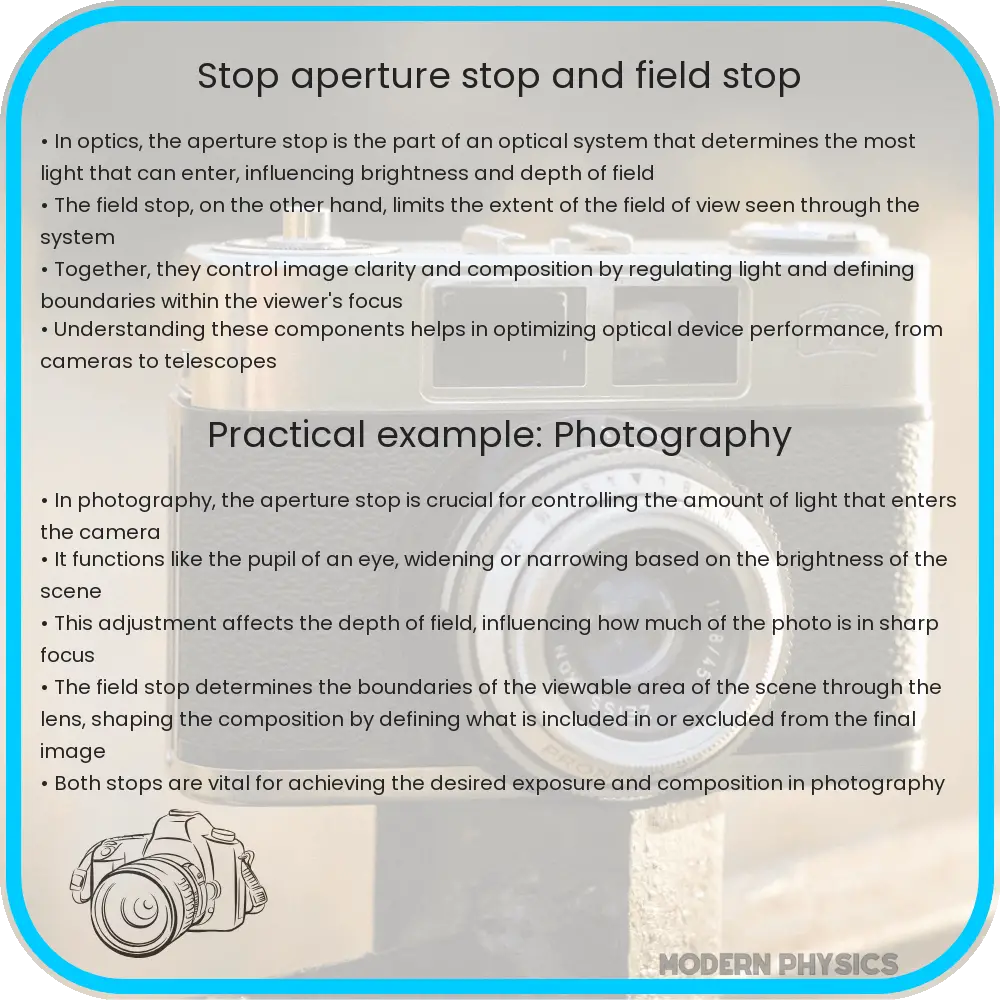
Aperture and field stop play critical roles in the design and function of optical systems, influencing precision, clarity, and control of the images produced. These components are essential in cameras, microscopes, telescopes, and other devices relying on optical principles to focus and control light. Understanding their functions and interactions is key to optimizing the performance of optical instruments.
The Role of Aperture in Optics
The aperture of an optical system refers to the opening that allows light to enter. It is usually equipped with a diaphragm that can be adjusted to control the amount of light passing through. The size of the aperture directly impacts the depth of field, brightness, and overall image quality. A larger aperture allows more light to enter, which is beneficial in low-light conditions but can reduce the depth of field, making it challenging to keep objects in both the foreground and background sharply focused. Conversely, a smaller aperture increases the depth of field but requires more light to achieve the same exposure.
Field Stop Functionality
The field stop, often less discussed, is equally critical in optical systems. It determines the field of view, which is the extent of the observable world visible through the lens at any given moment. Located at the image plane, the field stop works by blocking out extraneous light and only allowing light from the desired field of view to pass through. This control over the field of view not only enhances image quality by reducing flare and ghosting but also contributes to the precision of the instrument by delineating a clear boundary for the image.
Interplay Between Aperture and Field Stop
The relationship between aperture and field stop is a delicate balance that affects the final image’s clarity and detail. Adjusting the aperture size impacts the amount of light and the depth of field, which in turn can require adjustments to the field stop to maintain the desired field of view and image quality. This interplay is crucial for photographers, astronomers, and scientists who rely on precise optical instruments to capture detailed images under varying light conditions.
Understanding the roles and mechanisms of the aperture and field stop is fundamental for optimizing optical system performance. Through careful adjustment and calibration, users can achieve the desired balance of light, depth, and field of view, leading to images of remarkable clarity and detail.
Optimizing Optical Performance
To maximize the potential of any optical system, mastering the control of both aperture and field stop is essential. In photography, for example, selecting the appropriate aperture size is crucial for achieving the desired depth of field and exposure. Similarly, in telescopic observations, the precise adjustment of the field stop can significantly enhance the clarity of celestial bodies by limiting the field of view to exclude unwanted light sources.
Advanced optical systems often incorporate sophisticated mechanisms for adjusting the aperture and field stop, allowing for precise control over the image characteristics. For instance, variable apertures enable photographers to quickly adapt to changing light conditions, while adjustable field stops can refine the observer’s focus in microscopy, enhancing the visibility of fine details.
Practical Applications and Considerations
In practical applications, the choice between a wide aperture and a narrow one often depends on the specific requirements of the task at hand. A wide aperture is preferred for low-light photography or when a shallow depth of field is desired to highlight a subject against a blurred background. In contrast, narrow apertures are chosen to maximize the depth of field in landscape photography or when capturing images with multiple layers of focus.
Similarly, the adjustment of the field stop is crucial in applications requiring high precision, such as scientific research and detailed astrophotography. By precisely controlling the field of view, researchers can isolate and examine specific phenomena without interference from surrounding light.
Conclusion
The interplay between aperture and field stop is a foundational aspect of optical design that affects precision, clarity, and control in imaging systems. By understanding and manipulating these elements, users can significantly influence the quality of the images produced, tailoring them to specific needs and conditions. Whether in photography, astronomy, microscopy, or any field that relies on optical instruments, the careful adjustment of the aperture and field stop enables the capture of images with the desired depth of field, brightness, and clarity. As technology advances, the ability to control these aspects with greater precision will continue to expand the horizons of what can be achieved through optics, further blurring the lines between art and science.