
Explore the mysteries of galaxy formation and evolution, the role of dark matter, and the models used in astrophysics to understand the universe’s vast complexities.
Galaxy Formation: Unraveling the Mysteries
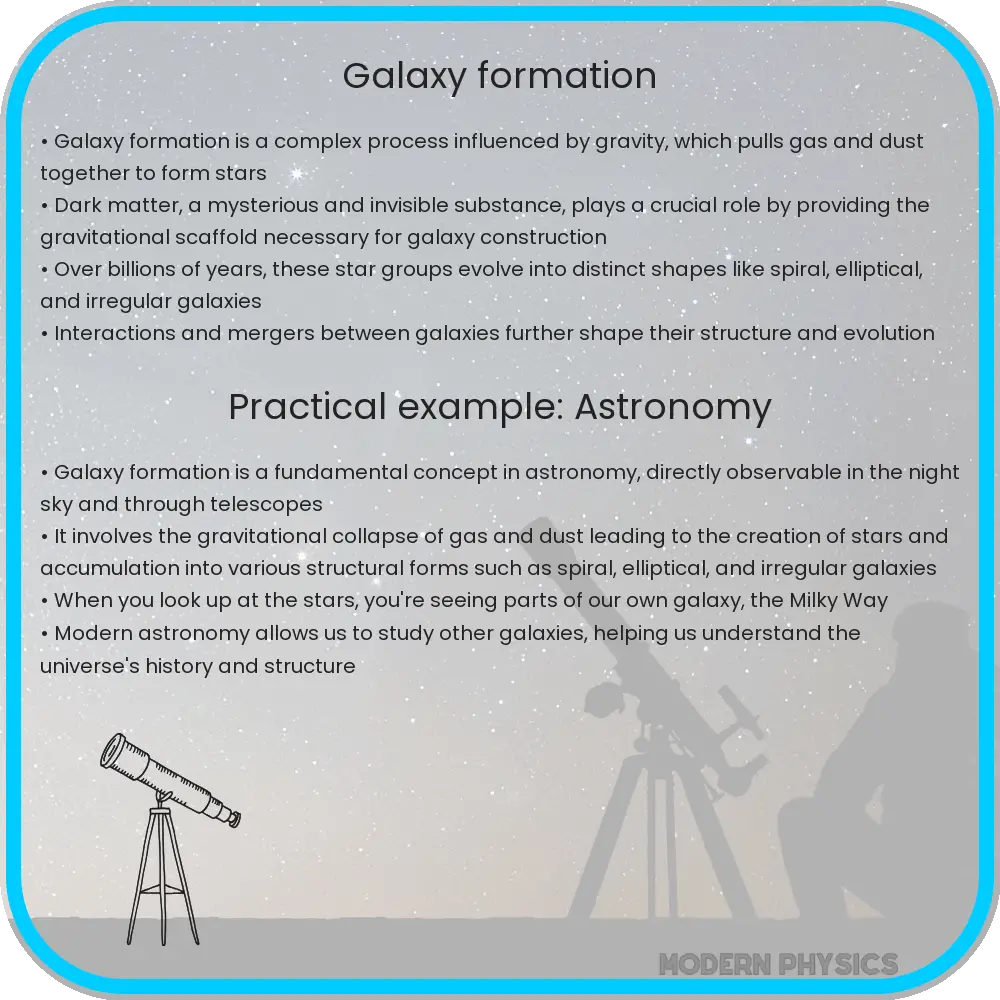
The cosmos is a vast, intricate tapestry woven with galaxies of all sizes and shapes. Understanding the formation and evolution of these celestial structures is a fundamental objective in astrophysics. Despite significant advancements, the process of galaxy formation remains one of the universe’s greatest mysteries, challenging our perceptions and pushing the boundaries of modern science.
The Evolution of Galaxies
Galaxies are not static entities; they undergo dramatic changes over billions of years. This evolutionary process is influenced by various factors, including the initial mass of the galaxy, its environment, and the presence of dark matter. The life cycle of a galaxy can be likened to that of a living organism, experiencing phases of birth, growth, and sometimes, mergers with other galaxies, which can significantly alter its structure and star formation rate.
Models in Astrophysics
Astrophysicists employ a range of models to simulate and understand galaxy formation. These models can be broadly categorized into two groups: semi-analytical models and hydrodynamical simulations. Semi-analytical models provide a faster, albeit less detailed, approach to understanding the basic principles governing galaxy formation. In contrast, hydrodynamical simulations offer a more comprehensive, albeit computationally intensive, picture, incorporating the laws of physics to simulate the interplay between gas, stars, and dark matter.
The Role of Dark Matter
Dark matter plays a pivotal role in galaxy formation. Although invisible and not directly observable, its gravitational effects are undeniable. Dark matter halos are thought to be the scaffolds on which galaxies are built. According to the cold dark matter model, small structures form first and merge to create larger structures, including galaxies and galaxy clusters. Understanding the nature of dark matter is crucial to unraveling the mysteries of galaxy formation and evolution.
Mysteries in Galaxy Formation
Despite the advancements in observational technology and theoretical modeling, numerous mysteries still pervade the field of galaxy formation. One significant enigma is the discrepancy between the predicted and observed number of small, satellite galaxies around larger galaxies like the Milky Way. This issue, known as the “missing satellite” problem, challenges our understanding of dark matter and galaxy formation. Additionally, the role of black holes in galaxy centers, particularly how they affect galaxy formation and evolution, remains a contentious and fascinating topic.
Observational Evidence and Future Missions
The study of galaxy formation is bolstered by observational evidence collected from telescopes and space missions. The Hubble Space Telescope has provided invaluable data, enabling the study of galaxies at various stages of evolution. Upcoming missions, like the James Webb Space Telescope, are expected to delve even deeper into the universe’s history, providing clearer insights into the early stages of galaxy formation and the role of dark energy and dark matter in shaping the cosmos.
Interdisciplinary Approaches
The quest to understand galaxy formation extends beyond traditional astrophysics, encompassing areas such as particle physics, cosmology, and computational science. The interdisciplinary approach is crucial for developing a comprehensive understanding of how galaxies form and evolve. By combining observations, theory, and simulations, scientists are piecing together the complex puzzle of the universe’s structure and history.
Conclusion
The study of galaxy formation and evolution is a cornerstone of modern astrophysics and cosmology. It challenges our understanding of the universe, from the smallest scales of particle physics to the vast expanses of intergalactic space. While significant progress has been made, the mysteries that remain serve not as roadblocks but as beacons, guiding the scientific community toward deeper understanding and new discoveries. As we stand on the brink of a new era of astronomical observations, the future of galaxy research promises to not only illuminate the past but also to redefine our place within the cosmos.