
Explore the fascinating world of exoplanets: their discovery, analysis, and the mysteries they hold in astrophysics. Learn about methods, challenges, and future prospects.
Introduction to Extrasolar Planets
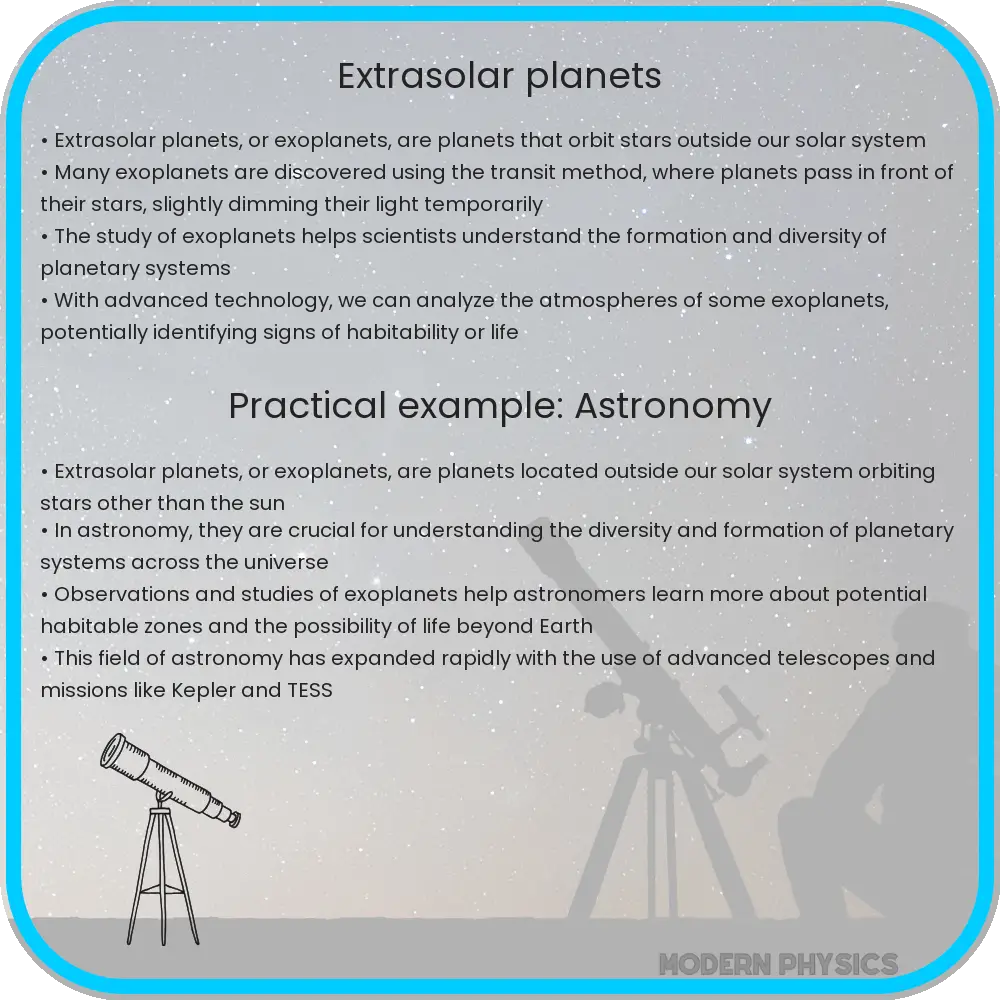
Extrasolar planets, also known as exoplanets, are planets that orbit stars outside our solar system. The first confirmation of an exoplanet orbiting a sun-like star occurred in 1995, marking a monumental breakthrough in astrophysics. Since then, the field of exoplanetary science has expanded rapidly, thanks to advancements in telescope technology and detection methods. These celestial bodies range from gas giants many times the size of Jupiter to rocky planets smaller than Earth, offering a diverse array of environments for study.
Methods of Discovery
Exoplanet detection relies on several sophisticated techniques. The Transit Method, one of the most productive means, observes the dimming of a star’s light as a planet passes in front of it. Another popular technique, the Radial Velocity Method, measures the star’s slight wobble due to the gravitational pull of an orbiting planet. Other methods include Direct Imaging, Astrometry, and Gravitational Microlensing, each contributing uniquely to the expanding catalog of known exoplanets.
Analysis and Classification
Exoplanets are often analyzed by their mass, size, orbit, and atmospheric composition. Classification into groups such as ‘Earth-like’ (rocky) or ‘gas giants’ helps scientists determine their potential for habitability and other geological or meteorological characteristics. The study of their atmospheres, through techniques like spectroscopy, allows scientists to detect the presence of gases like water vapor (H2O), methane (CH4), and carbon dioxide (CO2), which are critical for understanding their potential to support life.
Mysteries and Challenges
The study of exoplanets is filled with mysteries and challenges. For instance, the nature of ‘Hot Jupiters’, giant gas planets orbiting very close to their stars, contradicts initial theories of planetary formation. Similarly, ‘Super-Earths’, planets with masses higher than Earth but lower than Neptune, present a range of compositions and densities that puzzle scientists. The vast distances and faint signals associated with these planets also pose significant challenges for detection and analysis.
Future Prospects in Exoplanetary Science
The future of exoplanetary science holds promising advancements, with next-generation telescopes and missions poised to revolutionize our understanding. The James Webb Space Telescope (JWST), with its unprecedented resolution and sensitivity, aims to probe the atmospheres of exoplanets in detail, offering insights into their climatic conditions and potential for harboring life. Ground-based telescopes, equipped with advanced adaptive optics, will complement space-based observations, providing finer details about exoplanet surfaces and weather patterns.
Interdisciplinary Approaches and Technological Innovations
Interdisciplinary approaches, combining astrophysics, chemistry, geology, and biology, are crucial for unraveling the complexities of exoplanets. The development of new technologies, such as more sensitive spectrometers and specialized starshade spacecraft, will enable the direct imaging of Earth-like exoplanets, allowing scientists to study their surfaces and possibly detect signs of life, such as the spectral fingerprints of biological molecules.
The Importance of Public Interest and Collaboration
Public interest and international collaboration play vital roles in the advancement of exoplanetary science. Crowdsourcing projects and citizen science initiatives engage the public in the discovery process, contributing to the detection of new worlds. Collaborative efforts among countries and institutions foster the sharing of data and resources, accelerating scientific breakthroughs and enhancing our collective understanding of the universe.
Conclusion
The quest to discover and understand exoplanets is one of the most exciting and dynamic fields in modern astrophysics. From the detection of thousands of worlds beyond our solar system to the detailed analysis of their atmospheres and compositions, this discipline continues to challenge our perceptions of the universe and our place within it. As technology advances and our methods of observation become ever more refined, we edge closer to answering one of humanity’s most profound questions: Are we alone in the universe? The study of exoplanets not only enriches our knowledge of cosmic phenomena but also unites us in the shared pursuit of discovery and exploration beyond the confines of Earth.