
Explore the future of electronics with exciton-based devices, offering unparalleled efficiency, versatility, and scalability for advanced technologies.
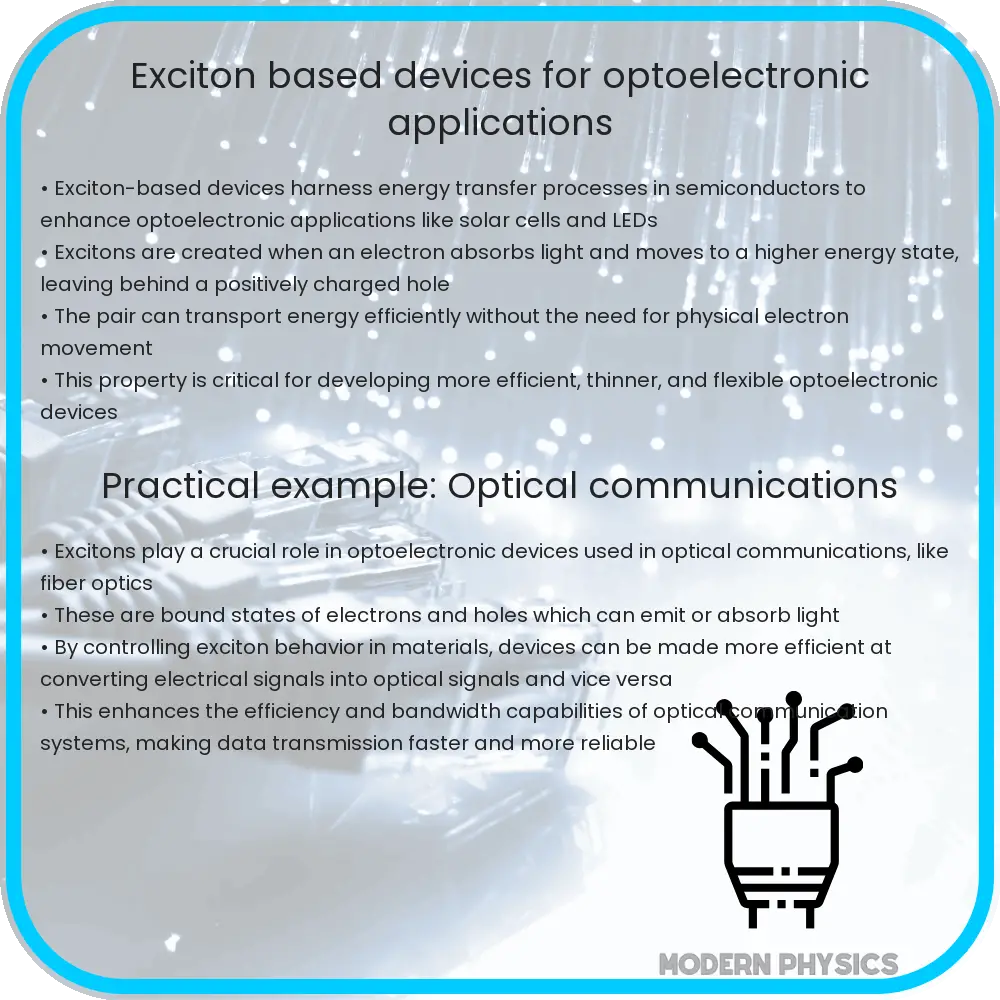
Exploring the Potential of Exciton-Based Devices
In the evolving landscape of semiconductor technology, exciton-based devices are emerging as a beacon of innovation, promising to redefine the capabilities of electronic and photonic systems. This groundbreaking technology leverages excitons, which are bound states of an electron and a hole attracted to each other by their electrostatic force. Excitons are created when a semiconductor absorbs light, leading to an excited state that can carry energy without transporting charge. The unique properties of excitons offer a pathway to devices that are not only more efficient but also versatile and scalable, making them a focal point for next-generation technological advancements.
Efficiency and Versatility: The Hallmarks of Exciton-Based Technology
One of the most compelling attributes of exciton-based devices is their exceptional efficiency. Unlike traditional semiconductor devices that rely on the movement of charge carriers, exciton-based systems minimize energy loss, offering a significant boost in performance. This efficiency stems from the ability of excitons to move energy across a material with minimal resistance, paving the way for high-efficiency optoelectronic devices such as solar cells, LEDs, and lasers.
The versatility of exciton-based devices is another key advantage. They can be engineered to operate across a wide range of wavelengths, making them suitable for a variety of applications from ultraviolet to infrared. This versatility is further enhanced by the ability to manipulate the properties of excitons through the engineering of the semiconductor material, such as altering the bandgap or utilizing different material compositions like organic semiconductors or two-dimensional materials such as transition metal dichalcogenides (TMDCs), represented by the formula MX2, where M is a transition metal (e.g., Mo, W) and X is a chalcogen (e.g., S, Se, Te).
Scalability: Paving the Way for Future Technologies
Scalability is a crucial aspect of exciton-based devices, allowing for the integration of excitonic systems into a wide array of electronic and photonic circuits. The ability to fabricate excitonic devices on a large scale, while maintaining high performance and reliability, opens up new avenues for the development of compact, energy-efficient, and high-speed electronic and photonic devices. This scalability is essential for the practical application of exciton-based technologies in industries ranging from telecommunications to renewable energy.
Exciton-Based Devices: Pioneers of Modern Electronics
Exciton-based devices are emerging as a cornerstone of advanced material science and electronics, marking a significant leap towards high-efficiency, versatile, and scalable technologies. An exciton is formed when an electron absorbs a photon and gets excited to a higher energy state, creating a bound state with a hole it leaves behind. This interaction, governed by Coulomb force, is pivotal in the operation of various semiconductor devices. The unique properties of excitons, such as their charge neutrality and ability to transport energy without transporting charge, open up new avenues for device engineering.
Efficiency and Versatility
The efficiency of exciton-based devices is attributed to their ability to manage energy at the quantum level. For instance, in organic light-emitting diodes (OLEDs), excitons play a crucial role in converting electrical energy into light with remarkable efficiency. This is because the recombination of an electron and a hole within an exciton releases energy in the form of photons, a process that can be finely tuned to emit light across the visible spectrum and beyond, enabling a wide range of applications from displays to advanced lighting solutions.
Versatility is another hallmark of exciton-based technologies. They are not just limited to light-emission; excitonic effects are exploited in photovoltaic cells, where they contribute to the generation of electric current by separating charge carriers, thereby enhancing solar cell efficiency. Moreover, excitons have a significant role in the burgeoning field of valleytronics, where the quantum state of an exciton in different energy valleys in semiconductors can be used to encode information, paving the way for new types of quantum computing and data storage devices.
Scalability Challenges and Solutions
Despite their promising attributes, the scalability of exciton-based devices poses challenges, primarily due to the intricate fabrication processes and the need for high-purity materials to maintain exciton stability. However, recent advances in material science, such as the development of two-dimensional materials like graphene and transition metal dichalcogenides (TMDs), offer a solution. These materials possess direct band gaps where excitons can be generated and manipulated efficiently, even at room temperature. Moreover, techniques like molecular beam epitaxy (MBE) and chemical vapor deposition (CVD) have evolved, allowing for the precise layering and doping of materials, essential for creating scalable exciton-based devices.
Conclusion
Exciton-based devices represent a paradigm shift in electronics, offering unprecedented efficiency, versatility, and scalability. The exploration and manipulation of excitons are leading us towards more sustainable and high-performance electronic devices, from ultra-efficient OLEDs and solar cells to novel quantum computing and data storage technologies. While challenges remain in material fabrication and exciton stability, ongoing research and technological advancements promise to overcome these hurdles, heralding a new era of exciton-based electronics. As we continue to unlock the potential of excitons, their impact on technology and society is poised to grow, making them a critical component of future electronic devices.