
Delve into the role of exciton dynamics in quantum mechanics and its applications in modern technology such as solar cells and lasers.
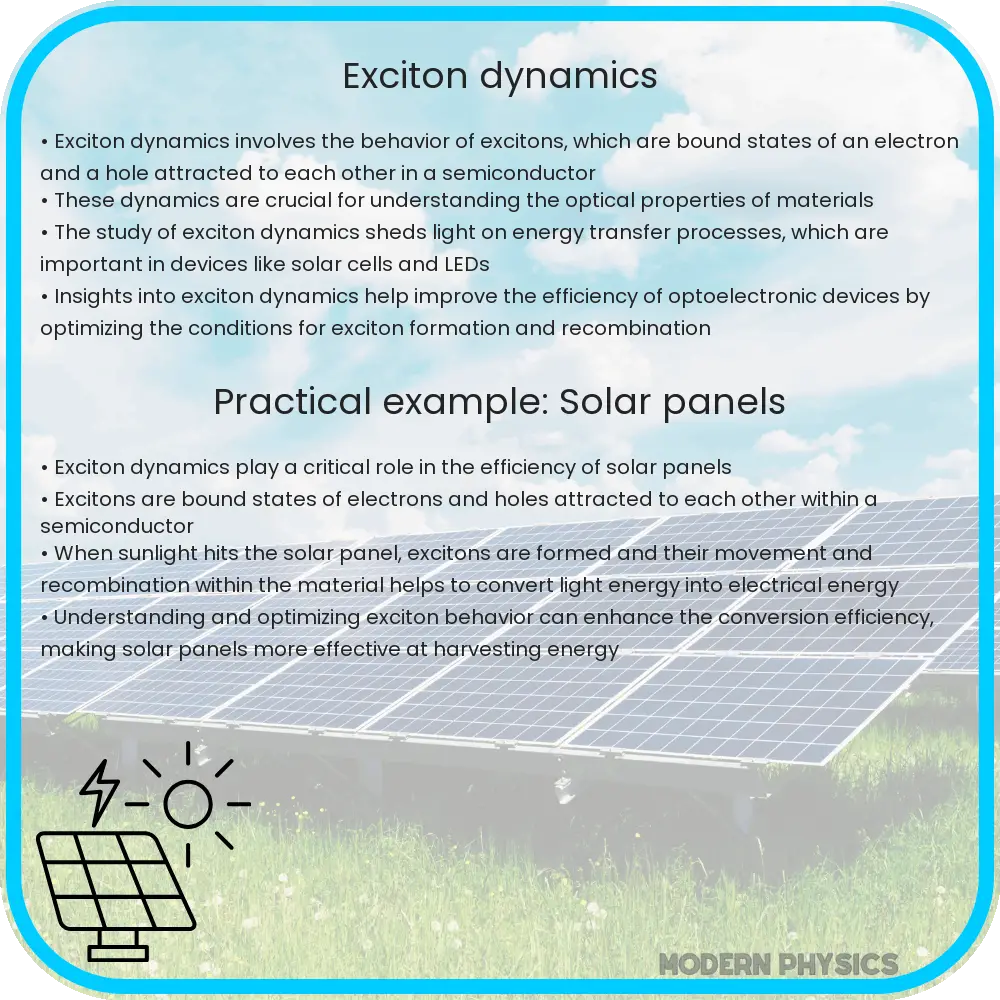
Understanding Exciton Dynamics
Exciton dynamics plays a crucial role in the fundamental understanding of quantum mechanics and its application in various technologies, including solar cells, lasers, and next-generation lighting. This topic merges complex ideas of quantum physics, spectroscopy, and energy transfer, offering a fascinating glimpse into the interaction of light with matter on a microscopic level.
What is an Exciton?
An exciton is formed when a photon is absorbed by a semiconductor or insulator, exciting an electron from the valence band to the conduction band and leaving behind a hole in the valence band. This electron and hole, which carry opposite charges, attract each other and bind together to form a composite particle or quasi-particle known as an exciton.
Quantum Effects in Excitons
The properties of excitons are significantly influenced by quantum mechanical effects. The exciton’s behavior is constrained by the quantum confinement resulting from its nanoscale environment. For example, in materials like quantum wells, quantum wires, and quantum dots, the spatial confinement can alter the energy levels available to excitons, thereby modifying their optical properties.
Spectroscopy of Excitons
Spectroscopic techniques are instrumental in studying excitons. By analyzing the absorption, emission, and scattering of light, researchers can deduce valuable information about the exciton’s energy levels, lifespan, and interactions. Photoluminescence (emission of light) and absorption spectroscopy are particularly useful in identifying the presence of excitons and their properties in a material.
Energy Transfer Through Excitons
Excitons are also pivotal in the process of energy transfer within a material. After formation, excitons can migrate through the material until they encounter a site where they can release their energy. The process of energy migration is fundamental in devices like organic photovoltaic cells and organic light-emitting diodes (OLEDs), where the efficiency of exciton diffusion directly impacts the device performance.
Understanding exciton dynamics involves the exploration of how these quasi-particles are generated, how they interact with the material’s matrix, and how they can relax by emitting a photon or through non-radiative processes. These mechanisms are vital for the design of materials with specific optical and electronic properties required in advanced technologies.
Applications of Exciton Dynamics in Modern Technology
Exciton dynamics have profound implications in various fields of technology. In photovoltaic cells, efficient exciton formation and separation is fundamental to converting sunlight into electricity. Similarly, in OLED technology used in smartphone and TV screens, mastering the movement and recombination of excitons allows for more vivid displays and improved energy efficiency. Understanding and manipulating excitons also push the boundaries in the development of quantum computing components, where control over quantum states is crucial.
Challenges in Exciton Research
Despite their promising applications, researching excitons comes with its share of challenges. One major hurdle is understanding the complex interactions within materials that affect exciton behavior, which can be sensitive to minute changes in environmental conditions, such as temperature and electromagnetic fields. Additionally, fabricating materials that can maintain exciton integrity over longer periods and at high efficiencies is an ongoing area of research.
Future Prospects
The future of exciton dynamics research holds great potential and may pave the way for breakthroughs in nanotechnology and materials science. Continued advances in experimental techniques and theoretical understanding will likely open up new avenues for exploiting excitons in commercial applications. As researchers delve deeper into controlling and harnessing the power of excitons, we may see more eco-friendly technologies and smarter, faster electronics that dramatically change our day-to-day lives.
Conclusion
Exciton dynamics serve as a fundamental concept bridging the gap between quantum mechanics and practical applications in technology. From increasing the efficiency of solar cells to enhancing the colors of digital displays, the control and understanding of excitons contribute significantly to advancing modern technology. Despite the challenges, continuous research and development in this field are leading to innovative solutions that might soon become part of our everyday technologies. By fostering a deeper understanding of exciton dynamics, scientists and engineers are opening up a realm of possibilities that could lead to the next generation of technological advancements.