
Environmental radioactivity examines radioactive materials in the environment from natural and human-made sources, assessing their impacts on health and ecosystems.
Understanding Environmental Radioactivity
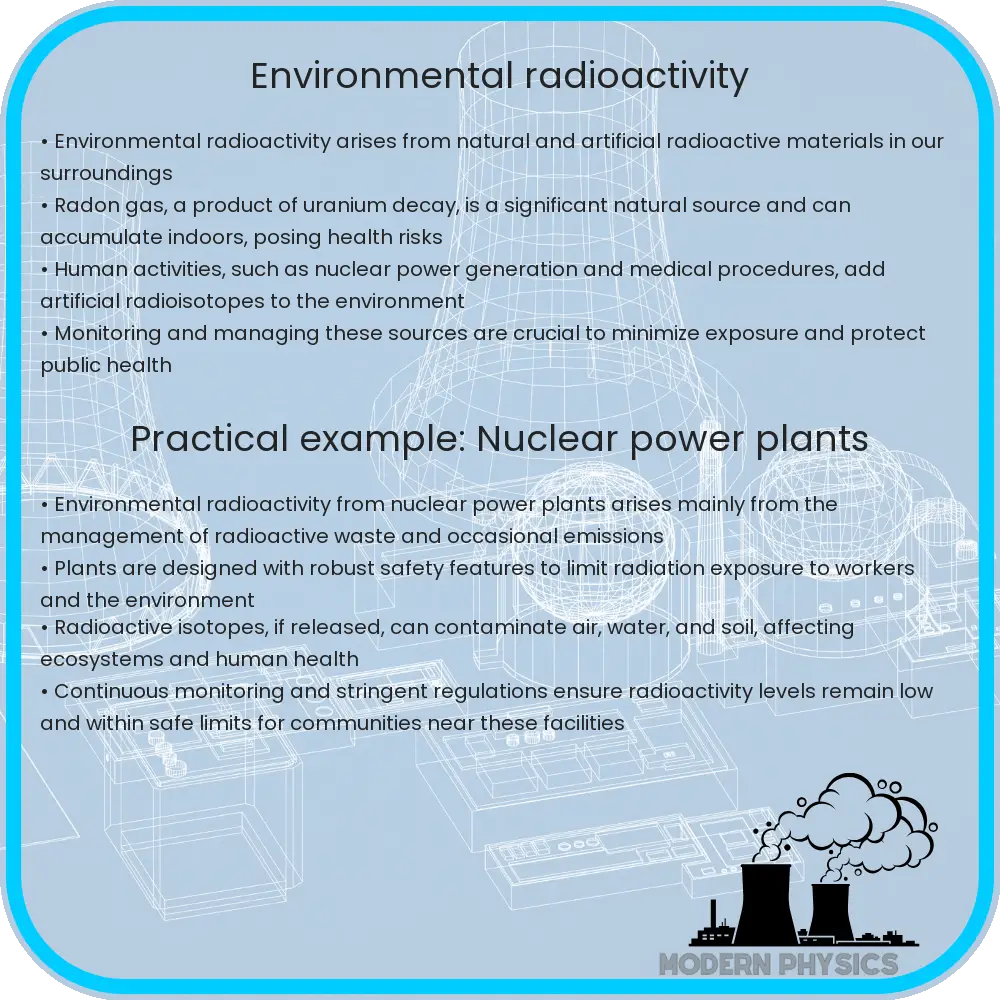
Environmental radioactivity involves the presence of radioactive materials in the environment, which originate from a variety of natural and anthropogenic (human-made) sources. These radioactive substances can have significant effects on the environment and human health, making it crucial to understand their sources, behaviors, and impacts.
Sources of Environmental Radioactivity
Environmental radioactivity comes from two main categories: natural and anthropogenic sources.
Natural Sources
- Cosmic radiation: High-energy radiation that originates from outer space and interacts with the Earth’s atmosphere.
- Terrestrial radiation: Emitted from radioactive materials present in the Earth’s crust, including elements like uranium, thorium, and radium. These materials decay into radon, a radioactive gas that is a significant health risk.
- Internal radiation: Comes from radionuclides naturally present in the human body (e.g., potassium-40).
Anthropogenic Sources
- Nuclear weapons testing: Historical nuclear weapons tests have left a legacy of radioactive contamination in the atmosphere, underwater, and underground.
- Nuclear power plants: Operations at nuclear power facilities produce radioactive wastes, which need careful handling, management, and disposal.
- Industrial, medical, and agricultural uses: Radioactive materials are used in various applications, including radiography, cancer treatment, and in fertilizers, which can contribute to environmental radioactivity.
- Accidental releases: Incidents like the Chernobyl and Fukushima nuclear disasters have released substantial amounts of radioactivity into the environment.
Impact of Environmental Radioactivity
The impact of environmental radioactivity on ecosystems and human health varies widely depending on the level and type of radioactivity, as well as the exposure duration. Here are some of the key concerns:
- Health risks: Exposure to high levels of radioactivity can cause acute health effects such as radiation sickness, while prolonged exposure to lower levels can lead to long-term health issues, including cancer and genetic damage.
- Environmental impact: Radioactive contamination can affect terrestrial and aquatic ecosystems, altering plant and animal life, sometimes leading to mutations and population decline.
- Economic consequences: Significant radioactive contamination can lead to loss of agricultural productivity, decrease in property values, and costly clean-up operations.
Understanding the behavior of radioactive materials in the environment involves studying their pathways — from their release to their interaction with various elements of the ecosystem. Radioactive decay, a natural process by which a nucleus of an unstable atom loses energy by emitting radiation, is characterized by the half-life, the time required for half of the radioactive atoms in a sample to decay. The half-lives of radioactive isotopes can range from fractions of a second to millions of years, affecting how long these materials remain hazardous in the environment.
The assessment and management of environmental radioactivity thus require a multidisciplinary approach, incorporating aspects of physics, chemistry, biology, and environmental science to mitigate its impact effectively.
Methods of Radioactivity Measurement and Monitoring
To manage environmental radioactivity effectively, it’s essential to measure and monitor the levels of radioactivity in different environments. Some common methods include:
- Geiger Counters: These devices detect and measure ionizing radiation using the ionization produced in a Geiger-Müller tube.
- Scintillation Counters: These use a scintillating material and a photomultiplier to detect radiation by measuring the light from a scintillating material.
- Semiconductor Detectors: Semiconductor materials detect radiation by absorbing energy and releasing it in the form of charge carriers.
- Radon Detectors: Specific for measuring radon levels, these can be deployed in homes and underground mines to monitor this pervasive gas.
Advanced spectroscopic methods can also differentiate between radiation types and isotopes, providing precise contamination profiles necessary for remediation efforts.
Preventive Measures and Regulations
Reducing the risks associated with environmental radioactivity involves implementing preventive measures and adhering to strict regulatory standards. Key measures include:
- Zoning: Restricting or controlling access to areas with high levels of radioactivity, such as nuclear fallout zones or high-radon areas.
- Waste Management: Secure containment and disposal of radioactive wastes from medical, industrial, and nuclear power sources.
- Regulations: Enforcing stringent operational standards on the handling and disposal of radioactive materials, guided by international bodies like the International Atomic Energy Agency (IAEA).
- Public Education: Informing the public about the risks of radioactivity and ways to mitigate exposure, particularly in regions prone to high radon levels.
These measures not only protect human health but also help preserve ecological balance by preventing widespread environmental contamination.
Conclusion
Environmental radioactivity, whether from natural or anthropogenic sources, poses significant challenges to both ecosystem integrity and human health. The complexities of radioactive decay and its long-lasting impacts necessitate ongoing vigilance in monitoring, assessment, and mitigation strategies. By understanding the sources, impact, and behaviors of radioactive materials, society can better engage in practices that reduce exposure, enhance safety, and promote environmental stewardship. With advanced monitoring technologies and strict regulatory frameworks, it is possible to manage the risks associated with environmental radioactivity effectively, ensuring safer living conditions and ecological preservation for future generations.