
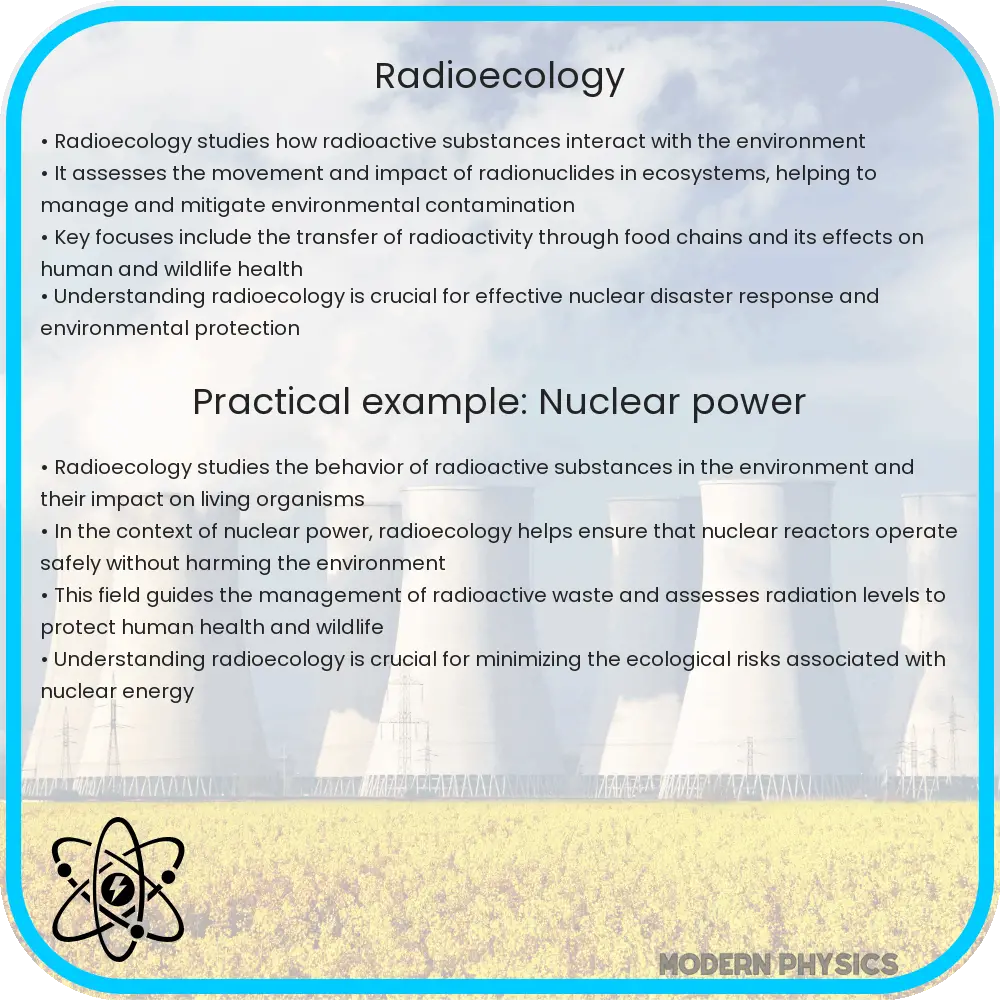
Radioecology studies radioactive substances in ecosystems, focusing on their sources, dispersion, and effects on organisms and the environment.
What is Radioecology?
Radioecology is a field of ecology that focuses on the study of radioactive substances in the environment, particularly how these substances interact with, and affect, ecosystems and organisms. It combines elements of both radiology and ecology, seeking to understand the sources, dispersion, and accumulation of radioactive materials in the environment, as well as their effects on living things.
Sources and Types of Radioactive Contamination
Radioactive contamination in the environment can come from a variety of sources. These include natural sources, such as radon gas emanating from the earth’s crust, and anthropogenic (human-made) sources like nuclear power plant accidents, nuclear weapons testing, and improper disposal of nuclear waste. Understanding these sources is crucial for managing and mitigating the risks associated with radiation.
- Natural Sources: These include terrestrial radiation, cosmic radiation, and radionuclides that occur naturally in the environment.
- Anthropogenic Sources: This category includes radiation from medical procedures, nuclear power plants, nuclear testing, and industrial activities that involve radioactive materials.
The Impact of Radioactive Contamination
Radioactive contamination can have serious effects on the environment and health of living organisms. When radioactive materials are released into the environment, they can contaminate the air, water, and soil. The biological effects of radiation depend on several factors including the type of radiation, the dose received, and the sensitivity of different organisms to radiation.
At higher doses, radiation can cause acute health effects such as radiation sickness, whereas lower doses might increase the risk of long term effects like cancer. On an ecological level, radiation can affect species diversity and abundance, alter food chains, and disrupt entire ecosystems.
Studying Radioecology
Studying radioecology involves a variety of scientific disciplines and methodologies. Researchers in this field employ tools from physics, chemistry, and biology to trace the movement of radioactive substances through the environment and to study their effects on organisms.
- Monitoring and Sampling: Regular monitoring and sampling of air, water, soil, and biological organisms helps to track the dispersion of radionuclides in the environment.
- Modeling: Scientists use computational models to predict the transport and fate of radioactive materials in the environment. These models help in understanding the potential impact and aid in decision-making for environmental management.
- Radiological Assessments: These are critical for assessing the risk to human health and to the environment, helping to establish regulatory standards and safety protocols.
The integration of these techniques enables a comprehensive understanding of how radioactive materials behave in the environment and how they affect living organisms, guiding efforts to protect public health and manage environmental risks effectively.
Challenges in Radioecology
One of the main challenges in radioecology is the complexity of predicting long-term environmental effects due to the subtle and extensive nature of radiation. Radioactive contaminants can persist in the environment for decades, complicating cleanup efforts and ecological recovery. Additionally, political and economic factors often influence environmental policies and the allocation of resources for research and remediation, affecting how effectively radioecological issues are addressed.
- Interdisciplinary Collaboration: Effective radioecological research relies on collaboration among experts from various fields such as geology, hydrology, environmental science, and health sciences.
- Data Limitations: There is often a lack of comprehensive data on the long-term impacts of radiation on different ecosystems and species, which poses a significant challenge in forming reliable conclusions and guidelines.
- Public Perception and Education: Misinformation and public fear regarding radiation can hinder rational decision-making and policy development. Educating the public about the real risks and benefits of nuclear technology is critical.
Future Perspectives in Radioecology
As global dependence on nuclear energy increases and the legacy of past nuclear activities continues to influence ecosystems, the importance of advancing radioecological research becomes more apparent. Future efforts in radioecology will likely focus on refining risk assessment models, developing more robust remediation technologies, and enhancing global cooperation in nuclear safety and waste management.
Advancements in technology, such as drones and remote sensing, also offer new tools for monitoring environments and assessing contamination spread more effectively. Furthermore, the integration of machine learning and artificial intelligence in data analysis could significantly improve the predictive accuracy of radioecological models.
Conclusion
Radioecology is a vital field that combines the intricacies of ecology with the principles of radiology to understand and mitigate the effects of radioactive substances in the environment. By studying the sources, impacts, and behavior of radioactive materials, researchers can help guide efforts to protect both human health and ecological integrity. Despite the challenges, continued research and international cooperation are imperative to manage and foresee the influences of radiation on our environment. Strengthening public understanding and involvement in radioecological issues is also essential in developing effective and sustainable nuclear-use policies. Ultimately, the field of radioecology not only aims to solve existing problems but also to anticipate future challenges in the ever-evolving relationship between humanity and its technological advancements.