
Electrospinning is a technique for producing ultra-thin fibers through electric forces, widely applied in various industries like healthcare and environmental protection.
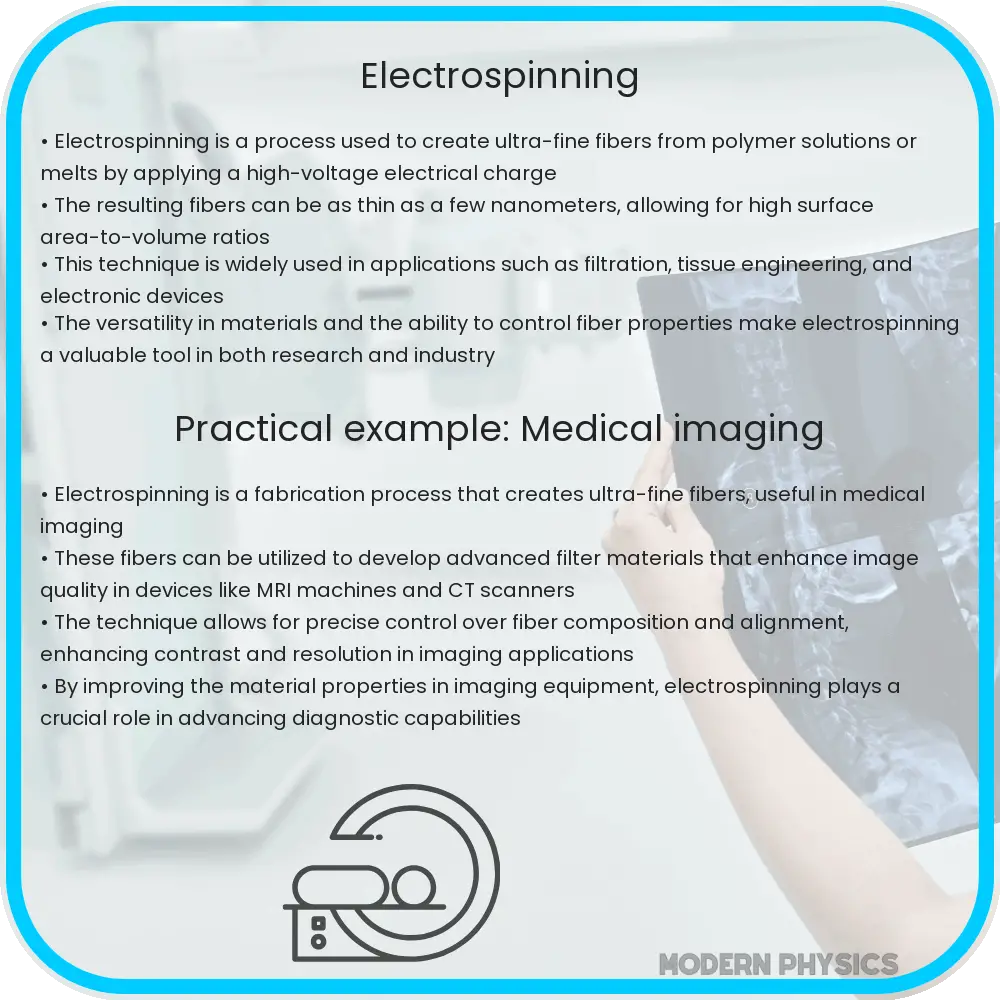
Electrospinning: Innovative, Versatile & Efficient
Electrospinning is a fascinating and versatile technology used to create ultra-thin fibers, ranging from a few nanometers to several micrometers in diameter. This innovative technique has wide-ranging applications across multiple industries, from healthcare to environmental protection. At the core of electrospinning is the integration of physics and engineering principles that manipulate electric forces to produce fibers from polymer solutions or melts.
Understanding the Basics of Electrospinning
Electrospinning operates on a relatively simple premise but involves complex interactions. The process begins with a polymer solution, which is held in a reservoir capped with a needle or spinneret. When a high voltage is applied to the polymer solution, it becomes charged. This charge induces a repulsive force against the surface tension of the solution, resulting in the formation of what is known as a Taylor cone. As the force becomes strong enough to overcome the surface tension, a jet of polymer is ejected from the tip of the cone.
Once the polymer jet is ejected, it undergoes a series of transformations. The solvent evaporates, and the jet stretches under electrostatic repulsion and external electric fields, eventually depositing as a thin, solid fiber on a grounded collector. The resulting fibers can have enormous surface area to volume ratios and high porosity, which are highly desirable properties in many applications.
The Role of Physics in Electrospinning
The key physics principles behind electrospinning include electric fields, fluid dynamics, and polymer physics. The balance of forces – electrical, viscous, and surface tension – is critical. The electric force not only initializes the jet but also elongates and thins it out through what’s known as a whipping process, caused by instabilities in the electric field. This results in fibers that are significantly finer than the original diameter of the polymer solution jet.
Mathematically, the behavior of the jet can be approximated and studied using principles from fluid dynamics. The dimensionless numbers such as Reynolds number (Re) and Ohnesorge number (Oh), which describe the fluid flow’s inertial and viscous forces relative to surface tension, help predict the behavior of the polymer solution:
- Reynolds number (Re) = $\frac{\rho v L}{\mu}$, where $\rho$ is the density, $v$ is the flow velocity, $L$ is the characteristic length, and $\mu$ is the viscosity.
- Ohnesorge number (Oh) = $\frac{\mu}{\sqrt{\rho \sigma L}}$, where $\sigma$ is the surface tension.
These equations are pivotal in designing the electrospinning setup to achieve desired fiber characteristics by tweaking parameters like polymer concentration, viscosity, voltage applied, and the distance between the needle and collector.
Applications of Electrospinning
Electrospinning’s ability to create nanoscale fibers gives it an edge in various applications. In the medical field, electrospun fibers are used for tissue engineering, wound dressings, and drug delivery systems due to their biocompatibility and high surface-to-volume ratio. In environmental engineering, these fibers have roles in filtration and sensors, assisting in the detection and removal of pollutants. Furthermore, in energy storage, electrospun materials are being explored as components of high-efficiency batteries and supercapacitors.
Innovations and Challenges in Electrospinning
As electrospinning technology evolves, researchers and engineers are continuously discovering innovative ways to enhance fiber production and functionality. One exciting development is the addition of nanoparticles or other functional materials into the polymer matrix. This modification can dramatically improve the mechanical properties, conductivity, or bioactivity of the fibers, expanding their potential applications. Additionally, recent advancements have been made in controlling fiber orientation and alignment, which are vital for applications requiring high structural integrity, such as in scaffolds for tissue engineering.
However, despite its numerous advantages, electrospinning faces several challenges that limit its widespread implementation. One of the major hurdles is the upscaling of the production process. While electrospinning is excellent for laboratory-scale production, translating these processes to industrial scales without compromising fiber quality or increasing production costs remains problematic. Moreover, issues such as the need for high voltage and the slow rate of fiber production are concerns that need to be addressed to make this technology more commercially viable.
Future Outlook and Conclusion
The potential of electrospinning is vast due to its simplicity, adaptability, and the unique properties of the fibers it produces. Looking ahead, the future of electrospinning appears promising, with ongoing research focused on addressing the current limitations and enhancing the process’s efficiency and applicability. Innovations such as automated systems for precise control of fiber properties and the development of novel polymers and composites could lead to breakthroughs in various domains, including regenerative medicine, environmental sustainability, and advanced material engineering.
In conclusion, electrospinning represents a remarkable integration of physics and engineering principles to create materials with significant potential across many fields. By overcoming current challenges and further refining the technology, electrospinning stands to offer even more revolutionary applications. It exemplifies how a deep understanding of basic scientific principles can lead to technological innovations that impact a wide array of industries, pushing the boundaries of what is possible in material science.