
Explore the Ehrenfest Paradox, its impact on understanding relativity in rotating frames, and its role in modern theoretical physics.
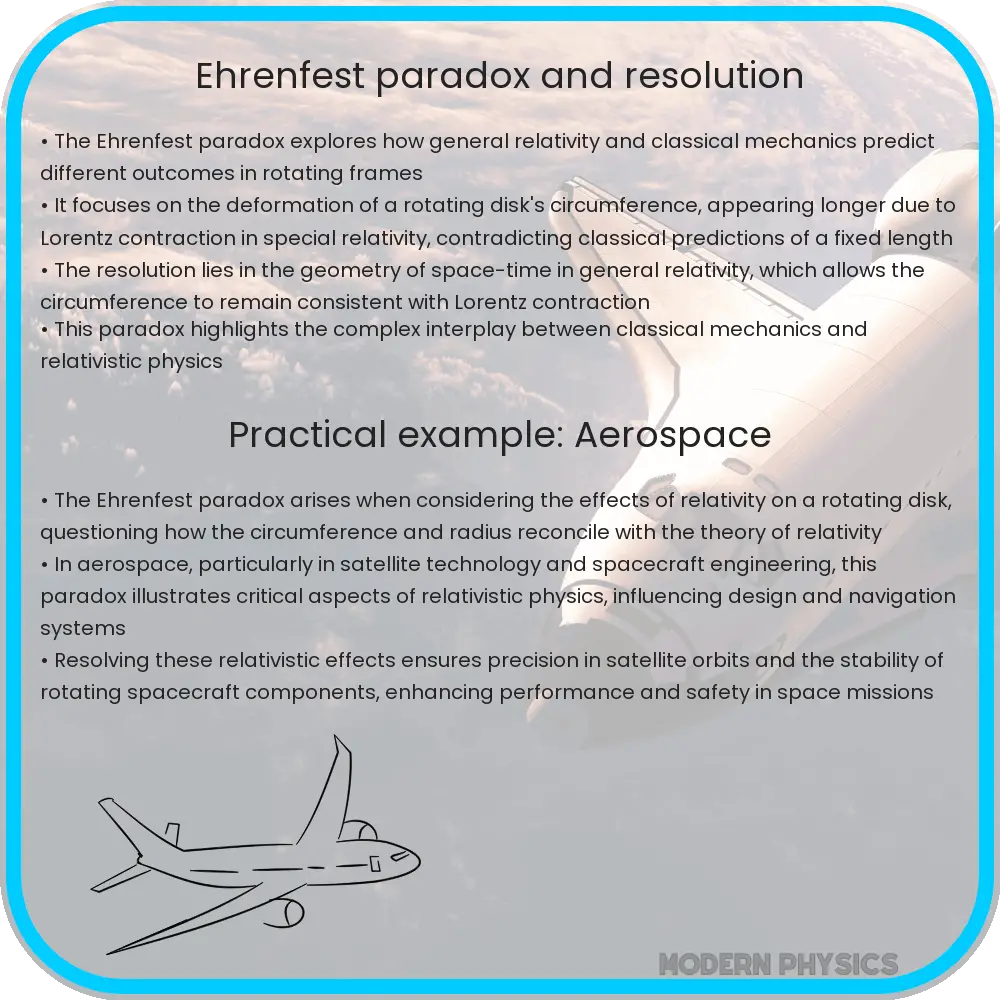
Understanding the Ehrenfest Paradox: Relativistic Effects in Rotating Frames
The Ehrenfest Paradox, named after physicist Paul Ehrenfest, arises from the application of special relativity to a rotating disk. This thought experiment highlights intriguing questions about the nature of space and time in a rotating reference frame. Understanding this paradox not only deepens our grasp of relativity but also offers insights into the complex relationship between rotation and spacetime.
The Paradox Explained
Consider a circular disk rotating in a flat, non-relativistic space. According to classical mechanics, an observer at the rim would measure the circumference (C) and radius (R) and find that C = 2πR. However, from a relativistic perspective, the situation becomes more complex. If the disk spins at a significant fraction of the speed of light, relativistic effects like length contraction come into play.
Relativistic Effects on the Rotating Disk
In a frame co-moving with the disk’s rim, the tangential velocity approaches the speed of light. Special relativity predicts that lengths parallel to the direction of motion undergo contraction. Thus, an observer on the disk would measure a contracted circumference but an unchanged radius, leading to a scenario where C < 2πR. This apparent violation of Euclidean geometry underpins the Ehrenfest Paradox.
The Role of Non-Euclidean Geometry
The resolution of the paradox lies in understanding the geometry of space in a rotating frame. Ehrenfest’s thought experiment inadvertently points to the necessity of non-Euclidean geometry in describing such scenarios. In a rotating frame, space is no longer flat (Euclidean) but curved, a concept that aligns with Einstein’s General Theory of Relativity.
General relativity, which extends the principles of special relativity to include gravity and acceleration, offers a framework to understand this curvature. In a rotating frame, spacetime curvature manifests, altering the relationship between circumference and radius. This curvature accounts for the observed discrepancies without violating the principles of relativity.
Thus, the Ehrenfest Paradox is not a paradox in the traditional sense but rather a demonstration of the limitations of classical physics and the necessity for a relativistic understanding of motion and geometry.
Exploring Further: Frame-Dragging and Gravitomagnetism
The implications of the Ehrenfest Paradox extend beyond simple rotational mechanics to phenomena like frame-dragging and gravitomagnetism, predicted by general relativity. Frame-dragging refers to the idea that rotating massive bodies can ‘drag’ the spacetime around them, affecting the motion of nearby objects. This effect, akin to gravitomagnetism, is analogous to the magnetic field created by moving electric charges. The Ehrenfest Paradox provides an intuitive entry point into understanding these complex concepts, which have been confirmed by experiments like the Gravity Probe B mission.
Modern Applications and Theoretical Implications
In the realm of theoretical physics, the Ehrenfest Paradox continues to inspire discussions on the nature of spacetime. Its principles are relevant in the study of astrophysical objects like rotating black holes and neutron stars, where extreme conditions bring relativistic effects to the forefront. Additionally, it serves as a conceptual tool in exploring the boundaries of quantum mechanics and general relativity, guiding physicists in their quest to develop a unified theory of quantum gravity.
Conclusion
The Ehrenfest Paradox is more than a theoretical curiosity; it’s a pivotal concept that challenges and enhances our understanding of the universe. By highlighting the limitations of classical mechanics and the necessity of a relativistic approach, it opens the door to a deeper exploration of the intricate relationship between motion, space, and time. The paradox not only underscores the significance of non-Euclidean geometry in explaining the behavior of rotating frames but also paves the way for understanding complex gravitational phenomena. In the broader context, it exemplifies the evolving nature of scientific knowledge, demonstrating how apparent paradoxes can lead to groundbreaking insights and theories. As we continue to explore the universe, the lessons learned from the Ehrenfest Paradox will undoubtedly remain essential in our quest to unravel the mysteries of the cosmos.