
Explore the Ehrenfest Paradox and its role in understanding Special and General Relativity, resolving space-time complexities in physics.
Understanding the Ehrenfest Paradox in the Context of Special Relativity
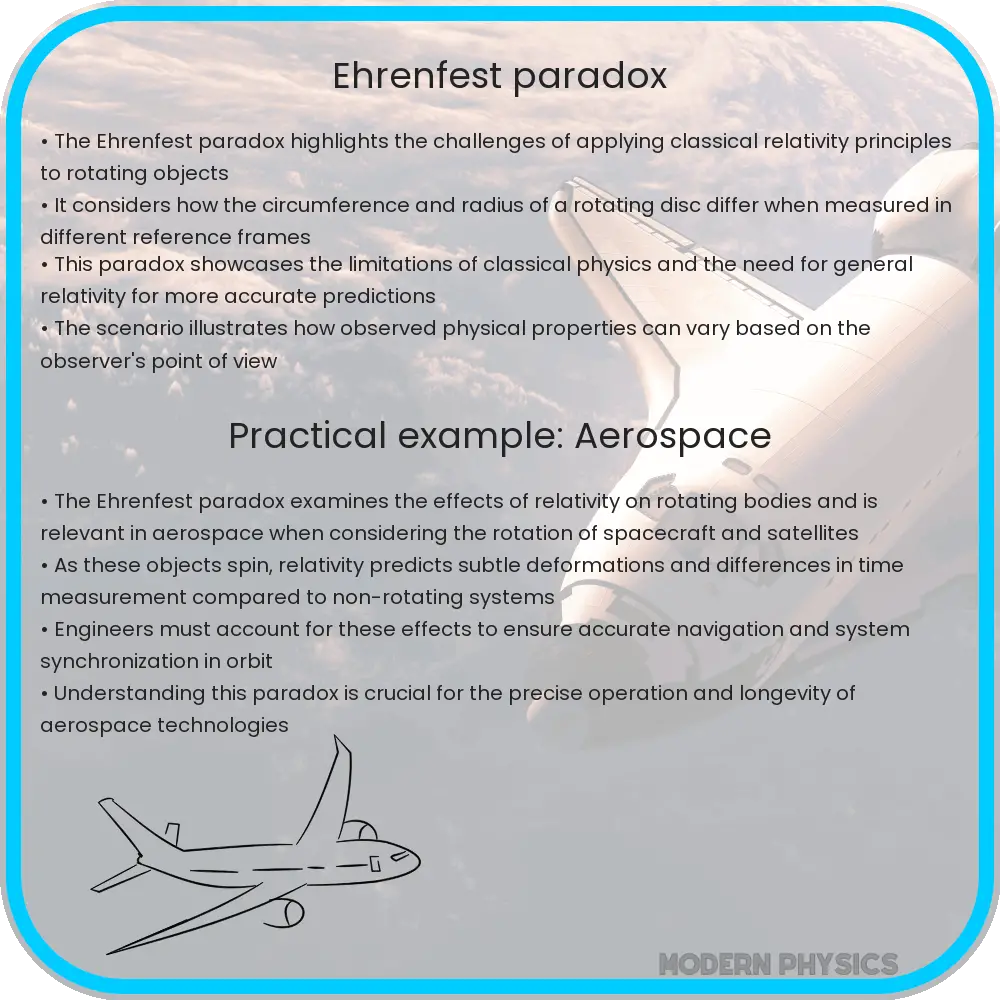
The Ehrenfest Paradox, named after the physicist Paul Ehrenfest, presents a fascinating challenge in understanding the implications of Albert Einstein’s Special Theory of Relativity. This paradox deals with the behavior of a rotating disk in a relativistic framework and raises questions about the nature of space and time in such conditions.
Special Relativity, formulated by Einstein in 1905, revolutionized physics by introducing concepts such as time dilation and length contraction. According to this theory, the laws of physics are the same in all inertial frames, and the speed of light in vacuum is constant for all observers, regardless of their relative motion. However, when applied to a rotating disk, intriguing paradoxes emerge.
The Essence of the Ehrenfest Paradox
The paradox arises when considering a disk rotating at a significant fraction of the speed of light. According to Special Relativity, an observer on the disk’s rim would measure the circumference to be greater than what an observer at rest with respect to the disk’s center would measure. This is due to the length contraction experienced by the moving rim. However, both observers would agree on the disk’s radius, leading to a contradiction when trying to reconcile the two measurements using the familiar formula for the circumference of a circle, \( C = 2\pi r \).
Key Insights and Debates
The Ehrenfest Paradox has sparked extensive debate and has been instrumental in exploring the limits and interpretations of Special Relativity. One key insight is the realization that the concepts of rigid bodies and simultaneity in Special Relativity are not as straightforward as in classical mechanics. The paradox emphasizes the non-Euclidean nature of space in a relativistic rotating frame, suggesting that Euclidean geometry may not be universally applicable.
Further, the paradox has implications for understanding the fabric of space-time itself. It hints at the complex relationship between rotation and relativity, challenging physicists to reconcile intuitive notions of geometry with the counterintuitive predictions of Special Relativity.
In summary, the Ehrenfest Paradox serves as a gateway to deeper questions about the nature of reality as described by modern physics. It underscores the ongoing journey of scientific discovery, where each answer unfolds new mysteries and perspectives on the universe we inhabit.
Resolving the Ehrenfest Paradox
To resolve the Ehrenfest Paradox, physicists have turned to General Relativity, Einstein’s theory which extends the principles of Special Relativity to non-inertial frames of reference, like a rotating disk. General Relativity posits that gravity is the result of the curvature of spacetime caused by mass and energy. In this framework, the geometry of spacetime in the vicinity of a rotating body is non-Euclidean, and this curvature of space can account for the apparent paradox.
When applied to the rotating disk, General Relativity suggests that space itself warps in such a way that the traditional Euclidean geometrical relationship between circumference and radius breaks down. This means that the geometry of the disk is no longer flat but curved, and thus the standard formula \( C = 2\pi r \) does not apply in the way we would expect in a flat space. This curvature of space is analogous to the warping caused by gravitational fields and is a direct consequence of the disk’s rotation.
Broader Implications and Modern Perspectives
The Ehrenfest Paradox not only illuminates the complexities of Special and General Relativity but also has implications in other areas of physics. For instance, it has played a role in discussions about the nature of quantum mechanics and spacetime at the quantum scale. In the realm of astrophysics, the paradox finds relevance in understanding objects like rotating black holes, where extreme gravitational effects and high rotational speeds make relativistic considerations essential.
Moreover, the paradox continues to inspire theoretical work in the search for a unified theory that could reconcile the principles of quantum mechanics with those of General Relativity, a major pursuit in modern physics.
Conclusion
In conclusion, the Ehrenfest Paradox serves not only as a fascinating thought experiment in the realm of theoretical physics but also as a pivotal point in understanding the nature of space and time. It highlights the necessity of General Relativity in explaining phenomena in a rotating reference frame and underscores the non-Euclidean geometry of spacetime under these conditions. As our understanding of the universe continues to evolve, the Ehrenfest Paradox remains a testament to the enduring quest for deeper insights into the fundamental laws that govern our cosmos.