
Explore ECR Plasma Technology’s role in achieving efficient ionization, uniform plasmas, and precise energy control for various industrial and research applications.
Understanding ECR Plasma Technology
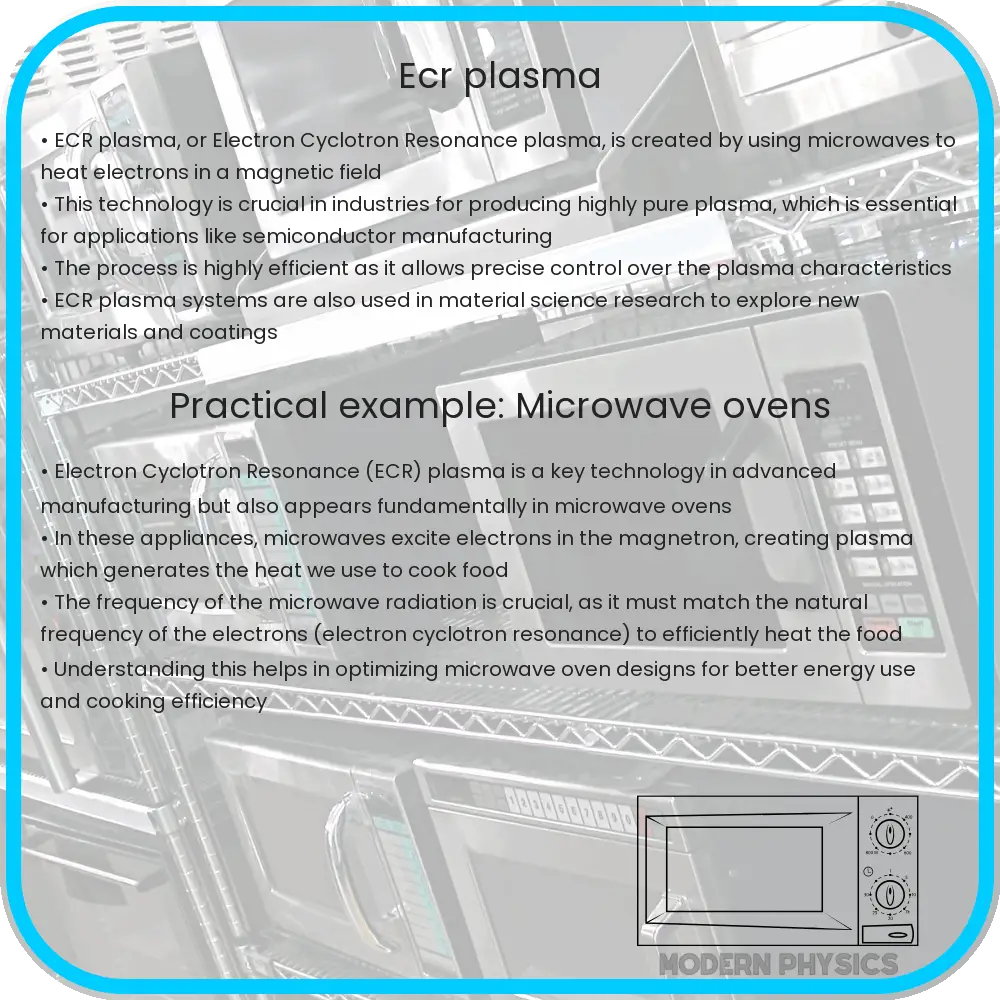
Electron Cyclotron Resonance (ECR) Plasma technology represents a groundbreaking approach in the field of plasma physics, offering efficient ionization, uniform plasmas, and precise energy control. This innovative method leverages magnetic fields to resonate with electrons, thereby creating highly ionized plasma states without the need for excessive heating or energy consumption. The ECR process is pivotal in various applications, including semiconductor manufacturing, material processing, and scientific research, due to its unique ability to generate uniform and controlled plasmas.
Efficient Ionization Process
The cornerstone of ECR technology lies in its efficient ionization process. By utilizing microwave frequencies that match the electron cyclotron frequency in a magnetic field, electrons gain energy in a resonant manner. This energy transfer is highly efficient, leading to significant ionization rates even at relatively low pressures and temperatures. As a result, ECR plasma systems can achieve high-density plasma states, making them ideal for processes requiring substantial ionization levels, such as etching and thin film deposition.
Uniform Plasma Generation
A distinguishing feature of ECR plasma systems is their ability to produce remarkably uniform plasmas. The magnetic field configuration, often a magnetic mirror or a cusp, is designed to contain and distribute the plasma evenly across the reaction chamber. This uniformity is crucial for applications demanding consistent treatment over large areas or volumes, ensuring homogenous process conditions and outcomes. The precision in plasma distribution also minimizes potential damage to sensitive materials, enhancing product quality and yield.
Precise Energy Control
ECR plasma technology excels in offering precise control over plasma energy and density. The ability to finely tune the microwave power and magnetic field strength allows for the adjustment of plasma parameters to suit specific process requirements. This level of control is essential for optimizing process efficiency, reducing energy consumption, and minimizing unwanted by-products. Additionally, the non-contact nature of ECR plasma generation ensures minimal contamination, further improving process purity and integrity.
In conclusion, ECR plasma technology stands out for its efficient ionization capabilities, uniform plasma production, and exceptional energy control. Its application across various industries underscores its versatility and effectiveness in meeting the demands of modern material processing and research endeavors.
Applications and Advantages of ECR Plasma
ECR plasma technology finds application in a wide array of fields, highlighting its versatility and efficiency. In the semiconductor industry, it is employed for etching intricate patterns with high precision and depositing thin films with exceptional uniformity. Material science benefits from ECR plasma in surface treatment processes, improving adhesion, corrosion resistance, and surface properties of materials. Additionally, in the realm of scientific research, ECR plasmas are pivotal in studies related to nuclear fusion, where creating and controlling high-temperature plasmas are essential.
Challenges and Future Directions
Despite its numerous advantages, ECR plasma technology faces challenges, particularly in scalability and energy efficiency at larger scales. Addressing these challenges requires ongoing research and development to enhance the design of ECR reactors and the efficiency of microwave power sources. Future advancements may include innovative magnetic field configurations and plasma diagnostics tools, further expanding the capabilities and applications of ECR plasma technology.
Conclusion
Electron Cyclotron Resonance (ECR) Plasma technology marks a significant advancement in the field of plasma physics, offering a unique blend of efficiency, uniformity, and control. Its ability to produce highly ionized, uniform plasmas at low temperatures and pressures makes it a cornerstone in critical industries such as semiconductor manufacturing and material processing. The precise control over plasma parameters afforded by ECR technology allows for optimized processes, reduced energy consumption, and minimized environmental impact. Despite facing challenges in scalability and energy efficiency, ongoing research and development promise to enhance its capabilities further. As we continue to explore and expand the frontiers of ECR plasma technology, its role in advancing scientific research and industrial applications is undoubtedly poised for growth. The future of ECR plasma technology shines brightly, holding the potential to revolutionize processes across various sectors and contribute significantly to the advancement of technology and science.