
Explore the essentials of Inductive Coupling Plasma (ICP), its efficiency, physics, and applications in environmental monitoring, pharmaceuticals, and material science.
Understanding Inductive Coupling Plasma (ICP)
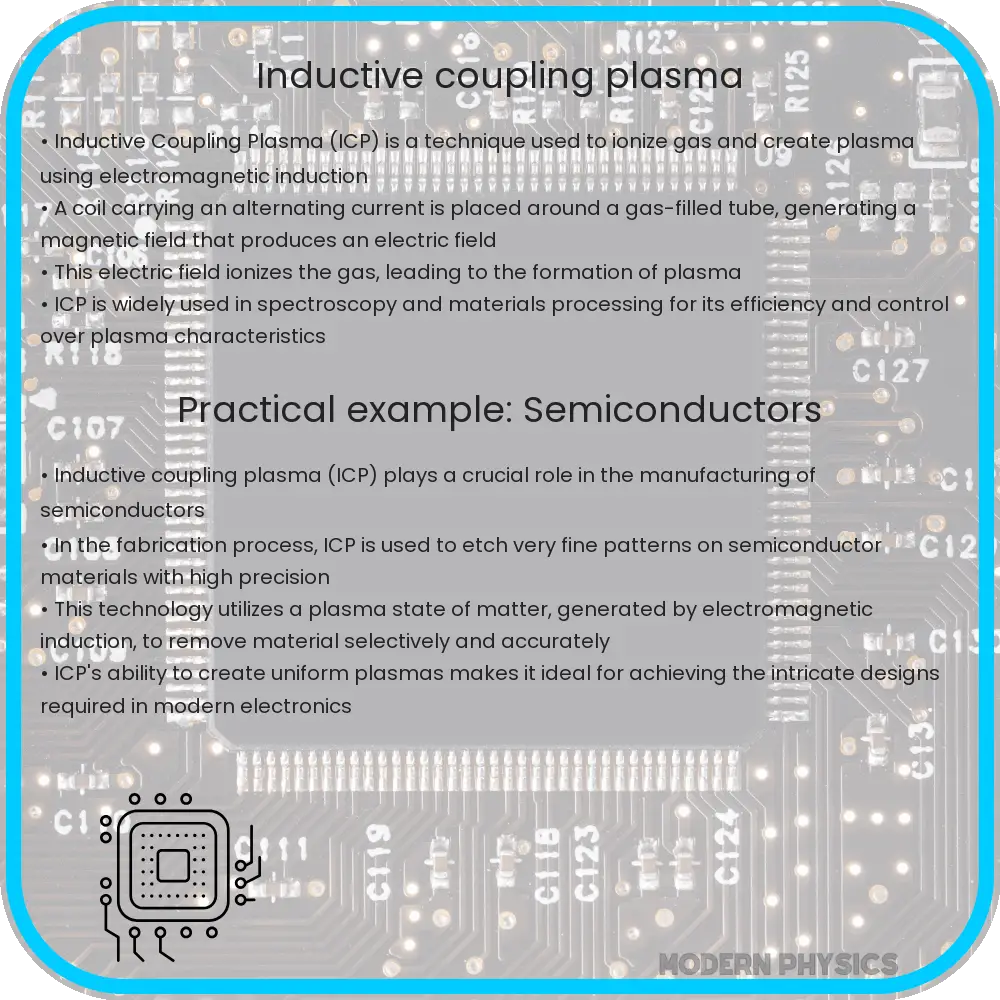
Inductive Coupling Plasma (ICP) represents a significant advancement in the field of analytical chemistry and material science, offering a high degree of efficiency and a wide range of applications. At its core, ICP is a type of plasma that is generated by inductively heating a gas, usually argon, with an electromagnetic coil. This process creates ions and electrons that are heated to extremely high temperatures, typically ranging from 6,000 to 10,000 Kelvin, enabling a myriad of chemical and physical processes to occur at rates and efficiencies often unattainable through other means.
The Physics Behind ICP
The fundamental principle of ICP operation lies in the induction of a current to generate the plasma. An RF (radio frequency) power source is connected to a coil wrapped around a quartz tube. When the RF power is applied, a magnetic field is created. According to Faraday’s Law of Electromagnetic Induction, this changing magnetic field induces a circular electric field within the gas inside the tube, ionizing the gas and creating plasma. The plasma, once formed, sustains itself through continuous absorption of energy from the electromagnetic field.
Efficiency of ICP Technologies
ICP technologies are renowned for their efficiency. The plasma’s high temperature ensures almost complete atomization and ionization of the sample, leading to highly accurate and sensitive analysis. This efficiency is crucial in applications requiring trace element detection and quantification, where the precision of the results is paramount. Moreover, the ability of ICP to handle samples in various states (solid, liquid, or gas) without significant pre-treatment further enhances its efficiency and applicability.
Applications of ICP
- Environmental Monitoring: ICP is instrumental in detecting and quantifying pollutants in water, air, and soil, aiding in environmental protection and regulation compliance.
- Pharmaceuticals: In pharmaceutical manufacturing, ICP is used to ensure the purity of raw materials and final products by detecting trace metals and other impurities.
- Material Science: ICP plays a crucial role in the analysis of metals, alloys, and ceramic materials, providing valuable information on composition and purity essential for research and development.
Advanced ICP Techniques
Inductive Coupling Plasma technology has evolved to include several sophisticated analytical techniques, notably ICP Mass Spectrometry (ICP-MS) and ICP Optical Emission Spectrometry (ICP-OES). ICP-MS is highly valued for its ability to detect trace elements and isotopes at parts per trillion levels, making it indispensable in geochemistry, toxicology, and forensic science. ICP-OES, on the other hand, excels in the rapid analysis of major and trace elements by measuring the optical emissions from the plasma, widely applied in environmental monitoring, metallurgy, and petrochemical industries.
Challenges and Future Directions
Despite its numerous advantages, ICP technology faces challenges such as equipment cost, complexity, and the need for skilled operators. Additionally, matrix effects—where components of the sample other than the analyte influence the measurement—can affect accuracy and precision. However, ongoing research and development are focused on overcoming these challenges through automation, improved sample introduction systems, and advanced data analysis techniques.
Conclusion
Inductive Coupling Plasma technology stands as a pillar of modern analytical chemistry and material science, characterized by its efficiency, versatility, and the breadth of its applications. From environmental monitoring to the stringent quality control required in pharmaceuticals and material science, ICP has proven to be an invaluable tool. The future of ICP looks promising, with advancements aimed at enhancing its accessibility, accuracy, and application range. As we continue to push the boundaries of science and technology, the role of ICP in fostering innovation and ensuring safety and quality in various industries cannot be overstated. Embracing these technologies, while addressing their challenges, will undoubtedly lead to new discoveries and advancements in the years to come.