
Dielectric elastomers are smart materials that expand and contract electrically, mimicking muscle movement for use in robotics, bioengineering, and more.
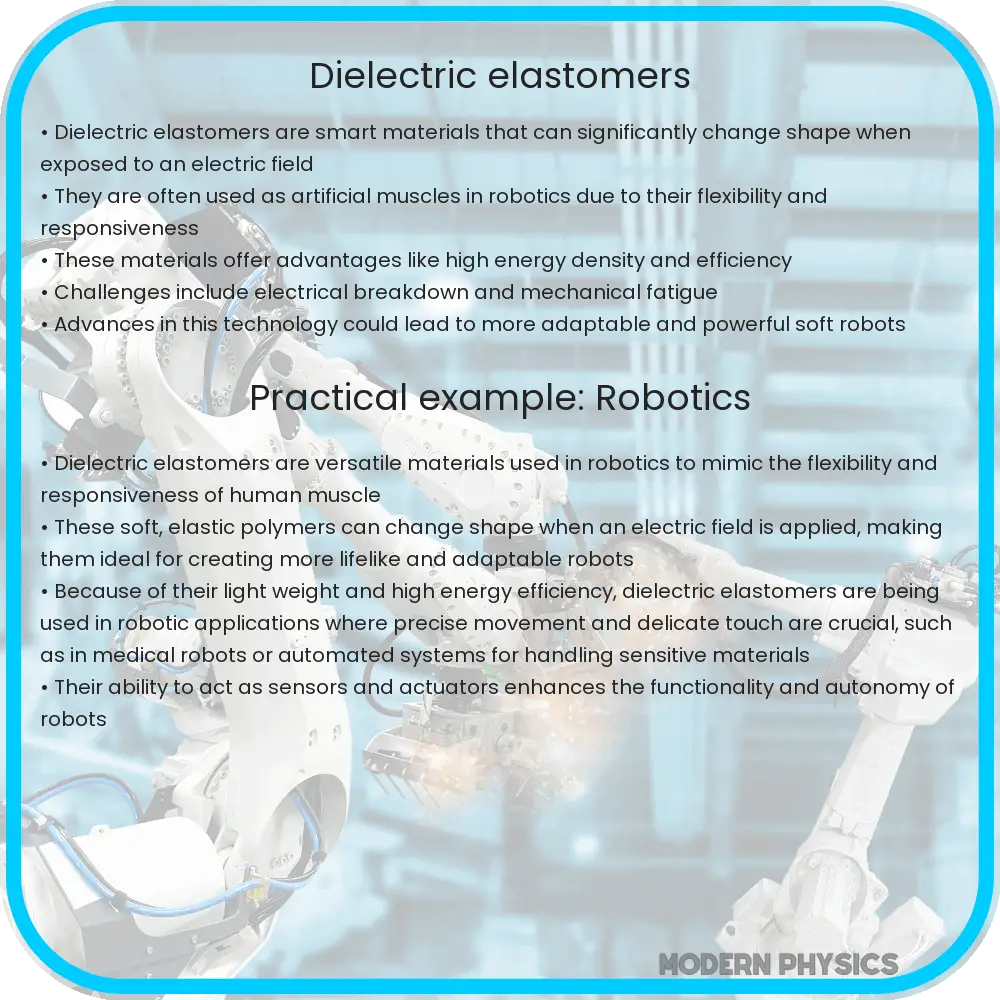
Understanding Dielectric Elastomers: High-Performance Smart Materials
Dielectric elastomers, a category within smart materials, are gaining attention for their remarkable ability to mimic natural muscle movement. This feature makes them incredibly useful in various applications, from robotics to bioengineering. Before diving into their applications, let’s break down the basics of what dielectric elastomers are and how they work.
The Composition and Mechanics of Dielectric Elastomers
Dielectric elastomers are soft, electrically insulating materials that can deform in response to electrical stimulation. Typically, they include a polymer matrix that is viscoelastic, meaning they combine the viscosity of a fluid and the elasticity of a solid. Embedded between compliant electrodes, when an electric field is applied across these materials, they experience a change in size or shape; this phenomenon is known as electrostriction. Specifically, they can expand in plane and reduce in thickness, mimicking a muscle-like actuation.
The electrical field across the material, calculated simply by V/d where V is the voltage applied and d is the thickness of the elastomer, creates an electrostatic pressure on the elastomer surfaces. This pressure, calculated by the equation:
\[ P = \frac{\varepsilon_0 \varepsilon_r V^2}{2d^2} \]
where \( \varepsilon_0 \) is the permittivity of free space, \( \varepsilon_r \) is the relative permittivity of the elastomer, and \( d \) is its thickness, drives the deformation.
Key Properties and Advantages
- High Elasticity: Dielectric elastomers can stretch up to several times their original size, displaying a hyperelastic property that is unusual in traditional materials used for actuators.
- Energy Efficiency: They boast high energy conversion efficiencies, meaning they are capable of converting a large portion of electrical energy into mechanical energy, and vice versa.
- Lightweight and Acoustically Transparent: Their lightweight nature and ability to be acoustically transparent make them ideal for applications where weight and impact on surrounding environments are concerns.
- Quick Response Time: The deformation response to electrical stimulus is incredibly rapid, allowing for fast actuation in systems that use these materials.
Applications of Dielectric Elastomers
One of the most exciting aspects of dielectric elastomers is their versatility in application across various fields:
- Adaptive Optics: They are used in telescope lenses and other optical components to change shape precisely and quickly, thus improving image quality.
- Soft Robotics: By simulating muscle motion, they facilitate a new generation of soft, more lifelike robots.
- Energy Harvesting: These materials can harness mechanical energy from natural motions, such as waves or human movement, and convert it into electrical energy.
- Sensors and Actuators: In sensors, dielectric elastomers can detect changes in mechanical forces and in actuators, they perform physical tasks by changing shape or size.
The expanding reach of dielectric elastomers showcases their potential to impact numerous technological fields.
Challenges and Future Potential
Despite their impressive capabilities, dielectric elastomers face several challenges that need addressing to further enhance their applicability.
- Material Durability: Continuous cycles of stretching and relaxing can lead to material fatigue and eventual breakdown. Research is ongoing to develop more durable materials that can withstand extensive use without degrading.
- Electrical Breakdown: High voltages required for operation can cause electrical breakdown, which compromises the functionality of the elastomer. Innovations in electrode materials and configurations are being explored to tackle this issue.
- Environmental Sensitivity: Factors like temperature and humidity can affect the performance of dielectric elastomers. Creating more environmentally stable versions is key to expanding their use in outdoor and variable climate applications.
Addressing these challenges opens up tremendous future possibilities for dielectric elastomers, including more sophisticated bioengineering applications and incorporation into wearable technology for health monitoring and augmented performance.
Conclusion
Dielectric elastomers are revolutionizing the way engineers and designers think about motion and actuation in technology. From enhancing the capabilities of robots to improving energy efficiency, these materials offer vast potential across multiple domains. While there are certain obstacles to overcome, particularly in the areas of durability and environmental resilience, the ongoing research and development are promising. As this field continues to evolve, dielectric elastomers may well become fundamental components in the next generation of smart devices and systems, making the fantasy of highly adaptable, efficient, and responsive materials a tangible reality.