
Explore the precision and efficiency of diamond turning in optics, a key technology shaping the future of optical manufacturing for clarity and performance.
Diamond Turning in Optics: Enhancing Precision, Clarity, and Efficiency
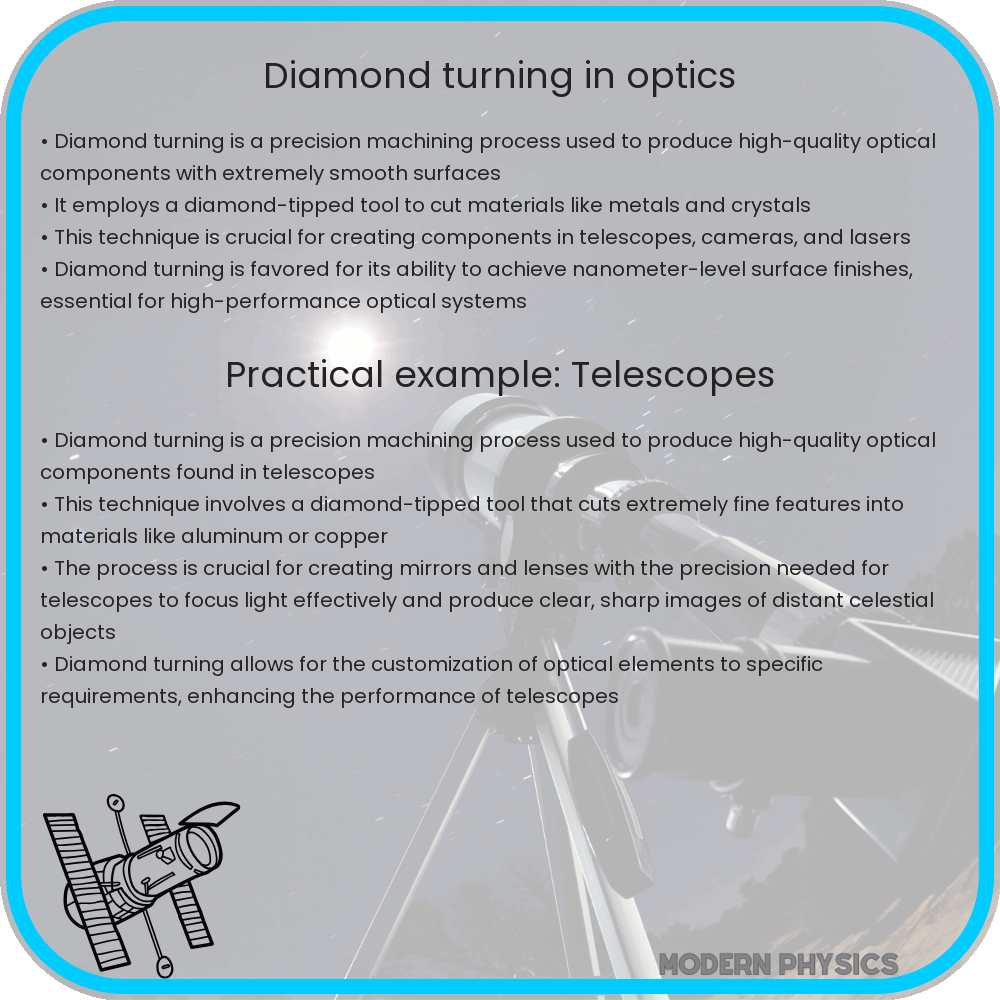
Diamond turning is a cutting-edge manufacturing process that plays a pivotal role in the production of high-precision optical components. Utilizing a diamond-tipped tool, this method allows for the creation of optics with unparalleled precision and surface finish. The significance of diamond turning extends across various industries, including aerospace, defense, and consumer electronics, where the demand for high-quality optical components is ever-increasing.
Core Advantages of Diamond Turning
Diamond turning offers several distinct advantages over traditional optical manufacturing techniques. Firstly, the use of a diamond cutting tool, the hardest material known, enables the machining of a wide range of materials, including metals, crystals, and polymers, with extreme precision. This results in optical components with superior surface quality, minimal sub-surface damage, and high levels of clarity.
- High Precision and Accuracy: The diamond turning process is capable of achieving surface roughness levels in the order of a few nanometers, which is crucial for high-performance optical systems.
- Efficiency and Versatility: It supports rapid prototyping and production, allowing for the efficient manufacturing of complex shapes such as spherical, aspherical, and freeform optics.
- Cost-Effectiveness: By reducing the need for post-processing and finishing steps, diamond turning can lower overall production costs, especially for custom and small-batch orders.
Materials and Applications
The versatility of diamond turning is evident in its compatibility with a broad spectrum of materials. Metals like aluminum and copper are commonly used for their excellent reflective properties, while polymers and crystals such as polycarbonate and silicon are selected for their specific optical characteristics. This adaptability makes diamond turning essential for the creation of a variety of optical components, including lenses, mirrors, and prisms, used in high-precision applications ranging from infrared imaging systems to laser optics.
In conclusion, the advent of diamond turning in optics has marked a significant leap forward in the manufacturing of optical components. Its ability to combine precision, clarity, and efficiency has set a new standard in the industry, making it a cornerstone of modern optical manufacturing processes.
Diamond Turning in Optics: The Path to Unparalleled Precision and Clarity
The realm of optical manufacturing has long pursued the twin goals of precision and clarity. In this pursuit, diamond turning has emerged as a cornerstone technology, offering unparalleled accuracy and surface finish for a wide range of optical components. This sophisticated machining process uses a diamond cutting tool to sculpt optical materials with nanometer-level precision, making it indispensable for producing high-quality lenses, mirrors, and other critical optical elements.
Advantages of Diamond Turning
Diamond turning is celebrated for its exceptional precision, which enables the creation of optical components with extremely smooth surfaces and intricate geometries. This process is particularly beneficial for applications requiring high levels of accuracy, such as infrared optics, where the clarity of the final product is paramount. Additionally, diamond turning is capable of machining a variety of materials, including crystals, metals, and plastics, thereby offering versatility across different optical applications.
- High Precision and Surface Quality: The use of a single-point diamond tool allows for the creation of surfaces with sub-nanometer roughness, significantly enhancing optical performance.
- Flexibility in Material Choice: Capable of machining a broad spectrum of materials, diamond turning is suitable for creating complex components out of challenging materials with minimal waste.
- Cost-Effectiveness: Despite the high initial setup costs, the efficiency and speed of diamond turning, combined with its ability to produce near-net-shape components, result in lower overall manufacturing costs.
Technological Innovations and Applications
The continuous advancement in diamond turning technology has expanded its application scope, now including the production of diffractive optical elements, freeform optics, and precision molds for optical replication. Innovations such as fast tool servos, precision air bearings, and advanced control systems have further refined the process, enhancing its accuracy and efficiency. These developments have made diamond turning integral to industries such as aerospace, defense, and consumer electronics, where optical components must meet stringent specifications.
Conclusion
Diamond turning in optics represents a pinnacle of manufacturing excellence, combining precision, efficiency, and versatility. Its ability to produce components with unmatched clarity and smoothness has made it a key technology in advancing optical applications. As the demand for high-performance optics continues to grow, diamond turning will undoubtedly play a crucial role in shaping the future of optical manufacturing, driving innovations and improving the quality of optical devices across various industries. With its ongoing technological advancements, diamond turning stands as a testament to the relentless pursuit of perfection in the optical manufacturing sector.
Is this conversation helpful so far?