
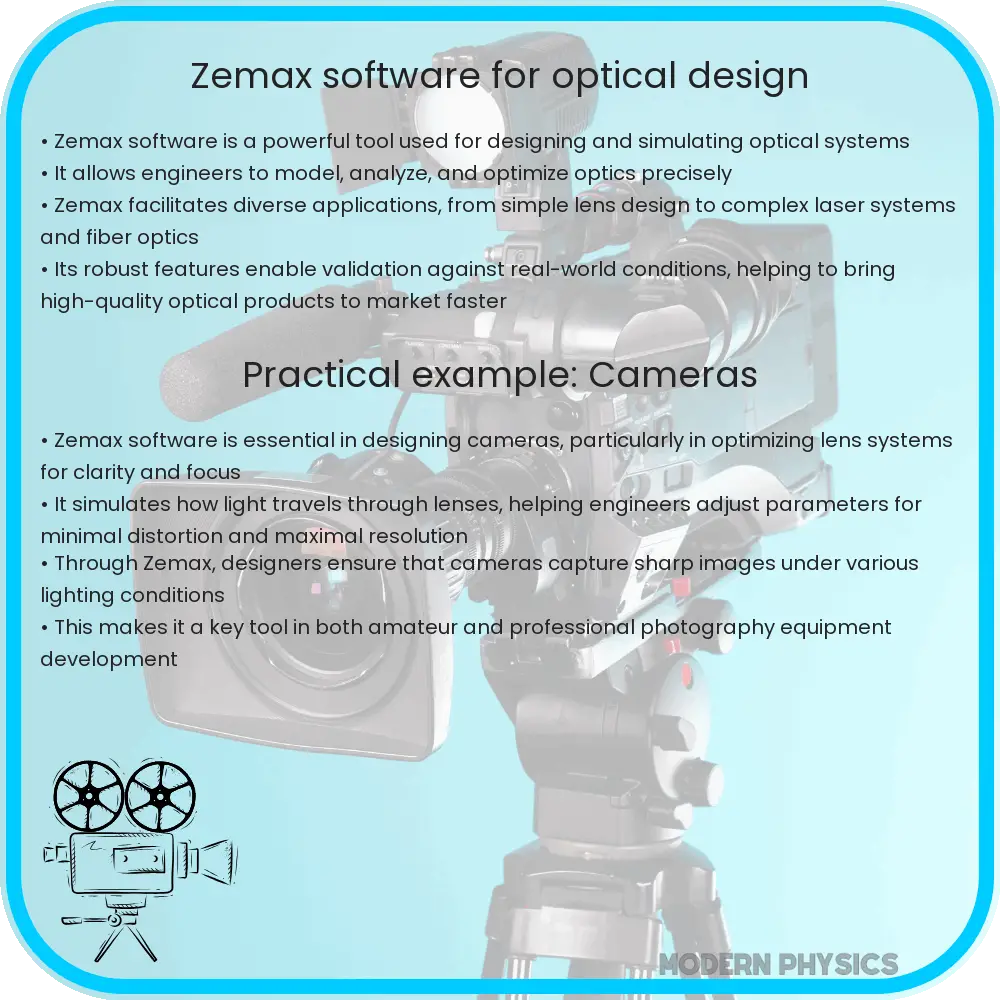
Discover how Zemax software revolutionizes optical design with precision and efficiency, streamlining projects across industries for innovation.
Zemax Software: Revolutionizing Precision, Efficiency, and Geometric Optics
Zemax Software stands as a cornerstone in the field of optical design, offering an unparalleled suite of tools for engineers, scientists, and researchers focused on precision, efficiency, and innovation in geometric optics. This software suite, known for its comprehensive analysis capabilities and user-friendly interface, enables the creation of cutting-edge optical solutions that push the boundaries of what’s possible in various industries including consumer electronics, automotive, aerospace, and healthcare.
Key Features of Zemax Software
At its core, Zemax is engineered to streamline the design process, from conceptualization to the final product, ensuring that optical systems deliver optimal performance. Key features include:
- Advanced Ray Tracing Capabilities: Zemax’s sophisticated ray tracing engine accurately predicts how light travels through and interacts with optical elements, allowing for the meticulous design and analysis of complex optical systems.
- Comprehensive Optical Component Library: Users have access to an extensive library of optical elements and materials, making it easier to experiment with different configurations and find the most effective design solutions.
- Intuitive User Interface: The software’s user-friendly interface facilitates a smooth design process, enabling both novice and experienced users to efficiently navigate through various features and capabilities.
- Seamless Integration with Mechanical Design Software: Zemax promotes collaboration across disciplines by allowing easy integration with mechanical design software, ensuring that optical designs are both physically viable and optimally integrated into larger systems.
The Impact of Zemax on Geometric Optics
Geometric optics, a branch of optics dealing with the approximation of light rays in systems with lenses, mirrors, and other optical surfaces, has been profoundly transformed by Zemax software. It enables designers to precisely control and manipulate light paths, leading to the development of innovative optical products with unprecedented performance. By accurately simulating the behavior of light within optical systems, Zemax assists in identifying and correcting aberrations, enhancing image quality, and achieving superior system performance.
The software’s precision and efficiency have made it indispensable in the development of complex optical systems, such as high-resolution cameras, advanced telescopes, and next-generation lighting solutions. Its ability to handle challenging optical design problems with ease and accuracy not only accelerates the development process but also opens up new possibilities for innovation in geometric optics.
Zemax Software: A Revolution in Optical Design
Zemax software stands at the forefront of optical design, offering unparalleled precision and efficiency in the field of geometric optics. This powerful software suite is engineered for professionals who demand accuracy and speed in their optical and illumination design projects. By integrating state-of-the-art features with an intuitive user interface, Zemax streamlines the design process, from concept to production, ensuring that engineers and scientists can focus on innovation and problem-solving.
Key Features and Benefits
Zemax’s suite, including OpticStudio and OpticsBuilder, offers a comprehensive range of features that cater to the intricate needs of optical design. OpticStudio is renowned for its advanced simulation capabilities, enabling users to model, analyze, and optimize optical systems with unprecedented precision. This is complemented by OpticsBuilder, which allows CAD engineers to directly convert optical designs into manufacturable components, significantly reducing the time and cost associated with traditional design workflows.
- Advanced Ray Tracing Capabilities: At the heart of Zemax’s power is its sophisticated ray tracing engine, capable of accurately simulating light’s behavior as it travels through and interacts with different optical elements.
- Comprehensive Optical Component Library: Users have access to an extensive library of optical components, from simple lenses and mirrors to complex gradient-index materials, facilitating the design of highly complex optical systems.
- Seamless Integration with CAD Software: Zemax’s ability to integrate seamlessly with popular CAD software enhances collaboration between optical and mechanical design teams, ensuring that optical systems are both effective and manufacturable.
Applications Across Industries
Zemax software finds its application across a myriad of industries, illustrating its versatility and effectiveness. In the realm of consumer electronics, it’s instrumental in designing compact and high-performance camera lenses and optical sensors. The aerospace and defense sector relies on Zemax for the development of sophisticated imaging systems, including telescopes and satellite optics. Moreover, the healthcare industry benefits from its precision in designing medical devices, such as endoscopes and diagnostic equipment, that require intricate optical components for life-saving procedures.
Conclusion
The adoption of Zemax software in optical design signifies a paradigm shift towards greater efficiency and accuracy in the field of geometric optics. Its comprehensive suite, equipped with advanced features and an extensive component library, addresses the complex challenges faced by today’s optical engineers and designers. By bridging the gap between optical theory and practical application, Zemax not only streamlines the design process but also opens up new possibilities for innovation across various industries. As optical technologies continue to evolve, the role of Zemax in facilitating cutting-edge designs and breakthroughs in optical engineering is unquestionably pivotal. In essence, Zemax is not just a tool but a catalyst for progress in the optical world, driving forward the boundaries of what is possible in geometric optics.