
Explore the breakthroughs and impacts of Quantum Phase Transitions, their role in advancing technology, and the challenges and future of quantum research.
Understanding Quantum Phase Transitions
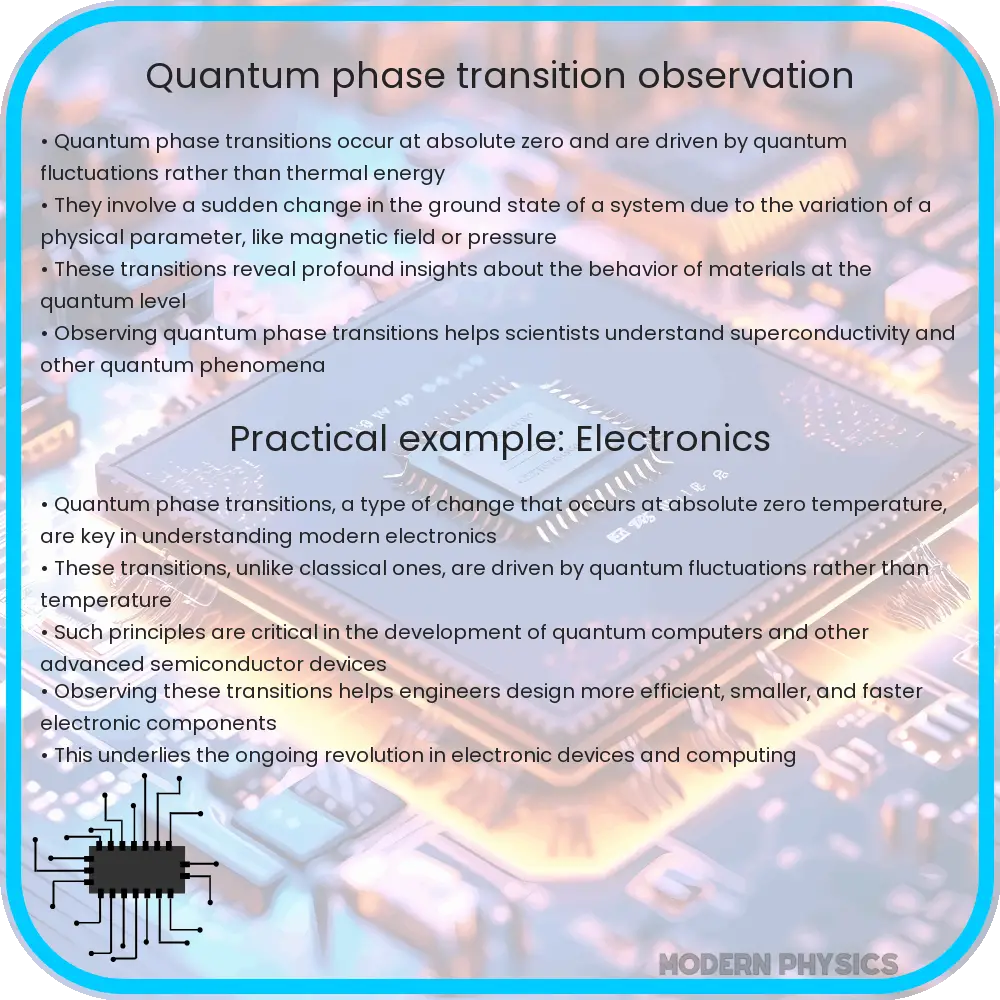
Quantum Phase Transition (QPT) represents a fundamental shift in the state of matter at zero temperature, driven by quantum fluctuations rather than thermal fluctuations. Unlike classical phase transitions, which occur due to changes in temperature, QPTs happen when some external parameter, such as pressure or magnetic field, is varied. This concept is not only a cornerstone in the field of condensed matter physics but also a bridge to understanding the complex behavior of quantum systems.
The Breakthroughs in Quantum Phase Transitions
The study of quantum phase transitions has led to significant breakthroughs in physics, offering insights into the behavior of materials at the quantum level. One of the key discoveries was the identification of the quantum critical point (QCP), a point at which the phase transition occurs. At the QCP, the material’s properties change drastically, leading to phenomena such as superconductivity and magnetism. This has profound implications for the development of new technologies, including quantum computing and high-temperature superconductors.
Visibility and Impact of Quantum Phase Transitions
The visibility of QPTs in experiments has been challenging due to the subtle nature of quantum fluctuations. However, with advances in experimental techniques, such as neutron scattering and ultra-cold atomic gases, researchers have been able to observe these transitions directly. The impact of understanding QPTs extends beyond fundamental physics, influencing material science, chemistry, and even information technology. For instance, the manipulation of quantum states for computing and data storage relies heavily on principles derived from QPT research.
Moreover, the theoretical frameworks developed to describe QPTs, like the renormalization group theory, have provided physicists with powerful tools to predict and analyze the behavior of complex systems. This has led to a deeper understanding of the quantum world, paving the way for future technological innovations.
Challenges and Future Directions in Quantum Phase Transition Research
Despite the progress in understanding and observing quantum phase transitions, several challenges remain. One of the primary hurdles is the complexity of the mathematical models required to describe QPTs accurately. These models often involve non-perturbative techniques that are difficult to solve. Additionally, the experimental observation of QPTs requires extremely low temperatures and precise control over external parameters, making these experiments both costly and technically demanding.
Another challenge is the scalability of quantum materials and devices based on QPT principles. For quantum technologies to become practical on a large scale, researchers must find ways to manufacture and manipulate quantum materials at the nanoscale with high fidelity and reliability. This includes overcoming decoherence and quantum noise, which can disrupt the quantum states essential for applications like quantum computing.
The Future of Quantum Phase Transitions
The future of quantum phase transition research is promising, with several exciting avenues for exploration. One area of focus is the discovery of new materials that exhibit QPTs, which could lead to the development of novel quantum devices. Researchers are also exploring the use of topological quantum states, which are robust against decoherence, for quantum computing and information processing.
Furthermore, the integration of quantum simulations with advanced computational techniques, such as machine learning, holds the potential to solve complex models of QPTs that are currently intractable. This could unveil new quantum phases of matter and provide deeper insights into the universe’s quantum nature.
Conclusion
Quantum phase transitions represent a fascinating intersection of physics, materials science, and technology. The breakthroughs in understanding these transitions have laid the foundation for quantum technologies that could revolutionize computing, encryption, and materials engineering. Despite the challenges, the ongoing research and technological advancements suggest a bright future for exploiting quantum phase transitions. As we continue to unravel the mysteries of the quantum world, we may well be on the cusp of a new era in science and technology, powered by the principles of quantum phase transitions.