
Explore the role of calorimetry in measuring reaction heat with a focus on precision, efficiency, and control in scientific and industrial applications.
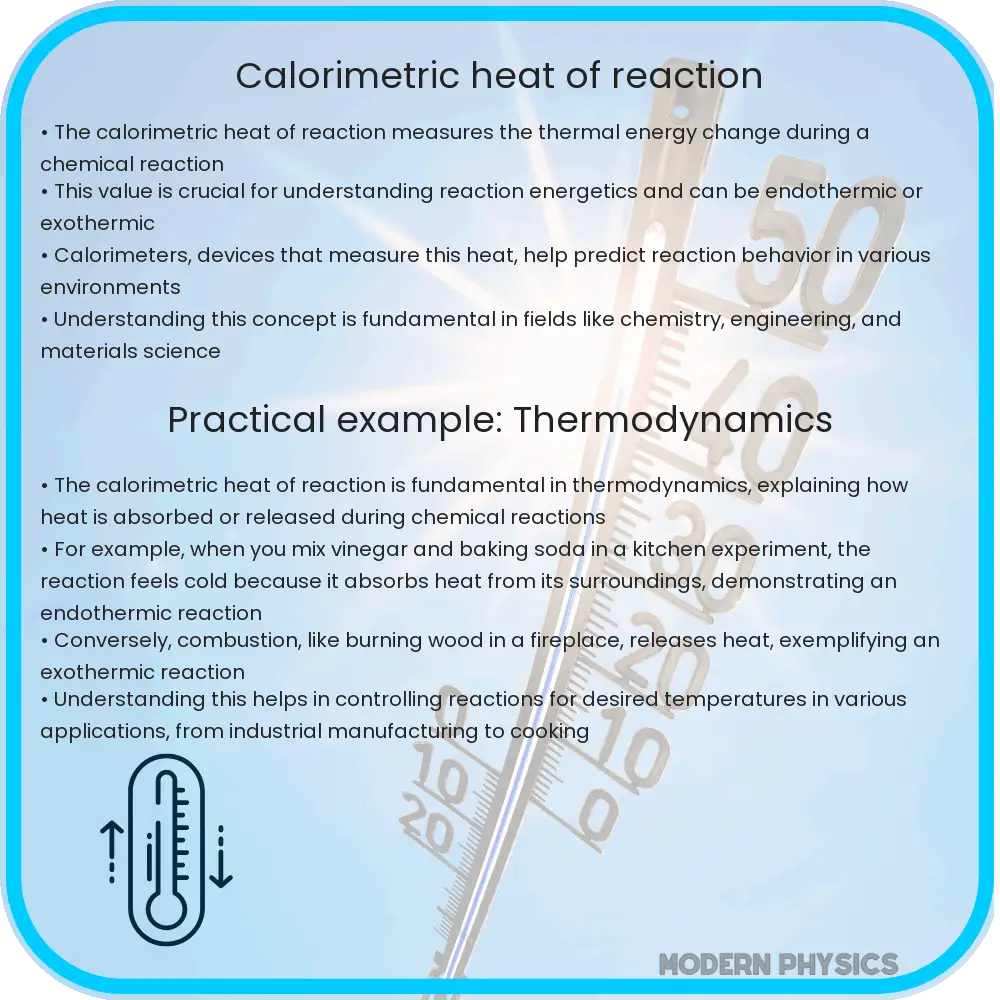
Understanding Calorimetric Heat of Reaction
Calorimetry, a pivotal technique in chemical thermodynamics, is instrumental in determining the heat of chemical reactions, known as the calorimetric heat of reaction. This process is critical for a variety of applications in chemistry, biochemistry, and engineering. The precision, efficiency, and control in calorimetric measurements are essential for accurate and reliable results, which have profound implications in research and industry.
Precision in Calorimetric Measurements
Precision in calorimetry refers to the ability to obtain consistent results over multiple measurements. This is vital in experiments where small differences in heat generation or absorption can lead to significant changes in interpretation. Advanced calorimeters are equipped with sensitive temperature sensors and well-designed calorimetric chambers to ensure minimal heat loss and accurate measurement. For example, in a reaction where hydrogen reacts with oxygen to form water, the heat released can be precisely measured as:
2H2(g) + O2(g) → 2H2O(l)
Efficiency of Calorimetric Methods
Efficiency in calorimetry is about maximizing the data quality while minimizing the time and resources needed. Modern calorimeters are designed for quick stabilization and have automated features that reduce the manual intervention needed. This efficiency is crucial in industrial settings, such as in the pharmaceutical industry, where rapid and accurate heat measurements of reactions are necessary for product development and quality control.
Control in Calorimetric Experiments
Control in calorimetric experiments involves regulating external variables that can influence the heat measurement. Temperature, pressure, and the rate of reaction are examples of such variables. Precise control is necessary to ensure that the measured heat corresponds solely to the reaction of interest. For instance, in an exothermic reaction like the combustion of methane (CH4 + 2O2 → CO2 + 2H2O), controlling the oxygen supply can prevent side reactions and yield more accurate heat measurements.
Understanding these three key aspects of calorimetry – precision, efficiency, and control – is crucial for accurately measuring the calorimetric heat of reaction. These principles guide researchers and professionals in obtaining reliable and reproducible data, which is the cornerstone of scientific and industrial advancements.
Applications and Challenges in Calorimetry
The applications of calorimetry in measuring the heat of reaction are diverse, ranging from academic research to industrial processes. In pharmaceutical research, calorimetry helps in understanding the energetics of drug interactions, crucial for drug design and development. Environmental science also benefits from calorimetry, as it is used to assess the energy content of fuels and the environmental impact of various chemical reactions.
Despite its wide usage, calorimetry faces challenges, especially in dealing with complex reactions. In biochemical reactions, for instance, the presence of multiple reactants and products can complicate the heat measurement. Additionally, maintaining the ideal reaction conditions over the course of the experiment is often challenging and requires sophisticated equipment and expertise.
Advancements in Calorimetric Techniques
Recent advancements in calorimetry have focused on enhancing precision, efficiency, and control. Microcalorimetry, for example, allows for the study of very small amounts of substances, reducing material costs and enabling studies on rare or expensive compounds. Isothermal Titration Calorimetry (ITC) has become a standard method in biochemistry for studying binding interactions, as it provides both thermodynamic and kinetic data.
Furthermore, computational methods are increasingly being integrated with calorimetric studies. These computational tools help in predicting the outcomes of reactions and in interpreting calorimetric data, especially in complex systems where multiple variables are at play.
Conclusion
In conclusion, calorimetric heat of reaction measurements are a cornerstone in scientific research and industrial applications. The precision, efficiency, and control offered by modern calorimetric techniques have significantly advanced our understanding of chemical and biochemical reactions. Despite the challenges, ongoing developments in technology and methodology continue to enhance the capabilities of calorimetry. As we move forward, calorimetry will undoubtedly remain an indispensable tool in unraveling the complexities of chemical reactions and contributing to scientific and technological progress.