
Explore the Clausius-Clapeyron equation’s role in phase transitions and enthalpy, with real-world applications in meteorology and material science.
Understanding the Clausius-Clapeyron Equation in Phase Transitions
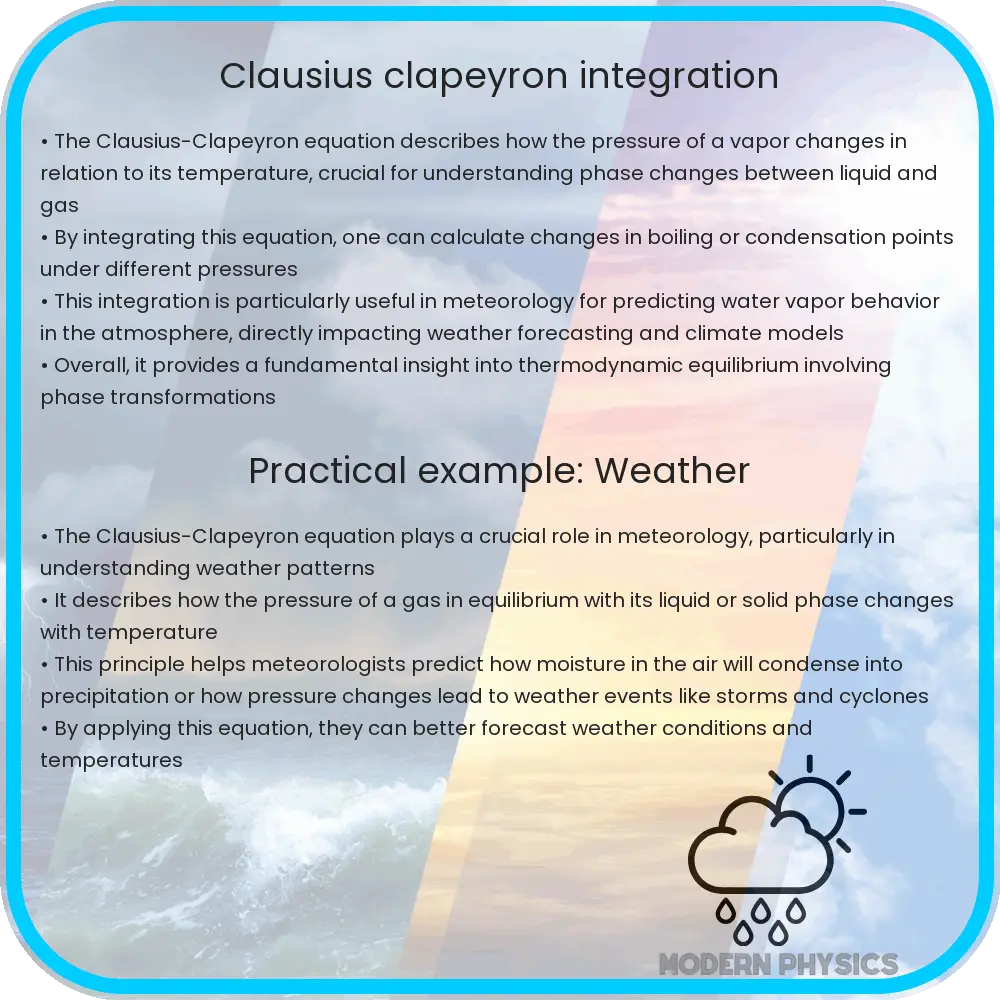
The Clausius-Clapeyron equation is a fundamental principle in thermodynamics, providing a quantitative description of the phase transition between two states of matter. It is particularly significant in understanding the relationship between temperature, pressure, and enthalpy change during phase changes such as boiling or melting.
Basics of Phase Transition
Phase transitions occur when a substance changes from one state of matter to another, such as from liquid to gas or solid to liquid. These transitions involve energy changes, where heat is either absorbed or released. This process is governed by two key thermodynamic quantities: enthalpy (H) and entropy (S).
The Clausius-Clapeyron Equation
The Clausius-Clapeyron equation provides a way to calculate the vapor pressure of a liquid or the pressure of a solid-liquid phase transition at different temperatures. The equation is expressed as:
\[ \frac{dP}{dT} = \frac{\Delta H}{T \Delta V} \]
Where dP/dT is the rate of change of pressure with temperature, ΔH is the enthalpy change of the phase transition, T is the absolute temperature, and ΔV is the change in volume during the transition.
Enthalpy Change in Phase Transitions
Enthalpy change (ΔH) is a crucial factor in phase transitions. It represents the amount of heat absorbed or released during a phase change at a constant pressure. For example, during boiling, a liquid absorbs heat without a rise in temperature. This absorbed heat is the enthalpy of vaporization.
Applications in Real World
The Clausius-Clapeyron equation has significant applications in various fields, including meteorology, environmental science, and chemical engineering. It helps in predicting weather patterns by understanding the behavior of water vapor in the atmosphere. In the chemical industry, it assists in designing processes involving phase changes, such as distillation.
The understanding of the Clausius-Clapeyron equation not only provides insight into fundamental thermodynamic principles but also aids in practical applications influencing everyday life.
Deepening the Understanding of Clausius-Clapeyron Equation
Delving deeper into the Clausius-Clapeyron equation, it’s important to understand how it models real-world phenomena. For instance, in meteorology, the equation helps in predicting the dew point, which is crucial for understanding humidity and cloud formation. Additionally, in the field of material science, understanding the phase transitions of materials under different temperatures and pressures is vital for developing new materials with desired properties.
Limitations and Considerations
While the Clausius-Clapeyron equation is powerful, it has limitations. The equation assumes that the change in volume (ΔV) is significantly large during gas-liquid transitions, and negligible during solid-liquid transitions. Also, it presumes ideal behavior in substances, which might not hold true in all conditions, especially under extreme temperatures and pressures. Therefore, for accurate predictions, these limitations must be taken into account.
Advanced Applications
In advanced applications, the Clausius-Clapeyron equation is modified to fit specific scenarios. For example, in supercritical fluid extraction, a technique used in food and pharmaceutical industries, modified versions of the equation are used to understand the behavior of substances beyond their critical points, where traditional phase definitions do not apply.
Conclusion
The Clausius-Clapeyron equation is a cornerstone in the study of thermodynamics and phase transitions. Its ability to relate the temperature and pressure during a phase change with the enthalpy change provides a fundamental understanding of matter’s behavior under different conditions. While it has limitations, its applications across diverse fields from meteorology to material science highlight its importance. Future advancements in thermodynamics may expand upon or refine this equation, but its core principles will remain integral to our understanding of phase transitions. This equation not only deepens our scientific knowledge but also enhances our capability to manipulate and utilize materials, impacting various sectors of technology and industry.