
The Brans-Dicke theory, a significant alternative to Einstein’s General Relativity, integrates the concepts of scalar fields and gravity to provide a unique perspective on cosmology.
Understanding Brans-Dicke Theory: A Blend of Scalar Field and Gravity
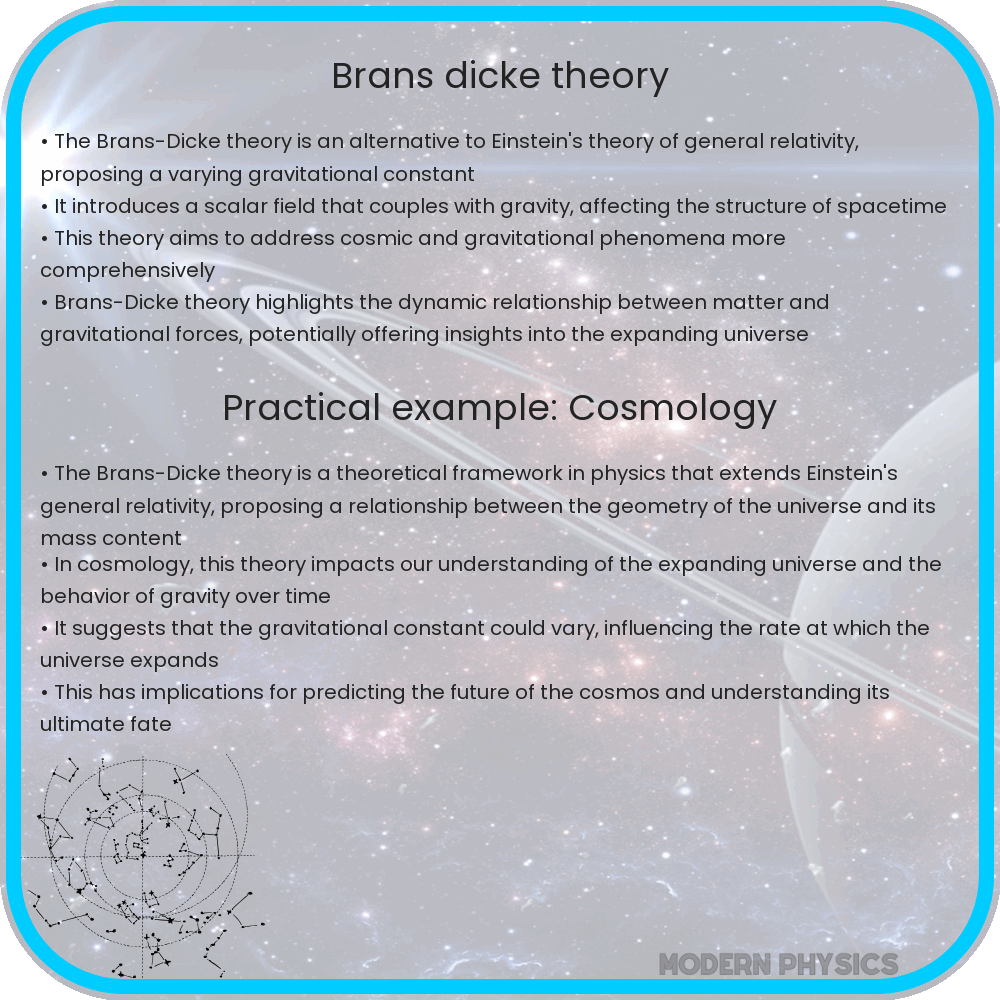
The Brans-Dicke theory, a significant alternative to Einstein’s General Relativity, integrates the concepts of scalar fields and gravity to provide a unique perspective on cosmology. Proposed by Carl Brans and Robert Dicke in the 1960s, this theory extends the general theory of relativity by incorporating a scalar field, often denoted as Φ, in addition to the metric tensor of spacetime. This addition aims to address certain cosmological issues and offers a varying gravitational constant, in contrast to the constant in Einstein’s theory.
Key Components of the Brans-Dicke Theory
The central elements of Brans-Dicke theory include:
- Scalar Field: The scalar field Φ represents a dynamic quantity affecting the strength of gravitational interaction. It varies across space and time, influencing the gravitational ‘constant’.
- Gravitational Coupling: The theory introduces a dimensionless coupling constant ω, which determines the strength of the interaction between the scalar field and matter. The value of ω is crucial in predicting different cosmological phenomena.
- Field Equations: Brans-Dicke theory modifies Einstein’s field equations by including the scalar field. These equations describe how matter, energy, and the scalar field influence spacetime curvature.
Implications in Cosmology
Brans-Dicke theory has profound implications for understanding the universe:
- Varying Gravitational Constant: The theory suggests that the gravitational constant may not be a true constant but varies with the scalar field. This could have significant effects on the evolution of the universe.
- Early Universe Dynamics: The theory provides alternative scenarios for the early universe, potentially explaining phenomena like cosmic inflation and dark energy.
- Tests and Observations: Several astrophysical observations, such as measurements of planetary motions and cosmic microwave background radiation, test the predictions of Brans-Dicke theory against General Relativity.
While the Brans-Dicke theory has not replaced General Relativity, it remains a vital framework for exploring gravitational theories beyond Einstein’s formulation. The interplay between the scalar field and gravity in this theory continues to inspire research in theoretical physics, particularly in the quest to unify gravity with other fundamental forces.
Challenges and Future Directions in Brans-Dicke Theory
Despite its intriguing propositions, the Brans-Dicke theory faces challenges. One significant issue is its compatibility with observational data. While the theory can align with some observations, it often requires fine-tuning of the scalar field and the coupling constant ω to match precise measurements, such as those related to solar system dynamics and cosmological parameters.
Integration with Quantum Mechanics and Dark Energy
A pivotal area of exploration is the integration of Brans-Dicke theory with quantum mechanics. This integration could lead to a more comprehensive understanding of gravity at both cosmological and quantum scales. Additionally, the theory’s potential in explaining dark energy — a mysterious force accelerating the universe’s expansion — is an active area of research. The scalar field in Brans-Dicke theory could serve as a candidate for dark energy, providing a theoretical basis for its elusive nature.
Scalar-Tensor Theories and String Theory
Brans-Dicke theory has also paved the way for the development of scalar-tensor theories, which generalize the concept of a varying gravitational constant. These theories are crucial in the context of higher-dimensional models, such as string theory. In string theory, scalar fields naturally arise from the compactification of extra dimensions, suggesting a deep connection between Brans-Dicke theory and fundamental physics theories.
Conclusion
The Brans-Dicke theory, blending scalar fields with gravity, represents a pivotal step in our quest to understand the universe’s fundamental nature. Although it has not supplanted Einstein’s General Relativity, its implications for cosmology, quantum gravity, and dark energy research are profound. The theory’s flexibility in accommodating a dynamic gravitational ‘constant’ and its influence on scalar-tensor theories contribute significantly to theoretical physics. Future research, particularly in reconciling it with quantum mechanics and observational data, will undoubtedly shed more light on the universe’s mysteries. As we continue to explore the cosmos, theories like Brans-Dicke offer valuable frameworks for pondering the grand questions of time, space, and the very fabric of reality.