
Explore the metric tensor’s crucial role in relativity, its applications from GPS to cosmology, and its future in unifying physics theories.
The Essence of the Metric Tensor in Relativity
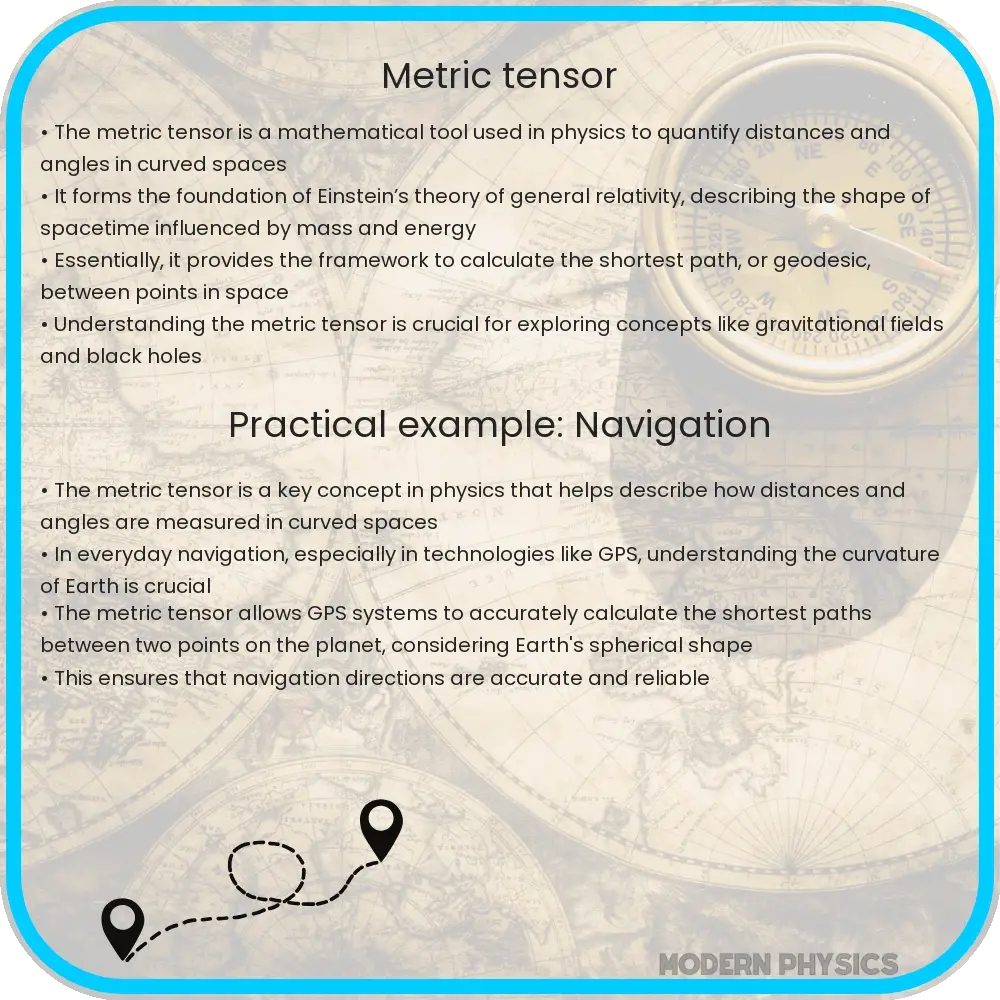
In the realm of physics, particularly in the theory of relativity, the metric tensor is a fundamental concept. It is a type of tensor that enables the calculation of distances and angles in a variety of spaces, which is crucial in understanding the fabric of the universe. The metric tensor is not just a mathematical abstraction; it has practical implications in understanding gravity, spacetime curvature, and the dynamics of celestial bodies.
Application in General Relativity
General Relativity, a theory proposed by Albert Einstein, revolutionized our understanding of gravity. Here, the metric tensor plays a pivotal role. It helps describe the geometry of spacetime, which is distorted by mass and energy. This distortion, in turn, affects the motion of objects, leading to what we perceive as gravitational attraction. The famous equation:
ds2 = gμνdxμdxν
represents the spacetime interval (ds2) in terms of the metric tensor gμν and the differentials of the coordinates dxμ. This equation is the cornerstone of understanding how spacetime is measured and perceived in General Relativity.
Theory and Mathematical Formulation
The metric tensor is more than just a tool for measuring distances. It is a profound expression of how spacetime itself is structured. Mathematically, it is represented as a symmetric matrix, and its components vary depending on the curvature and topology of the spacetime being considered. In the simplest case of flat spacetime, as described by Special Relativity, the metric tensor reduces to the Minkowski metric. However, in more complex scenarios, like near massive objects, its components become complex, reflecting the intricate nature of curved spacetime.
In conclusion, the metric tensor is not only central to the theory of relativity, but it also provides a deeper understanding of the universe. Its applications in calculating trajectories, understanding black holes, and even in the GPS technology we use every day, make it an indispensable tool in modern physics.
Advanced Applications of the Metric Tensor
The applications of the metric tensor extend beyond the basic understanding of spacetime. In cosmology, it helps in modeling the evolution of the universe. For instance, the Friedmann-Lemaître-Robertson-Walker (FLRW) metric is used in describing a homogeneous and isotropic universe. This has been instrumental in understanding the Big Bang and the expansion of the universe. Similarly, in the vicinity of black holes, the Schwarzschild metric provides insights into the nature of spacetime where gravitational effects are extreme.
Practical Implications in Technology
The metric tensor finds its way into practical applications as well. One of the most common examples is the Global Positioning System (GPS). GPS satellites need to account for the curvature of spacetime to provide accurate location data. This is where Einstein’s theory of General Relativity, and by extension the metric tensor, becomes crucial. The slight differences in time experienced by satellites in orbit as compared to those on Earth must be corrected using principles derived from the metric tensor.
Challenges and Future Prospects
Despite its widespread acceptance and utility, the metric tensor is not without challenges. One of the most significant is integrating the concept with quantum mechanics. This remains a fundamental problem in theoretical physics. The quest for a theory of quantum gravity, which would unite general relativity with quantum physics, is partly a quest to understand the metric tensor at the quantum level.
In the future, continued research in this area may lead to groundbreaking discoveries about the universe. Theoretical developments in string theory, loop quantum gravity, and other areas of physics all aim to provide a deeper understanding of the metric tensor’s role in the fabric of the cosmos.
Conclusion
The metric tensor is more than a mathematical construct; it’s a key to unlocking the mysteries of the universe. From the cosmic scale of galaxies and black holes to the precision required in modern technology like GPS, its applications are vast and varied. As we continue to explore the universe and develop our understanding of physics, the metric tensor will undoubtedly play a central role in bridging the known and the unknown, offering insights into the very nature of reality itself.