
Explore the intriguing world of Bosonic Fields in Quantum Field Theory, uncovering their properties, roles in particle physics, and cosmological impact.
Bosonic Fields: A Primer in Quantum Field Theory
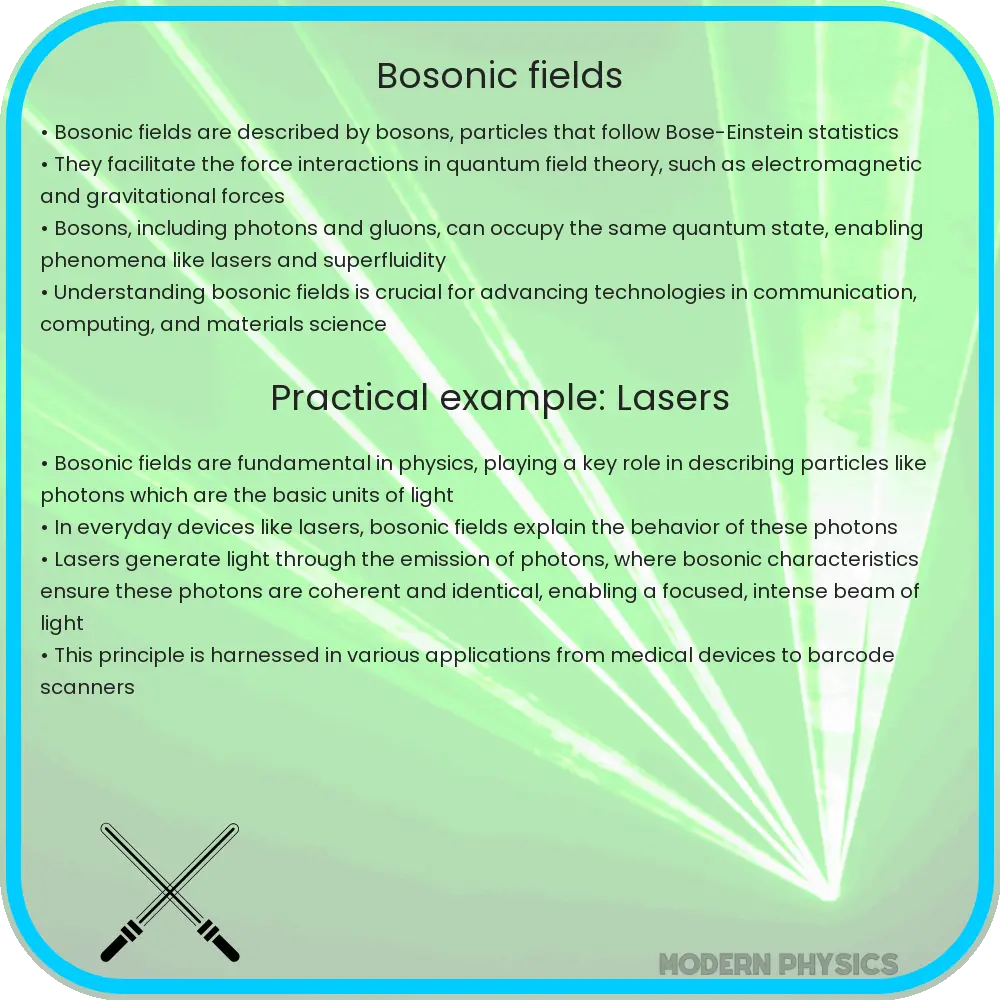
Quantum Field Theory (QFT) represents one of the most profound and compelling frameworks in modern physics, merging the principles of quantum mechanics with those of special relativity. At the heart of this theory are bosonic fields, a class of particles that adhere to Bose-Einstein statistics. These particles, including photons, W and Z bosons, and the Higgs boson, play a crucial role in mediating fundamental forces and imparting mass to other particles.
Understanding Bosonic Fields
Bosonic fields are characterized by integer spin values (0, 1, 2, …), distinguishing them from fermions, which have half-integer spins. This spin characteristic has profound implications, especially in terms of the Pauli exclusion principle. Unlike fermions, multiple bosons can occupy the same quantum state, leading to phenomena like Bose-Einstein condensates. This attribute underpins the behavior of forces in the standard model of particle physics, where bosons act as force carriers.
Properties and Characteristics
Key properties of bosonic fields include:
- Spin: Integer spin values allow bosons to occupy the same quantum state.
- Force Mediation: In the Standard Model, bosons mediate the fundamental forces – photons for electromagnetism, W and Z bosons for the weak force, and gluons for the strong force.
- Mass Acquisition: The Higgs boson, a pivotal discovery in particle physics, provides a mechanism for other particles to acquire mass through the Higgs field.
Applications in Modern Physics
Bosonic fields have critical applications in various areas of physics:
- Particle Physics: The study of fundamental particles and interactions heavily relies on understanding bosonic fields, especially in the context of the Standard Model.
- Condensed Matter Physics: Concepts like Bose-Einstein condensates, arising from bosonic behavior, are essential in studying phenomena like superfluidity and superconductivity.
- Cosmology: The early universe’s dynamics and the nature of dark matter are partially explained through bosonic field theories.
In conclusion, bosonic fields constitute a cornerstone of quantum field theory, illuminating our understanding of the universe’s fundamental workings. Their unique properties and diverse applications make them a central topic in both theoretical and experimental physics.
Advanced Concepts in Bosonic Field Theory
Delving deeper into the realm of quantum field theory, we encounter more intricate aspects of bosonic fields. One such concept is field quantization, where fields are treated as operators, leading to the creation and annihilation of particles. This approach is pivotal in describing interactions between particles and fields, particularly in the development of Feynman diagrams, which visually represent these interactions in particle physics.
Another advanced aspect is the role of bosonic fields in symmetry breaking mechanisms. The Higgs mechanism, a process where the symmetry of the Higgs field is broken, imparts mass to gauge bosons. This concept is central to the unification of the weak and electromagnetic forces, forming the electroweak interaction in the Standard Model.
Challenges and Future Directions
Despite the successes of QFT in explaining a vast array of phenomena, challenges remain. One significant issue is the reconciliation of quantum field theory with general relativity. Theories like string theory and loop quantum gravity attempt to address this, proposing frameworks where bosonic fields are integral in a more comprehensive understanding of the universe.
Furthermore, the exploration of dark energy and dark matter, which constitute a significant portion of the universe’s mass-energy content, may find explanations in extended bosonic field theories. These enigmatic components of our universe remain largely unexplained, and research into exotic bosonic fields, like axions, is a promising avenue for new discoveries.
Conclusion
Bosonic fields, fundamental to our understanding of the universe, are more than just constituents of particle physics. They represent the intricate balance and unity in the laws of nature, from governing the most fundamental interactions to shaping the cosmos. The study of these fields not only enhances our knowledge of the universe but also drives innovation in technology, such as advancements in superconductors and quantum computing.
The future of bosonic field research holds great promise. As we strive to integrate them with the broader framework of physics, including gravity, and explore their role in the universe’s dark components, we stand at the cusp of potentially revolutionary discoveries. The journey through the microscopic world of bosonic fields is an odyssey that continues to challenge and inspire physicists, promising a deeper understanding of the very fabric of reality.