
Bosons are fundamental particles in physics, essential for mediating forces and exhibiting unique characteristics like integer spin and Bose-Einstein condensation.
Introduction to Bosons
Bosons are a fundamental category of particles identified in particle physics that play a crucial role in the mechanisms that govern the universe. They are named after the Indian physicist Satyendra Nath Bose, whose work on quantum mechanics in the early 20th century laid the groundwork for the description of these particles. Unlike fermions, which make up matter, bosons are the carriers of force and facilitate the interactions between matter particles.
Characteristics of Bosons
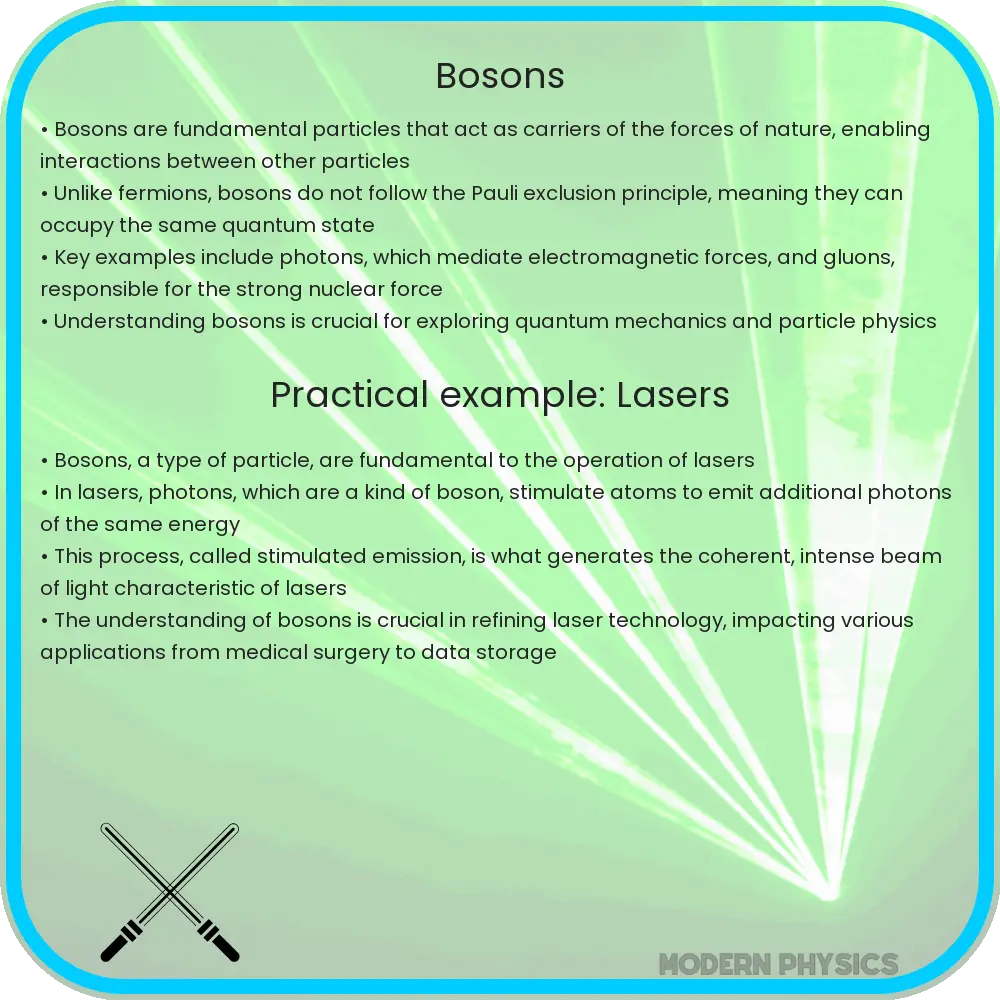
One of the most distinctive characteristics of bosons is that they obey Bose-Einstein statistics. Unlike fermions, which follow the Pauli Exclusion Principle and cannot occupy the same quantum state, bosons are not subject to these restrictions and can occupy the same quantum state. This ability leads to some of their unique properties, including the phenomenon of Bose-Einstein condensation where bosons at very low temperatures can collapse into a single quantum state, resulting in unique macroscopic quantum phenomena.
Another significant characteristic of bosons is their integer spin. In quantum mechanics, particles are classified according to their spin, a form of intrinsic angular momentum. While fermions have half-integer spins (like 1/2, 3/2), bosons possess integer spins (0, 1, 2, etc.). This integer spin is integral to their ability to mediate forces.
Types of Bosons
- Elementary Bosons: These are the force carriers in the field of particle physics, also known as gauge bosons. They include photons (which mediate electromagnetic forces), gluons (which mediate strong nuclear forces), weak bosons W and Z (which mediate weak nuclear forces), and the hypothetical gravitons (which are thought to mediate gravitational forces).
- Composite Bosons: These particles are made up of an even number of fermions, which gives them an overall integer spin. Examples include mesons (which are made of a quark and an antiquark) and certain atomic nuclei like deuterium (which has one proton and one neutron).
- Higgs Boson: This is a unique type of boson predicted by the Standard Model of particle physics. It differs from gauge bosons in that its primary role is not to mediate forces but rather to give other particles mass through the Higgs mechanism. Its discovery at the Large Hadron Collider in 2012 was a monumental moment in physics.
Importance of Bosons
Bosons play an instrumental role in the physical universe, from the smallest scales of particle physics to the large-scale structure of the cosmos. By mediating forces, they are essential to maintaining the structure of atoms, binding atomic nuclei, and governing the interactions between various particles. The characteristics and behaviors of bosons also fuel advancements in technology, such as the development of lasers (which rely on the properties of photons, a type of boson) and superconductivity.
Applications of Bosons in Modern Technology
The principles governing bosons have profound implications not only in theoretical physics but also in practical applications. For instance, the understanding and manipulation of photons have led to the development of lasers, which have numerous applications in medicine, industry, and telecommunications. Similarly, the phenomenon of Bose-Einstein condensation has implications in future quantum computing technologies, potentially leading to advances in processing power and efficiency.
Additionally, research into the Higgs boson and its associated field may one day provide insights into new forms of energy or novel materials with unique properties. The exploration of these particles continues to push the boundaries of what is technologically achievable.
Challenges in Boson Research
While bosons provide numerous opportunities for scientific advancement, they also present unique challenges. The detection and study of bosons, especially those like the Higgs boson and hypothetical gravitons, require highly sensitive equipment and large-scale experiments, such as those conducted at the Large Hadron Collider. This makes research both costly and complex.
Furthermore, theoretical challenges remain in unifying the different forces mediated by various bosons, particularly in integrating gravity with the other fundamental forces—a goal of the yet-to-be-achieved theory of everything.
Conclusion
Bosons, spanning from photons and gluons to the Higgs boson, are fundamental to our understanding of the universe. As force carriers, their unique ability to occupy the same quantum state and their integer spin characteristics make them integral to both the structure and dynamics of matter. With ongoing research and technological advancements, our understanding of bosons continues to evolve, opening new possibilities in various fields including computing, material science, and theoretical physics. As we deepen our comprehension of these particles, we may unlock further secrets of the universe, paving the way for future innovations. This ongoing journey not only underscores the importance of bosons in the natural world but also highlights the continually evolving nature of scientific inquiry.