
Explore Yang-Mills Theory in quantum mechanics: its role in gauge symmetry, particle behavior, and challenges, paving the way for new physics.
Understanding Yang-Mills Theory: A Pillar of Quantum Mechanics
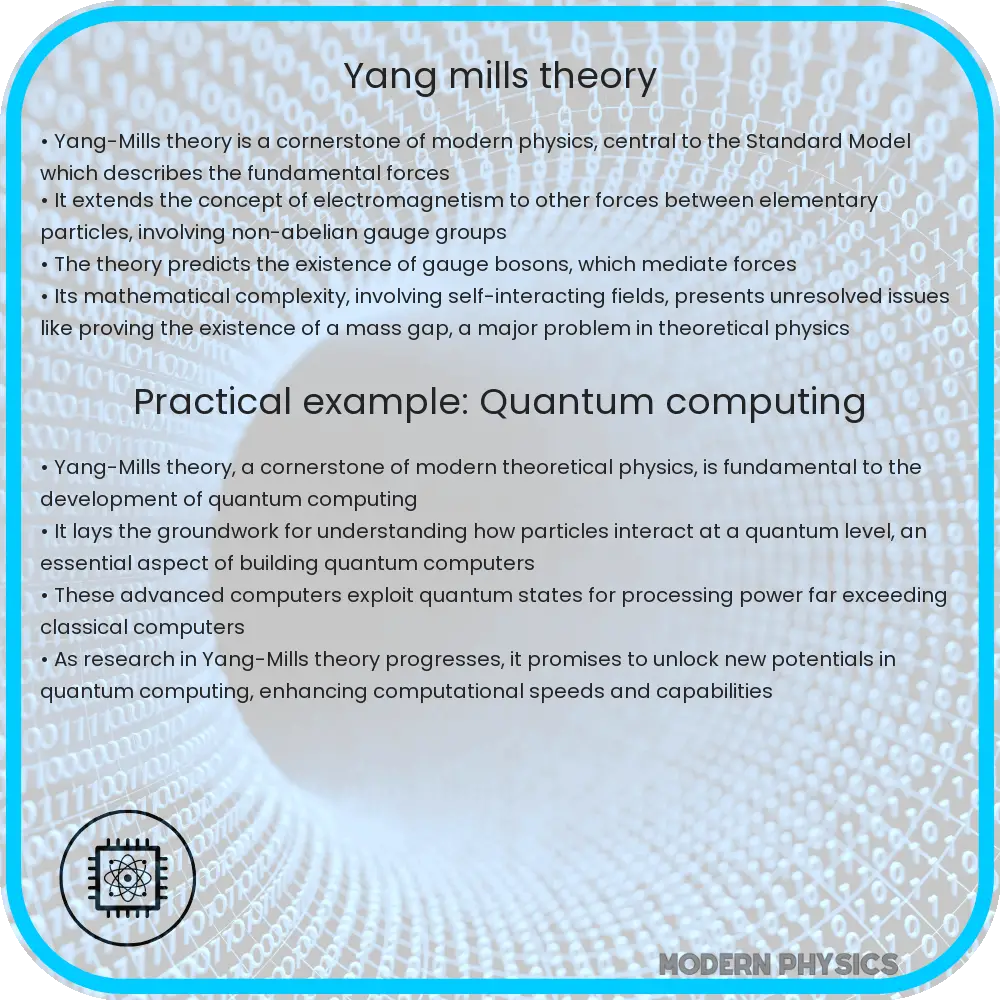
Yang-Mills theory stands as a cornerstone in the realm of theoretical physics, particularly in quantum mechanics and the study of gauge symmetries. Developed in the mid-20th century by physicists Chen Ning Yang and Robert Mills, this theory extends the concept of gauge symmetry, a fundamental principle in electromagnetism, to more complex fields. It plays a pivotal role in our understanding of the strong force, one of the four fundamental forces in nature, which binds particles inside atomic nuclei.
Gauge Symmetry and Quantum Mechanics
Gauge symmetry is a principle that underlies many fundamental theories in physics. It states that certain transformations, which can vary from point to point in space and time, do not affect the physical properties of a system. In quantum mechanics, this concept becomes crucial in describing how particles interact with fields. The most familiar example of gauge symmetry is electromagnetism, where the electric and magnetic fields remain invariant under specific transformations.
Yang-Mills theory extends these ideas to non-abelian gauge theories, which involve gauge groups that do not commute, unlike the abelian group of electromagnetism. This extension allows for a more comprehensive framework to describe interactions between particles, particularly those involved in the strong force, such as quarks and gluons.
Particles and Fields in Yang-Mills Theory
In Yang-Mills theory, particles like quarks are described as field quanta. These particles carry a property called “color charge”, analogous to the electric charge in electromagnetism, but with more complex properties due to the non-abelian nature of the theory. Gluons, the force carriers of the strong force, are responsible for binding quarks together to form particles like protons and neutrons.
The theory posits that gluons themselves carry color charge, leading to their self-interaction – a distinctive feature not seen in electromagnetism. This self-interaction is fundamental to the theory and explains why the strong force is so powerful at short distances, yet diminishes rapidly beyond the scale of atomic nuclei.
Moreover, Yang-Mills theory forms the foundation for the Standard Model of particle physics, which describes how the basic building blocks of the Universe interact. Its application extends beyond the strong force, providing insights into weak interactions and the unification of fundamental forces.
Despite its success, Yang-Mills theory poses significant mathematical challenges. For instance, proving the existence and mass gap of Yang-Mills fields remains one of the Millennium Prize Problems, a testament to its complexity and fundamental significance in physics.
Challenges and Implications of Yang-Mills Theory
One of the most intriguing aspects of Yang-Mills theory is its complexity and the challenges it poses to mathematicians and physicists. A key unresolved issue in the theory is the “mass gap” problem. This problem pertains to the existence of a gap between the lowest energy state (the vacuum) and the next state with higher energy, in a quantum field theory. Proving this for Yang-Mills theory is essential for understanding why particles like gluons and quarks, which mediate the strong force, cannot be observed freely in nature, unlike photons in electromagnetism.
Furthermore, Yang-Mills theory is integral to the development of quantum chromodynamics (QCD), the theory describing the strong interaction. QCD extends the concepts of Yang-Mills to include the dynamics of quarks and gluons. This has led to groundbreaking discoveries about the behavior of these particles, especially under extreme conditions, such as those existing in the early universe or in neutron stars.
Unification of Forces and Beyond
Yang-Mills theory not only enhances our understanding of the strong force but also plays a pivotal role in the quest for the unification of fundamental forces. The Standard Model, which unifies electromagnetic, weak, and strong forces, relies heavily on the principles of gauge symmetry central to Yang-Mills theory. This unification represents one of the major triumphs of modern physics, yet it also highlights the limitations of our current understanding, particularly in integrating gravity with other fundamental forces.
Moreover, the study of Yang-Mills theory has spurred advancements in other fields such as mathematics, particularly in topology and geometry. The concepts derived from this theory have led to novel insights into the structure of space-time and the nature of quantum fields.
Conclusion
In conclusion, Yang-Mills theory is a fundamental pillar in the structure of theoretical physics, offering deep insights into the nature of particles and forces. Its influence extends far beyond its original scope, impacting various fields and pushing the boundaries of our understanding of the universe. Despite its challenges, particularly the mass gap problem, its continued study promises not only to deepen our grasp of quantum mechanics and field theory but also to possibly pave the way towards new physics, potentially including a unified theory of all fundamental forces. The pursuit of these answers continues to drive some of the most exciting research in physics today.