
Explore the mysteries of Baryon Acoustic Oscillations (BAOs) and their crucial role in understanding the universe’s structure, dark matter, and dark energy.
Understanding Baryon Acoustic Oscillations: The Cosmic Rhythm
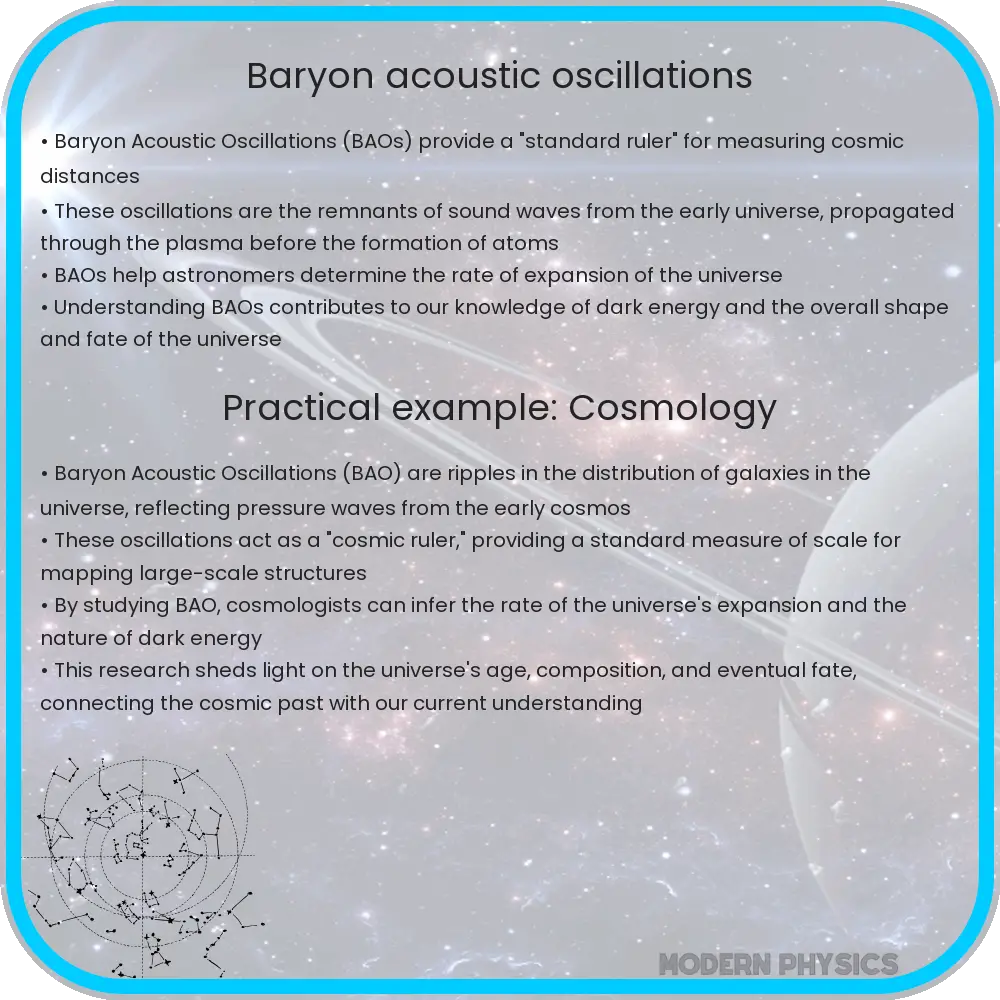
Baryon Acoustic Oscillations (BAOs) are a phenomenon tied deeply to the early universe and the formation of large-scale structures, such as galaxies and clusters of galaxies. These oscillations are the imprint of sound waves that traveled through the early universe, specifically through the hot, dense plasma that filled the cosmos shortly after the Big Bang. Understanding BAOs is essential for cosmologists as they provide a “standard ruler” for measuring distances in the universe and thus help in understanding the nature of dark energy and dark matter.
Origins and Nature of BAOs
The story of Baryon Acoustic Oscillations begins in the very early universe, at a time when it was filled with a hot, dense mixture of electrons, protons (which together with neutrons make up baryons), and photons (light particles). This mixture is known as the “baryon-photon plasma. In the nascent universe, regions of slightly higher density would attract more matter due to gravitational forces, creating pressure. However, this attraction of matter was counterbalanced by the radiation pressure of photons, creating a push-pull dynamic that led to oscillations — much like sound waves propagating through air.
As the universe expanded and cooled, protons and electrons combined to form neutral hydrogen atoms, a process known as recombination, causing the photons to decouple from the baryons. This decoupling left behind an imprint of these sound waves in the distribution of matter. The scale of these oscillations, approximately 150 Mpc (mega parsecs), acts as a standard ruler for cosmic distances because it is well-defined and can be observed in the large-scale structure of the universe.
Impact on Cosmic Structure Formation
BAOs have played a crucial role in the formation of the cosmic web, the large-scale structure of the universe that includes voids, sheets, filaments, and clusters. The oscillations set a preferred scale for the clustering of matter, which influenced the distribution of galaxies and galaxy clusters. By studying the pattern and scale of BAOs through surveys of the cosmic microwave background (CMB) and large-scale galaxy surveys, cosmologists can trace the expansion history of the universe and gain insights into the mysterious components of the cosmos: dark matter and dark energy.
BAOs as Probes of Dark Energy and Dark Matter
The significance of Baryon Acoustic Oscillations extends beyond the understanding of early cosmic conditions; they are pivotal in elucidating the nature of dark energy and dark matter. Dark energy, a mysterious force driving the accelerated expansion of the universe, leaves its imprint on the cosmic scale through its influence on the expansion rate. By measuring the length scale of BAOs at different epochs in the universe’s history, astronomers can infer the rate of expansion and thus the properties of dark energy.
Similarly, dark matter, which does not emit, absorb, or reflect light, reveals its presence through gravitational effects on visible matter, including the clustering patterns influenced by BAOs. The distribution and density of dark matter affect the strength and scale of BAOs in the cosmic microwave background and the large-scale structure of the universe. By studying BAOs, researchers can map the distribution of dark matter and better understand its role in cosmic evolution.
Recent Advances and Future Prospects
Recent advancements in telescope technology and data analysis techniques have dramatically improved our ability to measure BAOs across vast distances and at various times in cosmic history. These measurements have led to more precise estimates of the Hubble constant, the rate of cosmic expansion, and have provided stringent constraints on models of dark energy and modifications to the standard model of cosmology.
The future of BAO research looks promising, with several large-scale galaxy surveys underway or in planning stages. These surveys aim to map out the distribution of galaxies over unprecedented volumes of the universe, providing more detailed BAO measurements that will refine our understanding of the cosmos, from the nature of dark energy and dark matter to the curvature of space and the validity of Einstein’s theory of general relativity.
Conclusion
Baryon Acoustic Oscillations represent one of the most powerful tools in cosmology for probing the large-scale structure of the universe and understanding the fundamental components that shape its fate. From their origins in the early universe to their implications for the nature of dark matter and dark energy, BAOs encapsulate a critical chapter in the story of the cosmos. As observational techniques continue to advance, the study of BAOs will undoubtedly play a pivotal role in unveiling the mysteries of the universe, offering insights into its past, present, and future.