
Explore the formation, dynamics, and evolution of galaxy clusters, the largest structures in the universe, and their role in cosmology and galaxy transformation.
Introduction to Galaxy Cluster Environments
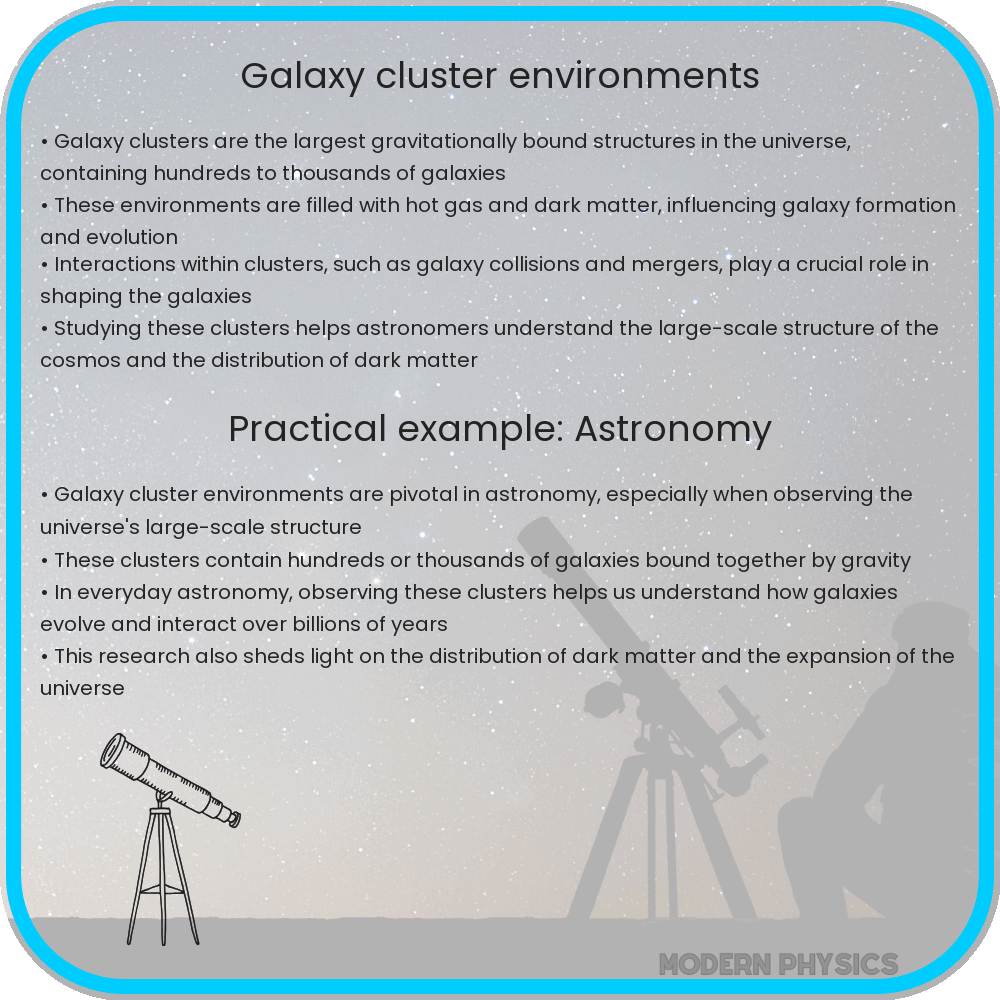
Galaxy clusters represent the largest structures in the Universe that are bound by gravity. They consist of hundreds to thousands of galaxies, hot gas emitting X-rays, and dark matter. Understanding their formation, dynamics, and evolution is crucial for unraveling the mysteries of the cosmos.
Formation of Galaxy Clusters
The formation of galaxy clusters is deeply rooted in the Big Bang theory. In the early universe, minor fluctuations in the cosmic microwave background radiation led to inhomogeneities in the matter distribution. Over billions of years, these inhomogeneities, governed by dark matter, grew under gravity to form the large-scale structure we observe today. Galaxy clusters form in regions where the density of dark matter is highest, pulling in galaxies through gravitational attraction.
Dynamics within Galaxy Clusters
The internal dynamics of galaxy clusters are complex and influenced by various forces. The galaxies within a cluster move under the influence of the cluster’s gravitational field, which is dominated by dark matter. This movement is not random; galaxies follow orbits determined by the cluster’s mass distribution. Additionally, the hot intracluster medium (ICM), consisting of gas at temperatures of 107 to 108 K, exerts pressure and experiences shocks and cooling flows within the cluster environment.
Evolution of Galaxy Clusters
Galaxy clusters are not static entities; they evolve over time through mechanisms such as mergers and accretion. Smaller groups of galaxies can merge with larger clusters, a process that can significantly alter the cluster’s structure and the properties of its member galaxies. Furthermore, the ICM evolves as it interacts with the galaxies and the dark matter halo, influencing star formation rates and galaxy morphology. The study of this evolution provides insights into the history of the universe and the role of dark matter and dark energy in shaping the cosmos.
Environmental Effects within Galaxy Clusters
Galaxy clusters exert profound environmental effects on their constituent galaxies. Processes such as ram-pressure stripping can remove gas from galaxies as they move through the intracluster medium, quenching star formation and transforming spiral galaxies into elliptical ones. Moreover, galaxy harassment, tidal interactions, and mergers within the dense environments of clusters can lead to significant morphological transformations and trigger starburst activities.
Observational Studies and Cosmological Implications
Advancements in observational astronomy have allowed for detailed studies of galaxy clusters across the electromagnetic spectrum. X-ray observations reveal the hot intracluster gas, while optical and infrared data provide information on the galaxies and their evolution. Gravitational lensing studies offer insights into the distribution of dark matter within clusters. These observations, combined with theoretical models, help refine our understanding of cosmology, including the rate of expansion of the universe and the nature of dark energy.
Challenges and Future Prospects
Despite significant progress, there remain challenges in galaxy cluster research. Accurately simulating the complex physics of galaxy clusters, including feedback mechanisms from supermassive black holes, requires sophisticated models and extensive computational resources. Additionally, understanding the detailed physics of the intracluster medium, and its interaction with galaxies, remains an ongoing area of research. Future observatories and telescopes, such as the James Webb Space Telescope and the Euclid mission, promise to provide deeper insights into the formation and evolution of galaxy clusters.
Conclusion
Galaxy clusters are essential to our understanding of the universe. They serve as laboratories for studying the interplay of dark matter, dark energy, and baryonic matter. The dynamics and evolution of galaxy clusters inform us about the cosmological parameters that shape our universe and the physical processes influencing galaxy formation and evolution. As observational techniques advance and theoretical models become more refined, our knowledge of galaxy clusters will continue to expand, shedding light on the darkest corners of the cosmos and offering a clearer picture of the universe’s grand design.