
Explore the role of axions in quantum field theory and cosmology, unraveling their potential as dark matter candidates and solving the strong CP problem.
Axions: Bridging the Gap in Modern Physics
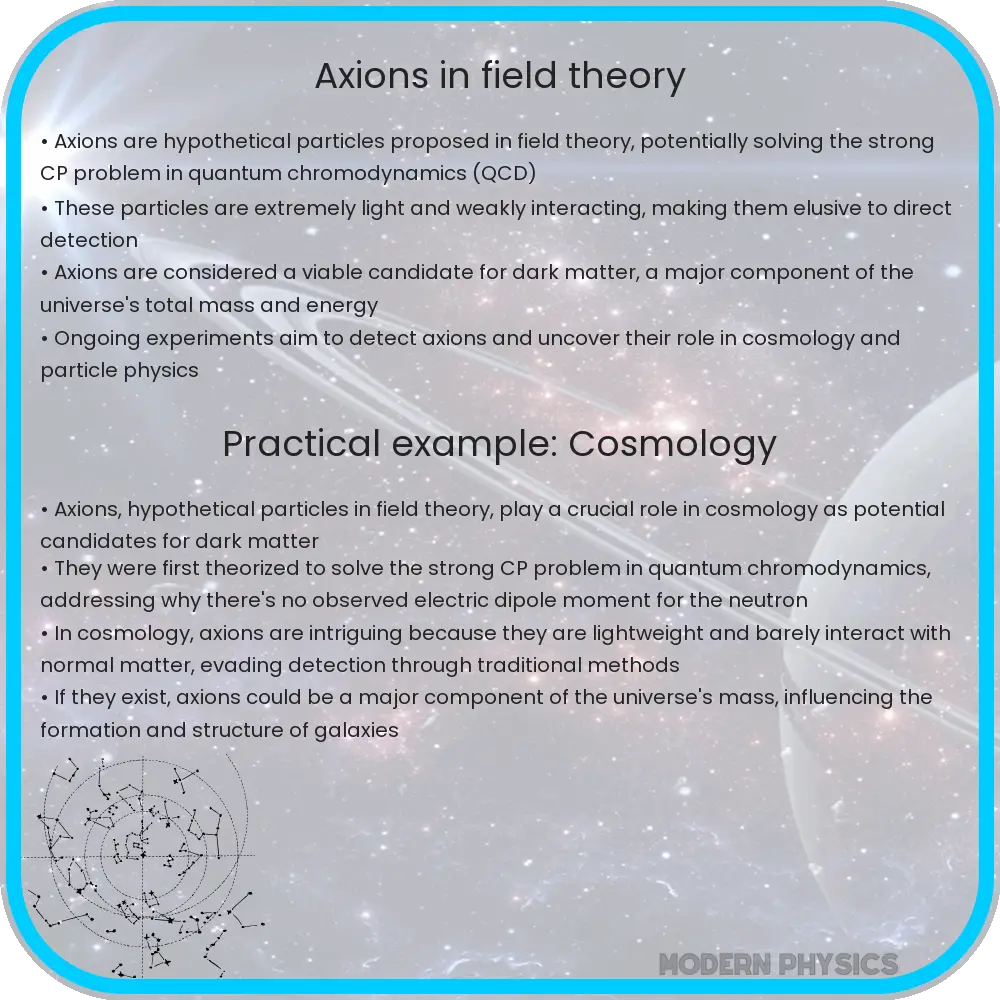
The quest for understanding the fundamental components of the universe has led physicists to explore various exotic particles, among which axions stand out due to their intriguing properties and implications in both quantum field theory (QFT) and cosmology. Originating from the Peccei-Quinn theory, designed to resolve the strong CP problem in quantum chromodynamics (QCD), axions are hypothesized to be a key component of dark matter, one of the most elusive subjects in modern astrophysics.
Understanding Axions in Quantum Field Theory
In quantum field theory, axions emerge as a byproduct of the Peccei-Quinn mechanism. This mechanism was proposed to address the strong CP problem, a major theoretical issue involving the non-observation of charge-parity (CP) violation in strong interactions. Axions are pseudo-Nambu-Goldstone bosons associated with the spontaneous symmetry breaking of the Peccei-Quinn symmetry at a high energy scale. Unlike other particles predicted by QFT, axions are remarkably light and interact only weakly with ordinary matter and electromagnetic fields, making them extremely challenging to detect.
Axions and the Dark Matter Conundrum
The potential of axions as a dark matter candidate lies in their unique properties. Dark matter, accounting for approximately 27% of the universe’s mass-energy composition, remains undetected through electromagnetic radiation, posing a significant challenge in cosmology. Axions, with their low mass and weak interaction with regular matter, fit well into the criteria for cold dark matter. They are theorized to have been produced abundantly in the early universe and to persist due to their stability and weak interactions.
Experimental searches for axions involve detecting their conversion into photons under strong magnetic fields, a process inversely proportional to their mass. Notable experiments include the Axion Dark Matter Experiment (ADMX) and the CERN Axion Solar Telescope (CAST), which aim to directly detect axions by exploiting their hypothesized interactions with electromagnetic fields.
Furthermore, axions are also considered in the context of astrophysical observations. Their impact on the evolution of stars and the dynamics of galaxies provides indirect evidence supporting their existence and role as dark matter.
Exploring the Cosmological Implications of Axions
The implications of axions extend beyond their role in resolving the strong CP problem and as a dark matter candidate. In cosmology, axions provide a promising avenue for understanding the early universe’s evolution. Theoretically, during the era of inflation, the Peccei-Quinn field could have experienced fluctuations, leading to the generation of axions. These axions, surviving from the early universe, could offer insights into the period of cosmic inflation, potentially shedding light on the conditions and processes that shaped the early cosmos.
Challenges and Future Prospects in Axion Research
Despite their theoretical appeal, axions pose significant experimental challenges. Their weak interaction with ordinary matter and light makes direct detection extraordinarily difficult. This has led to the development of highly sensitive and specialized detectors. Future advancements in quantum sensing technologies and improvements in magnetic field generation could enhance the sensitivity of axion detection experiments, increasing the likelihood of discovering these elusive particles.
In addition to experimental searches, advancements in theoretical models are crucial. Refining the models that predict axion properties, such as their mass and coupling constants, is key to narrowing down the search parameters. Collaboration between theorists and experimentalists is essential in this endeavor, as theoretical guidance can significantly inform and direct experimental efforts.
Conclusion: The Promising Horizon of Axion Research
Axions, though still hypothetical, stand at the forefront of modern physics, offering potential solutions to some of the most profound mysteries in quantum field theory and cosmology. Their role in addressing the strong CP problem, coupled with their candidacy as a major component of dark matter, makes them a prime focus in the quest to understand the fundamental nature of our universe. The ongoing and future experimental searches, along with theoretical advancements, hold the promise of unveiling these enigmatic particles, potentially leading to a new era in our understanding of the cosmos. As research progresses, axions may not only elucidate the dark matter mystery but also provide a deeper comprehension of the universe’s early history and the fundamental forces that govern it.