
Explore dark matter’s role in the universe, linking relativity and quantum mechanics, and the quest to unify cosmic and quantum phenomena.
Exploring the Enigmatic Universe: Dark Matter Models Linked with Relativity and Quantum Mechanics
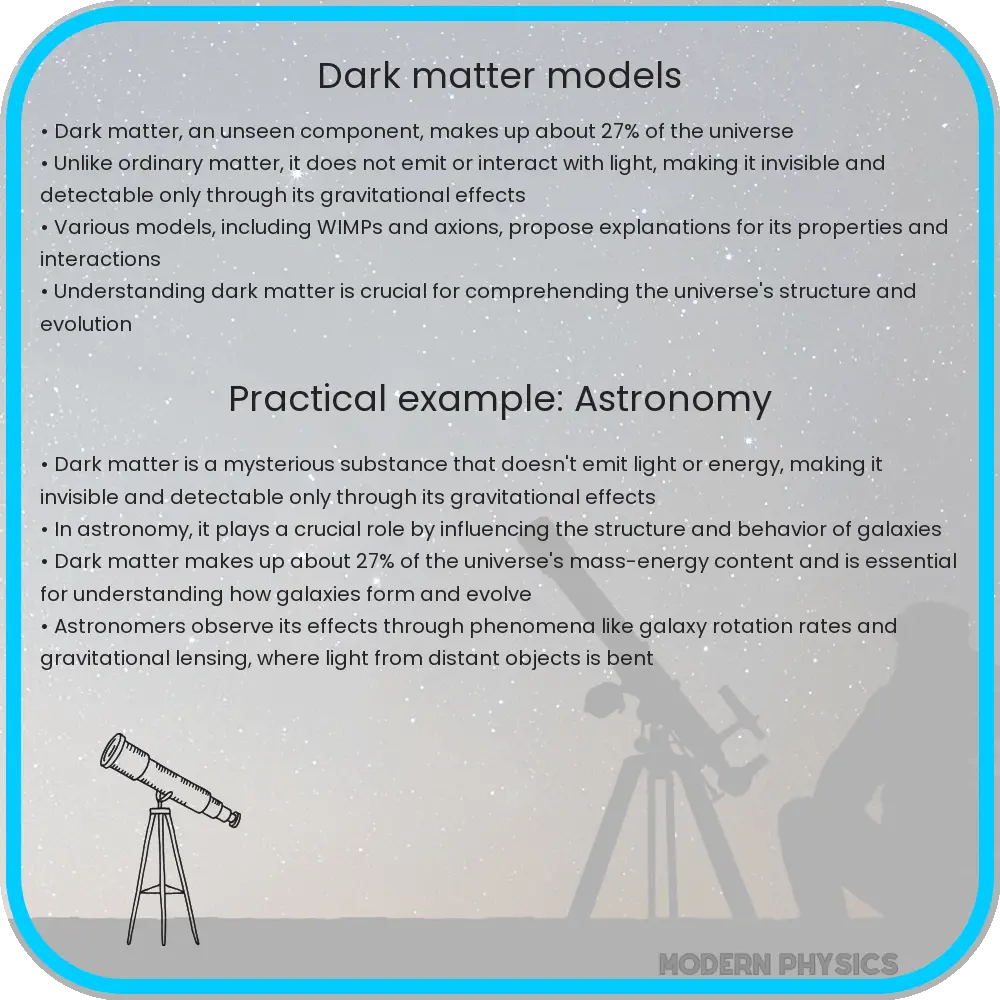
The universe is a vast expanse filled with mysteries, and one of the most intriguing is the enigma of dark matter. This unseen substance, which does not emit, absorb, or reflect light, is believed to make up approximately 27% of the universe’s total mass and energy. Despite its elusive nature, dark matter has a profound impact on the cosmic structure and the behavior of galaxies, challenging our understanding of physics. In this exploration, we delve into the latest insights linking dark matter models with the principles of relativity and quantum mechanics.
The Role of Dark Matter in the Cosmos
Dark matter’s gravitational effects play a critical role in the formation and evolution of galaxies. According to astrophysical observations, galaxies rotate at such speeds that, without the presence of dark matter’s gravitational pull, they would tear themselves apart. The rotational speeds of galaxies, as measured by their outer stars, do not decrease in the manner predicted by the visible mass alone, suggesting the presence of an invisible mass—dark matter.
Relativity’s Insight: Gravitational Lensing
Einstein’s theory of general relativity, which describes gravity as the warping of spacetime by mass, provides a tool for observing dark matter through gravitational lensing. This phenomenon occurs when the gravity of a massive object, like a galaxy or a cluster of galaxies, bends the light from objects behind it, creating distorted or magnified images. Such observations have been pivotal in mapping the distribution of dark matter and understanding its influence on cosmic scales.
Quantum Mechanics and Dark Matter Particles
Quantum mechanics, the branch of physics that deals with the behavior of particles at the smallest scales, offers another perspective on dark matter. Theoretical physicists have proposed various exotic particles as candidates for dark matter. Among these are Weakly Interacting Massive Particles (WIMPs), axions, and sterile neutrinos. WIMPs, in particular, have attracted significant attention due to their potential interaction with normal matter through weak nuclear forces, a concept that aligns with the Standard Model of particle physics.
Experiments conducted in underground laboratories, shielded from cosmic radiation, aim to detect these elusive particles. However, despite extensive searches, direct detection of dark matter particles remains a challenge, pushing the boundaries of our current understanding and technology.
Unifying Dark Matter with Quantum Field Theory
A promising approach to understanding dark matter is through quantum field theory (QFT), which combines quantum mechanics with the theory of special relativity. QFT treats particles as excitations in a quantum field, which could provide a framework for describing dark matter particles. The integration of dark matter into QFT could lead to new insights, potentially bridging the gap between the microscopic world of quantum particles and the macroscopic phenomena governed by general relativity.
Challenges and Future Prospects in Dark Matter Research
Despite the advances in both observational and theoretical physics, dark matter remains one of the most challenging puzzles in modern science. The difficulty in detecting dark matter particles and the need for new physics beyond the Standard Model represent significant hurdles. Future experiments, such as more sensitive particle detectors and advanced astronomical observations, are crucial for making progress in this field.
Implications for Cosmology and Particle Physics
The pursuit of understanding dark matter is not just a quest to identify a missing cosmic ingredient. It is also a journey that might reveal new physics, potentially leading to a more comprehensive theory that unifies the quantum and relativistic realms. Discoveries in dark matter research could have profound implications for cosmology, shedding light on the early universe, galaxy formation, and the ultimate fate of the cosmos. In particle physics, uncovering the nature of dark matter could lead to an expanded Standard Model or entirely new theoretical frameworks.
Conclusion
In conclusion, the intersection of dark matter research with the principles of relativity and quantum mechanics represents one of the most exciting frontiers in physics. While the true nature of dark matter remains elusive, the ongoing efforts in theoretical and experimental physics hold the promise of groundbreaking discoveries. These endeavors not only aim to solve the mystery of dark matter but also strive to deepen our understanding of the fundamental laws governing the universe. As we continue to probe the cosmos and the quantum world, the enigma of dark matter stands as a beacon, guiding us toward a more complete understanding of reality.