
Explore the revolutionary impact of autorefractors in eye care, offering speed, precision, and the latest in optical technology for accurate vision assessments.
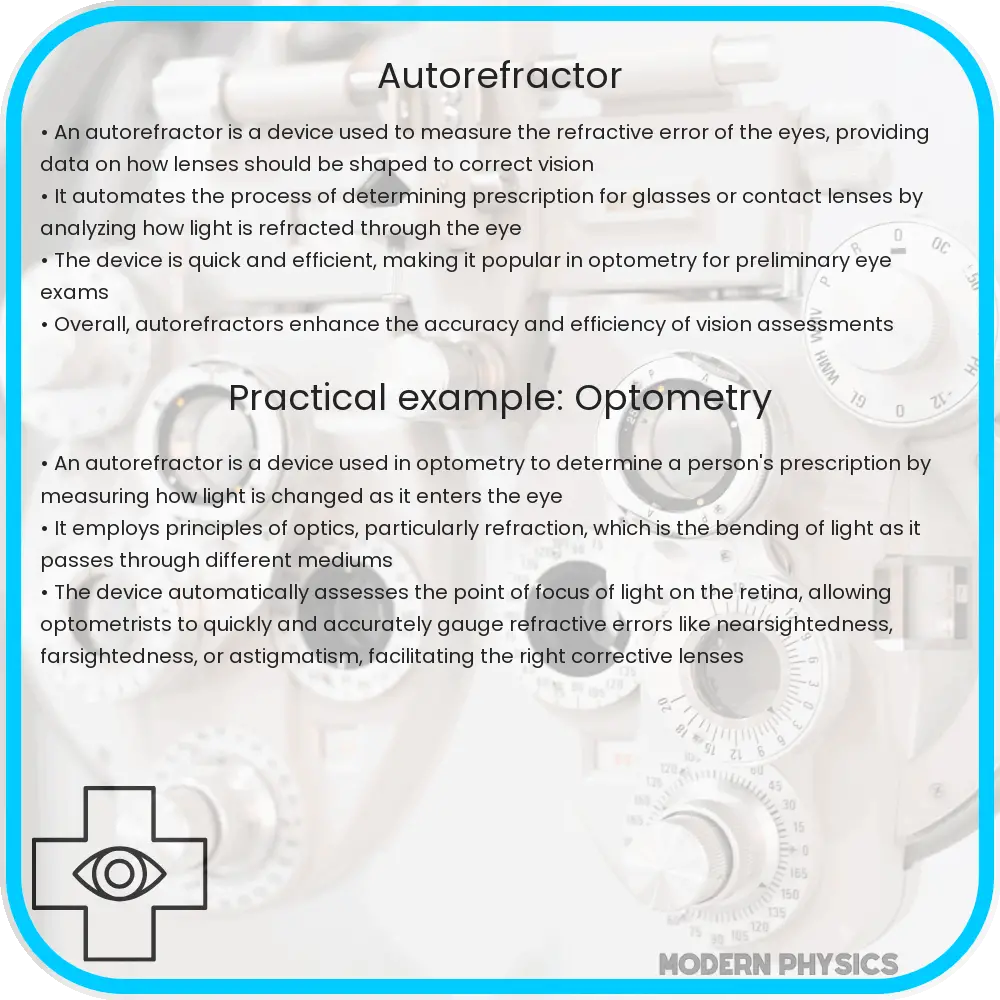
Understanding the Autorefractor: Revolutionizing Eye Care
Autorefractors have become a staple in modern eye care, offering unprecedented precision and speed in determining a person’s refractive error. This advanced technology utilizes sophisticated optics to analyze the way light is refracted through the eye, providing eye care professionals with a quick and accurate assessment of a patient’s refractive status.
How Does an Autorefractor Work?
At its core, the autorefractor employs a complex system of lenses and mirrors. It projects a light into the eye and measures how it changes as it bounces back from the retina. The device then automatically calculates the refractive error based on these changes. This process involves a series of intricate optical principles, primarily the use of infrared light that ensures minimal discomfort to the patient.
Advantages of Autorefractors
- Speed: One of the most significant benefits is the rapidity of the autorefractor. Traditional methods of determining refractive error can be time-consuming, but autorefractors can provide results within seconds.
- Precision: The high degree of accuracy in autorefractors minimizes the risk of human error, making them highly reliable in diagnosing vision problems.
- User-Friendly: Autorefractors are designed for ease of use, requiring minimal input from the operator. This simplicity makes them an excellent tool for initial eye examinations.
Technological Innovations in Autorefractors
Recent advancements in optical technology have further enhanced the capabilities of autorefractors. These include adaptive optics, which corrects for distortions in the eye’s media, and wavefront technology that analyzes the light as it travels through the eye, providing a more detailed view of refractive errors.
The Role of Autorefractors in Modern Eye Care
The integration of autorefractors into eye care practices has streamlined the process of vision assessment. Their ability to quickly and accurately determine refractive errors makes them invaluable in prescribing eyeglasses or contact lenses, and in preparing patients for refractive surgery. With ongoing technological enhancements, autorefractors continue to play a critical role in advancing the field of optometry and ophthalmology.
Enhancing Patient Experience with Autorefractors
Autorefractors not only benefit eye care professionals but also enhance the patient experience. The quick and non-invasive nature of the test reduces patient discomfort and anxiety, especially beneficial for children and individuals with special needs. This efficiency leads to shorter appointment times, allowing clinics to serve more patients effectively.
Integration with Other Diagnostic Tools
Modern autorefractors are often integrated with other diagnostic devices, such as keratometers, which measure the curvature of the eye’s front surface. This integration provides a comprehensive analysis of the eye’s refractive status and corneal health, crucial for diagnosing conditions like astigmatism.
Future of Autorefractor Technology
The future of autorefractor technology is promising, with ongoing research focusing on further enhancing precision and incorporating artificial intelligence (AI) to interpret results more effectively. These advancements aim to make refractive assessments even more accurate and personalized, paving the way for customized treatment plans.
Limitations and Considerations
Despite their advantages, autorefractors have limitations. They may not always be suitable for patients with certain eye conditions, such as cataracts or severe refractive errors. In these cases, manual refraction or additional tests may be necessary. Furthermore, the accuracy of autorefractors can be affected by the patient’s cooperation and eye health, emphasizing the need for a comprehensive eye examination by a qualified professional.
Conclusion
The advent of autorefractor technology marks a significant milestone in the field of eye care. By offering rapid, precise, and user-friendly assessments of refractive errors, autorefractors have not only streamlined the diagnostic process but also enhanced patient care. The integration of advanced optic technologies, such as adaptive optics and wavefront analysis, further elevates their efficacy. Despite certain limitations, the ongoing technological advancements in autorefractors promise even greater contributions to eye health in the future. As we embrace these innovations, the role of autorefractors in improving vision and quality of life continues to expand, solidifying their place as an indispensable tool in modern optometry and ophthalmology.