
Explore the precision and role of phoropters in vision testing and optical design, and discover how technology enhances modern eye care.
Understanding the Phoropter: A Key Instrument in Vision Testing
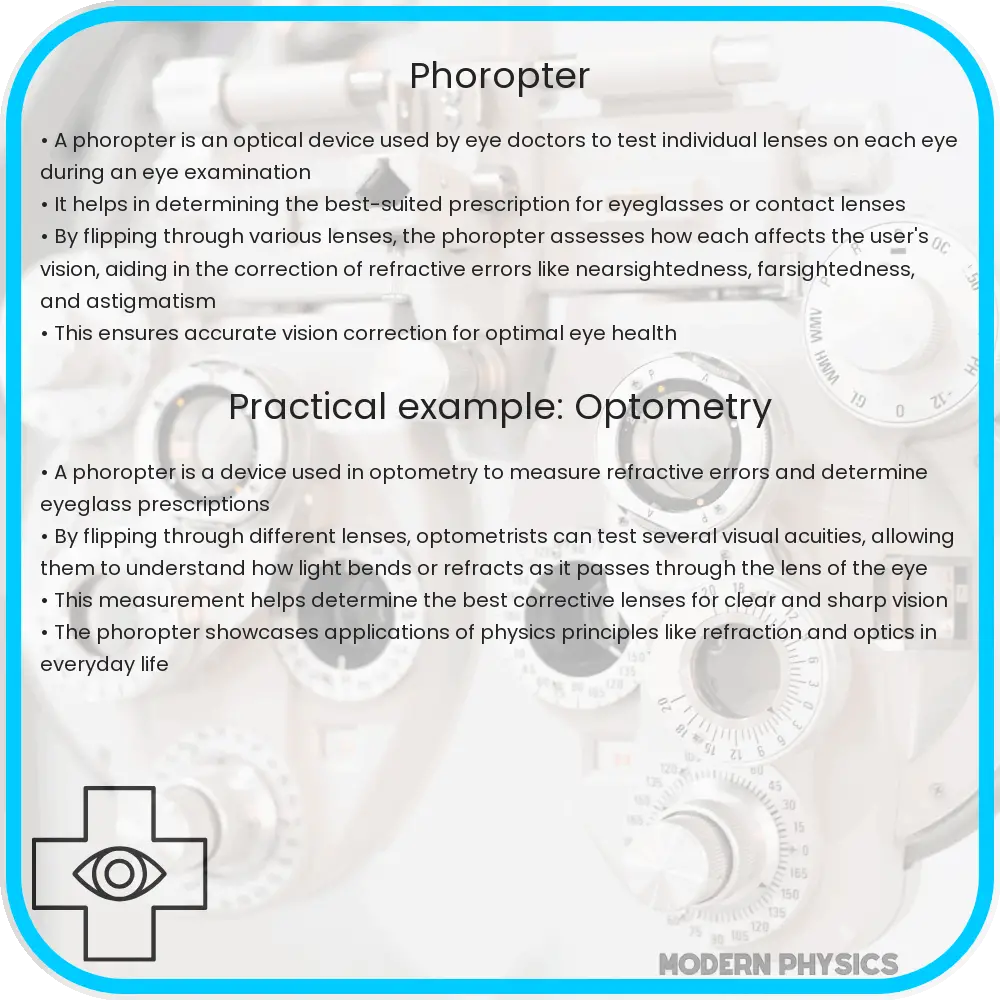
The phoropter, an essential tool in optometry, is a complex instrument designed for precision in vision testing. Its primary function is to determine an individual’s eyeglass prescription, making it a cornerstone in the field of optical design and ophthalmology. This article delves into the intricacies of the phoropter, exploring its design, operation, and the critical role it plays in ensuring optimal vision correction.
Precision and Functionality of the Phoropter
The phoropter’s precision lies in its intricate design, composed of numerous lenses and optical components. Each component is meticulously calibrated to measure refractive errors, such as myopia (nearsightedness), hyperopia (farsightedness), astigmatism, and presbyopia. The instrument allows eye care professionals to swiftly switch between different lenses during an eye examination, enabling them to fine-tune the prescription required for optimal vision correction.
Components and Operation
A phoropter consists of various lenses, including spherical, cylindrical, and prismatic lenses. These lenses are mounted on a rotating disk, allowing for quick adjustments. The spherical lenses (indicated as ‘S’) correct myopia and hyperopia. Cylindrical lenses (‘C’) are used for correcting astigmatism, a condition caused by an irregular curvature of the cornea or lens. Astigmatism correction requires precise axis alignment, which is facilitated by the phoropter’s adjustable settings.
The Role of Phoropters in Vision Testing
During a vision test, the patient looks through the phoropter at an eye chart while the optometrist changes lenses and settings. The goal is to find the lens combination that provides the clearest vision. This process, known as refraction, is critical in determining the appropriate corrective lenses. Additionally, the phoropter aids in the diagnosis of certain eye conditions, contributing to overall eye health assessment.
Advancements in Optical Design
The evolution of phoropters reflects advancements in optical design and technology. Modern phoropters are more automated and user-friendly, enhancing both the accuracy of measurements and the comfort of the patient. These improvements are pivotal in providing precise vision correction solutions, demonstrating the phoropter’s enduring significance in the field of optometry.
As an indispensable tool in eye care, the phoropter embodies the intersection of precision engineering, optical science, and patient care. Its continued evolution and adaptation underscore its vital role in enhancing visual acuity and quality of life for individuals with refractive errors.
The Impact of Digital Technology on Phoropter Design
Recent advancements in digital technology have revolutionized the design and functionality of phoropters. Digital phoropters offer enhanced precision and efficiency, streamlining the eye examination process. These modern instruments come equipped with computer-controlled lens selection, allowing for more accurate and rapid adjustments. This technology not only improves the accuracy of prescriptions but also significantly reduces the examination time, enhancing patient comfort and experience.
Training and Skill in Phoropter Use
Despite technological advancements, the effectiveness of a phoropter largely depends on the skill and experience of the eye care professional. Proper training is crucial for optometrists and ophthalmologists to accurately interpret the results obtained from a phoropter. The ability to discern slight differences in visual acuity and to make appropriate adjustments is essential for prescribing the most effective corrective lenses.
Personalized Eye Care and Patient Experience
The phoropter not only aids in precise vision correction but also contributes significantly to personalized eye care. By allowing eye care professionals to assess visual needs accurately, phoropters play a pivotal role in customizing prescriptions. This personalization ensures that each individual receives the most suitable lenses for their specific vision requirements, thereby enhancing the overall quality of life.
Future Trends in Phoropter Technology
The future of phoropter technology is likely to see further integration with digital systems, including artificial intelligence and advanced diagnostic tools. These innovations promise to further enhance the precision of vision testing and to offer more comprehensive eye health assessments. The integration of these technologies signifies an exciting frontier in optical design and eye care.
Conclusion
In conclusion, the phoropter stands as a testament to the advancements in optical science and technology. Its evolution from a manual instrument to a sophisticated, digitally-enhanced device highlights the ongoing commitment to precision and excellence in vision care. As we look towards the future, the phoropter will undoubtedly continue to play a vital role in diagnosing and correcting vision impairments, improving the quality of life for countless individuals. The marriage of technology and skilled practice in the use of the phoropter exemplifies the dynamic and ever-progressing field of optometry, ensuring that precise vision correction remains at the forefront of eye care services.