
A comprehensive guide to retinoscopy, a diagnostic method for assessing refractive errors and determining eye prescriptions.
Understanding Retinoscopy: A Tool for Eye Health Diagnosis
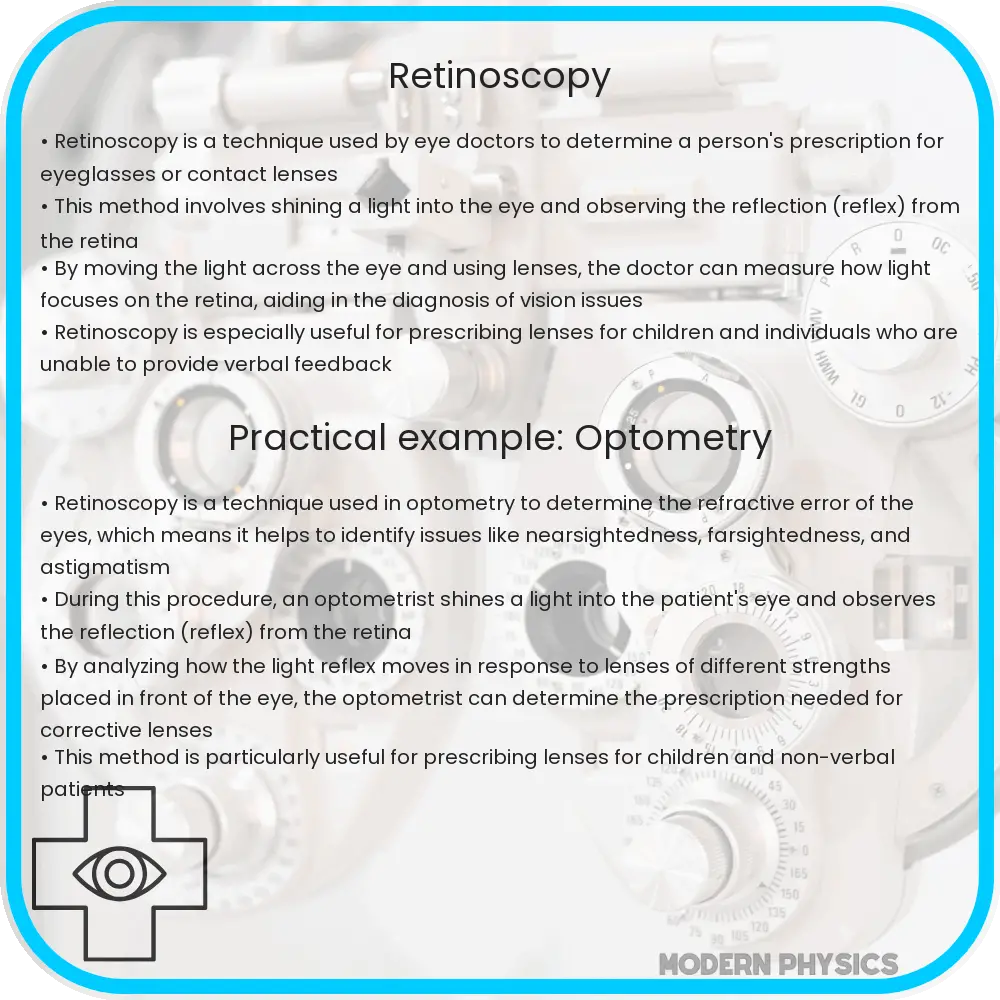
Retinoscopy is a diagnostic procedure used to measure the refractive error of the eyes, which is essential for determining prescriptions for glasses or contact lenses. By understanding how light behaves as it enters the eye, optometrists can detect irregularities that affect vision. This article explores the basics of retinoscopy, highlighting its principles, process, and importance in maintaining eye health.
Principles of Retinoscopy
The fundamental principle behind retinoscopy involves the use of a retinoscope, a device that emits light into the eye. The key to this examination is observing how light reflects off the retina, which is the light-sensitive layer at the back of the eye. During retinoscopy, an optometrist shines a light beam into the patient’s eye and observes the reflection (reflex) off the retina through various lenses.
A change in the observed reflex indicates a refractive error, such as myopia (short-sightedness), hyperopia (far-sightedness), or astigmatism, which are caused by the improper focus of light due to the shape of the eye. To correct this error, the optometrist places different lenses in front of the eye until the light reflex is seen to move in a specific desired way, indicating that the light is focusing correctly on the retina.
The Retinoscopy Procedure
The process of retinoscopy generally follows these steps:
- Patient Preparation: The patient is usually asked to focus on a distant point to keep the eyes relatively dilated naturally. This allows for better observation of the reflex.
- Room Dimming: The room lighting is dimmed to further dilate the pupil for a better visual of the retina and a clearer reflex.
- Light Movement: The optometrist directs a beam of light into each eye and observes the movement of the reflex through a series of lenses. The direction and nature of the movement are key indicators of the type of refractive error.
- Lens Adjustment: By inserting different lenses in front of the eye, the optometrist determines which lens best corrects the refractive error as indicated by the stabilization of the reflex movement (neutralization).
Typically, the optometrist seeks a ‘neutral reflex’ which looks steady and does not move in response to additional changes in light direction. Achieving a neutral reflex indicates that the light beams entering the eye are focusing exactly on the retina, signifying an optimal corrective lens strength.
Importance of Accurate Refractive Measurement
Accurate measurement of refractive errors is crucial not just for determining the prescription of eyeglasses or contact lenses but also for identifying potential eye health issues. Regular retinoscopy can help detect changes in vision and potential eye diseases early, allowing for timely treatment. This is particularly important for children, as undetected visual problems can impact learning and development.
Furthermore, retinoscopy is invaluable in situations where a patient cannot actively respond to a vision test, such as in young children or non-verbal individuals. This makes it a versatile tool in both routine eye examinations and specialized pediatric or neurological applications.
In the next section, we will delve deeper into the technical details of retinoscopy, discussing how varying light paths can indicate different types of refractive errors and the implications these findings have on overall eye health. Additionally, the role of retinoscopy in advanced eye care and vision therapy will be explored.
Technical Insights into Retinoscopy
During a retinoscopy examination, the path of light as it moves through the cornea, pupil, and lens to the retina is critical. If the light does not directly focus on the retina, it indicates a refractive error. By adjusting the angle of the light and altering the lenses placed before the eye, an optometrist can deduce the exact nature and magnitude of this error. For instance:
- Myopia: If the reflex moves in the same direction as the light beam (with motion), minus lenses are used to correct the focus.
- Hyperopia: If the reflex moves against the direction of the light beam (against motion), plus lenses are necessary to bring the light to focus on the retina.
- Astigmatism: This is indicated by a distorted or skewed reflex, and cylindrical lenses are required to correct the uneven curvature of the cornea or lens.
The precision with which these adjustments are made significantly affects the effectiveness of the prescribed corrective lenses.
Retinoscopy in Advanced Eye Care and Vision Therapy
Aside from its fundamental role in corrective lens prescriptions, retinoscopy has a compelling application in advanced eye care. For instance, it can be instrumental in the fitting of specialized contact lenses for conditions like keratoconus, where the cornea thins and gradually bulges outward. In vision therapy, retinoscopy assists therapists in assessing how vision correction might integrate with neurological processes and motor responses, tailoring therapies to improve eye coordination and visual perception.
Retinoscopy’s detailed assessment capabilities also allow eye care professionals to monitor the progress of certain eye conditions over time. Regular retinoscopy sessions provide invaluable data that can help predict patient outcomes and refine treatment approaches.
Conclusion
Retinoscopy is more than just a basic eye examination method; it is a versatile and powerful diagnostic tool. By understanding how light interacts with the eye, optometrists can use this process to accurately diagnose refractive errors, prescribe precise corrective measures, and contribute to broader eye health management. Its fundamental principles and applications make it indispensable in both standard visual tests and more specialized medical settings. Thus, retinoscopy not only helps in enhancing visual accuracy but also plays a crucial role in maintaining overall eye health and facilitating effective vision therapy.
For anyone interested in the mechanics of eye health, or for those pursuing optimal vision, understanding and appreciating the science behind retinoscopy can be immensely beneficial. Like a window into the workings of the eye, retinoscopy sheds light on how we see the world, and more importantly, how we can see it better.