
Discover the Ritchey-Chrétien telescope design, an advanced optical system offering unparalleled precision and clarity for professional astronomy.
Ritchey-Chrétien Telescope Design: A Gateway to the Cosmos
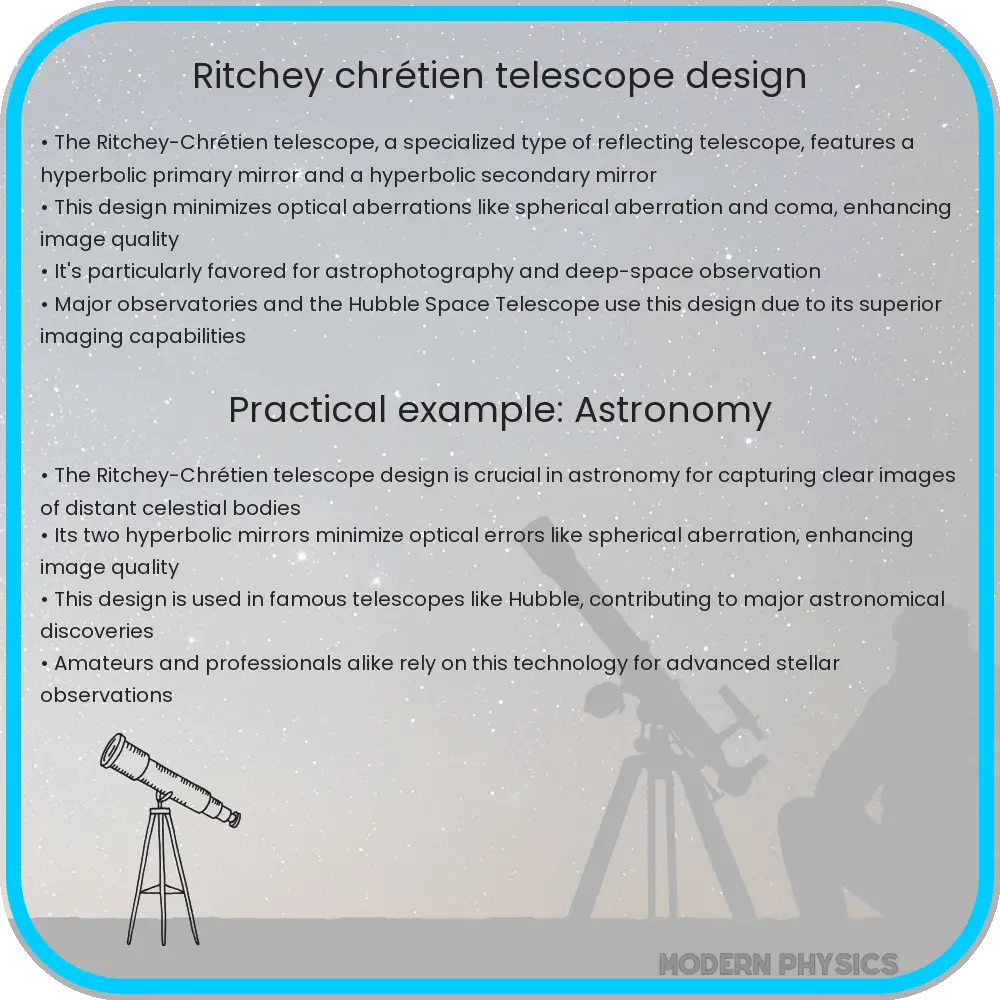
The Ritchey-Chrétien (RC) telescope, a refined variant of the Cassegrain telescope, is renowned for its exceptional precision, clarity, and advanced optics. This design has become a cornerstone in the field of astronomy, offering unparalleled views of the universe. Its innovative configuration minimizes optical aberrations, providing images of celestial objects with remarkable detail and sharpness.
Core Features of the Ritchey-Chrétien Telescope
At the heart of the RC telescope’s design are its two hyperbolic mirrors. Unlike the traditional parabolic primary mirror and spherical secondary mirror found in classic Cassegrain telescopes, both the primary and secondary mirrors in an RC telescope are hyperbolic. This unique setup effectively eliminates spherical aberration and reduces other common distortions such as coma and astigmatism. As a result, astronomers are able to capture wide-field images with minimal distortion at the edges, making the RC telescope ideal for deep-sky observations.
Applications in Professional Astronomy
The precision and clarity of the Ritchey-Chrétien design have made it the telescope of choice for several prominent observatories and space telescopes around the world. Notably, the Hubble Space Telescope, one of the most famous astronomical instruments, utilizes an RC design to capture its breathtaking images of the universe. This design is also preferred for large, ground-based observatories, where the demand for wide-field and high-resolution imaging is paramount.
Advanced Optics and Adaptations
The advanced optics of the Ritchey-Chrétien telescope are further enhanced by modern adaptations. Adaptive optics technology, for example, compensates for atmospheric distortion, allowing ground-based RC telescopes to achieve near-space quality images. Moreover, the integration of charge-coupled devices (CCDs) for capturing images has significantly increased the sensitivity and resolution of observations, making it possible to observe previously unseen celestial phenomena.
The combination of its unique mirror configuration, the ability to minimize optical aberrations, and the integration of modern technologies have solidified the Ritchey-Chrétien telescope’s status as a pivotal tool in the exploration of the cosmos. Its contributions to astronomy—ranging from the detailed study of planets and stars to the discovery of distant galaxies—underscore the importance of precision and clarity in unlocking the mysteries of the universe.
The Ritchey-Chrétien Telescope: A Leap Forward in Astronomical Observation
The Ritchey-Chrétien (RC) telescope design represents a significant advancement in optical systems, primarily used for high-precision astronomical observations. This design improves upon the classical Cassegrain telescope by introducing a hyperbolic primary mirror and a hyperbolic secondary mirror, a configuration that significantly reduces optical aberrations such as coma and spherical aberration. The result is a wider field of view and sharper images, making the RC design a preferred choice for professional observatories and space telescopes, including the renowned Hubble Space Telescope.
Advanced Optics and Imaging Precision
The core advantage of the Ritchey-Chrétien design lies in its advanced optics. By employing two hyperbolic mirrors, the telescope achieves a flat focal plane, which is ideal for astrophotography and detailed astrometric measurements. This design intricacy allows astronomers to capture images of celestial bodies with unprecedented clarity and detail, across a broader field of view compared to traditional designs. Such precision is indispensable for deep-sky observations, where capturing faint galaxies and nebulae is critical.
Challenges and Solutions in RC Telescope Design
Despite its advantages, the Ritchey-Chrétien telescope design presents challenges in manufacturing and alignment. The hyperbolic shape of the mirrors requires more sophisticated fabrication techniques, making it more complex and costly than simpler designs. Additionally, precise alignment is crucial for optimal performance, necessitating advanced engineering solutions and maintenance practices. However, the benefits in terms of image quality and observational efficiency often outweigh these challenges, justifying the investment in such advanced telescopic systems.
Conclusion
The Ritchey-Chrétien telescope design has revolutionized the field of astronomy, offering an unparalleled combination of precision, clarity, and advanced optics. Its ability to minimize optical aberrations while providing a wide field of view has made it an indispensable tool for professional astronomers and a cornerstone in the construction of some of the world’s most powerful telescopes. Despite the complexities and costs associated with its manufacturing and maintenance, the RC design continues to be a testament to the ever-advancing pursuit of celestial discovery. As technology progresses, the Ritchey-Chrétien telescope remains at the forefront, pushing the boundaries of what we can observe and understand about the universe around us.