
Explore how acoustic wave delay lines utilize sound wave properties through various mediums to achieve signal delays in signal processing.
Understanding Acoustic Wave Delay Lines in Signal Processing
Acoustic wave delay lines are a fascinating aspect of both physics and engineering, serving critical functions in signal processing. This technology is pivotal in various applications, including radar, telecommunications, and signal synchronization, among others. An acoustic wave delay line operates by using the physical properties of sound waves traveling through a medium to delay signals, facilitating precise timings which are vital for efficient signal processing.
Basics of Acoustic Wave Delay Lines
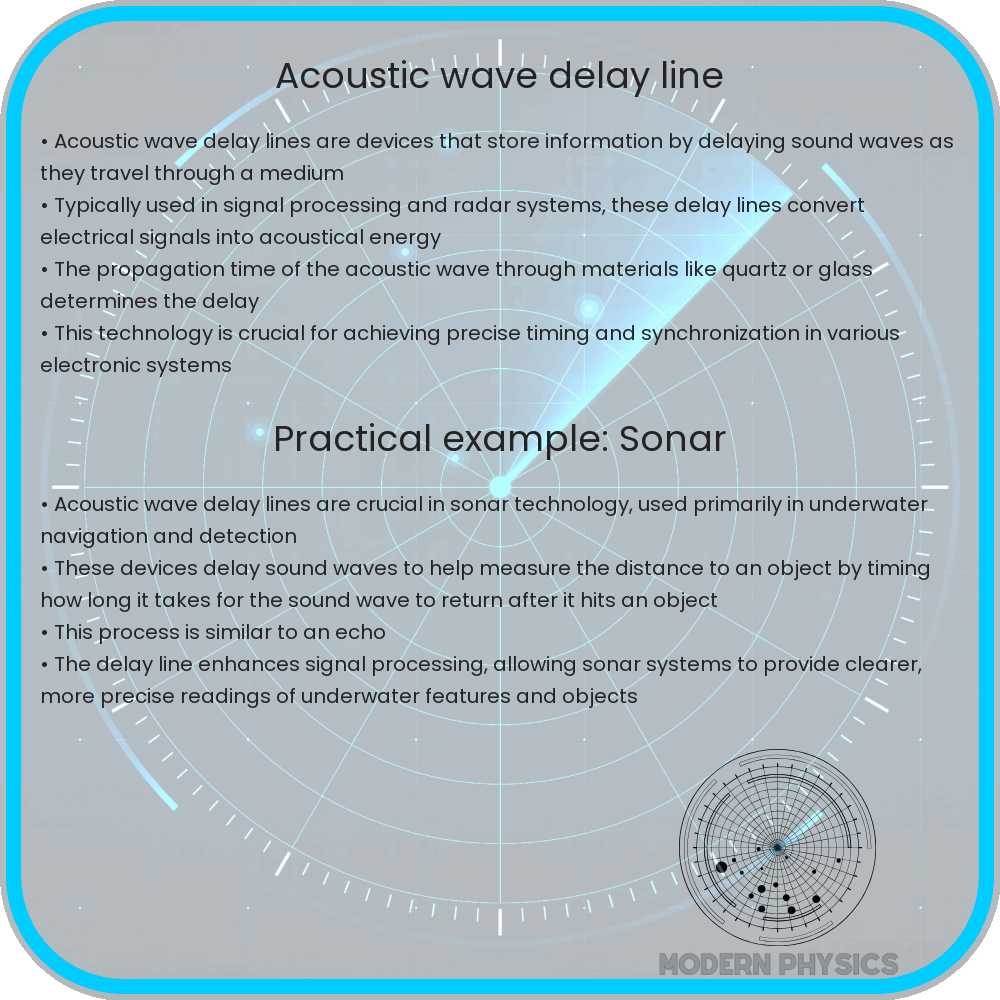
An acoustic wave delay line is a device that utilizes the propagation of acoustic waves (sound waves) through a medium to achieve signal delay. Essentially, when an electrical signal is converted into an acoustic wave, this wave travels through a medium such as quartz or lithium niobate at a set speed. Subsequently, the acoustic wave is converted back into an electrical signal, thereby achieving a delay. The delay time is primarily dependent on the length of the medium and the speed of the sound wave through the medium.
Components and Function
The basic components of an acoustic wave delay line include an input transducer, a propagation medium, and an output transducer. The input transducer converts the input electrical signal into an acoustic wave. This wave travels through the propagation medium, during which time the signal is effectively delayed. Finally, the output transducer reconverts the acoustic wave back into an electrical signal.
- Input Transducer: Often made from piezoelectric materials, which convert electrical signals into mechanical vibrations.
- Propagation Medium: The material through which the acoustic wave travels. This can be a solid, liquid, or gas, each affecting the speed and efficiency of wave propagation.
- Output Transducer: Similar to the input transducer, this converts the mechanical vibrations back into electrical signals.
Signal Processing and Efficiency
The efficiency of an acoustic wave delay line is influenced by several factors including the materials used, the frequency of the input signal, and environmental conditions such as temperature and pressure. The choice of material for the propagation medium, in particular, plays a critical role. Materials like quartz and lithium niobate are popular due to their piezoelectric properties and their ability to maintain integrity under various environmental conditions.
Moreover, the design of the transducers and the quality of the interfaces between the transducers and the propagation medium also significantly affect the efficiency. Any mismatch in impedance or a less than optimal interface can lead to energy losses due to reflections and absorption, thus reducing the overall efficiency of the delay line.
Applications of Acoustic Wave Delay Lines
Acoustic wave delay lines have a wide range of applications in modern technology. One of the most common uses is in radar systems where they are critical in the timing of signal transmission and reception, which helps in calculating distances accurately. In telecommunications, these delay lines help in echo generation and signal alignment, which are crucial for clear communication. Furthermore, they are employed in electronic music for creating echo and reverb effects, adding depth to the sound.
Advancements and Future Prospects
Recent advancements in materials science and microfabrication techniques have led to the development of more compact and efficient acoustic wave delay lines. Researchers are exploring the use of new materials and designs to further enhance performance and reduce size, making them more practical for a broader range of applications. The integration of these devices into microelectronic systems is a promising area that could lead to substantial improvements in device performance and functionality.
Conclusion
The understanding of acoustic wave delay lines bridges a critical gap in both the physics and engineering domains, showcasing how principles learned in theory are applied in practical devices that impact our daily lives. From improving communication systems to enhancing radar technologies, these devices play a pivotal role in the functioning of many modern technologies. As research continues and technology progresses, the capabilities and applications of acoustic wave delay lines are expected to expand, bringing even more intriguing and useful innovations to the world of signal processing.